
Choosing the right automatic door system is crucial for commercial projects. Digital Home Systems provides expert advice and premium automatic door solutions tailored to Australian standards, traffic demands, and project requirements.
From retail and healthcare to corporate and industrial developments, Digital Home Systems helps you select reliable, efficient, and durable door systems.
In this guide, we’ll cover the key factors to consider when selecting an automatic door system for your project.
Understanding Your Building Requirements Before Choosing an Automatic Door System

Before choosing an automatic door system, it is important to understand how the entrance will be used. Traffic volume, available space, structural conditions, and accessibility requirements all influence which system will perform reliably over the long term.
Daily Foot Traffic Volume and Peak Usage Rates
The number of people using an entrance is one of the most important factors when selecting an automatic door system.
A quiet office may have relatively low pedestrian traffic, while a shopping centre or hospital may experience continuous and intensive use. For high-traffic environments, the door operator must be designed for a higher duty cycle to handle frequent opening and closing without excessive wear.
Peak periods should also be considered, rather than relying only on average daily traffic. A 1,000–3,000 mm clear opening can help reduce congestion during busy periods.
Digital Home Systems Tip: Always specify the door based on its expected peak usage, not just its average daily traffic.
Spatial Constraints and Structural Layout
The available space around an entrance can determine which automatic door configuration is suitable.
Before installation, check the headroom, overhead lintel capacity, and side clearance available for the door and operator.
The choice between sliding and swing doors also depends on the building layout:
- Sliding doors: Move laterally and are useful where clear circulation space is important.
- Swing doors: Can provide a wide clear opening where side space is limited, but require sufficient space for the door leaf to swing safely.
For external entrances, wind loads and pressure differences should also be considered. Strong wind or pressure changes can affect door movement and place additional demands on the operator.
Digital Home Systems Tip: An early site assessment can identify structural or spatial limitations before they become costly installation problems.
Universal Accessibility and Inclusivity Requirements
Accessibility should be considered from the beginning of the project, not added as an afterthought.
For Australian commercial buildings, the design should take into account DDA requirements and applicable accessibility standards to provide safe, barrier-free access for people with different mobility needs.
For projects referencing standards:
- AS 1428.1: Sets requirements for accessible doorways, including clear opening widths and circulation spaces. A minimum 850 mm clear opening is specified for doorways on a continuous accessible path of travel.
- Access to Premises Standards: Establishes accessibility requirements for pedestrian entrances and accessible paths in buildings.
Sensor configuration is equally important. Sensor zones and hold-open times should allow sufficient time for wheelchair users, elderly people, and people pushing carts or prams to pass through safely.
Read more: Automatic Door Closer Ideas: 9 Practical Solutions for Easier, Safer Door Closing
Digital Home Systems Tip: A well-designed automatic door system should not only meet technical requirements – it should be comfortable, predictable, and safe for every person using the building.
How to Choose an Automatic Door System

Choosing the right automatic door depends on the building’s traffic level, available space, security requirements, and operating environment. Each door type offers different advantages, so the best choice is the one that matches the specific needs of the project.
Types of Automatic Door Systems: Features & Applications
Different automatic door systems are designed for different traffic levels, spaces, and building requirements. Understanding the key features and applications of each type helps you choose the right solution for your project.
Automatic Sliding Doors
- Best for: High-traffic entrances such as supermarkets, shopping centres, hospitals, and corporate lobbies.
- Configurations: Single-leaf, bi-parting, telescopic, and curved designs.
- Key benefit: Bi-parting doors suit wider entrances, while telescopic doors provide a larger opening where side space is limited.
Automatic Swing Doors
- Best for: Retrofit projects, narrow entrances, restrooms, and executive offices.
- Installation options: Surface-mounted operators for simpler retrofits or concealed overhead operators for a cleaner appearance.
- Key benefit: A practical solution where sliding doors are not suitable due to limited space.
Revolving and Specialty Cleanroom Doors
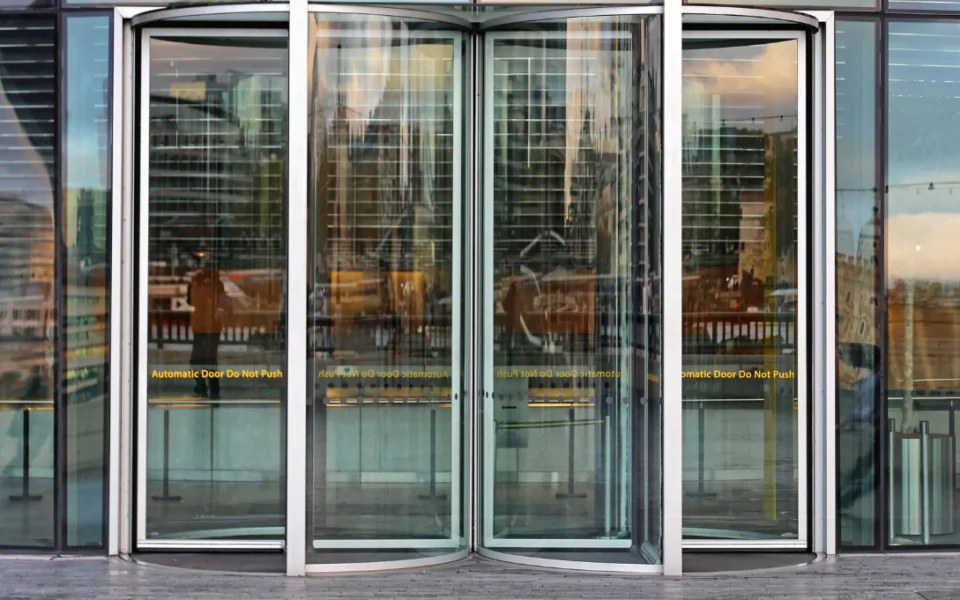
- Revolving doors: Ideal for high-rise lobbies, hotels, airports, and premium commercial buildings.
- Key benefits: Excellent thermal efficiency, draft control, and reduced air exchange.
- Cleanroom doors: Designed for controlled environments such as hospitals, operating theatres, and cleanrooms where air-tight sealing is essential.
Read more: How Do Automatic Doors Work? A Complete Guide to Automatic Door Systems in Australia
The table below highlights the key differences between automatic door systems to help you choose the right solution for your project.
| Door Type | Ideal Application | Traffic Capacity | Thermal Efficiency | Space Footprint |
| Bi-parting Sliding | Main Lobbies & Retail | High to Very High | Moderate | Requires side slide-zone |
| Telescopic Sliding | Narrow Corridors | High | Moderate | Minimal side clearance |
| Swing Door Operator | Retrofits & Office Entries | Low to Medium | High | Requires arc sweep space |
| Revolving Door | Luxury Towers & Airports | Very High | Excellent | Large floor area requirement |
Kinematic Analysis: Matching Door Type to Traffic Dynamics
A comprehensive traffic audit is the essential first step in selecting an entrance mechanism tailored to user volume and structural constraints.
- Linear and Telescopic Sliding Doors: Engineered for high-volume, two-way pedestrian traffic. Telescopic sliding configurations maximize clear opening width in space-restricted structural openings.
- Revolving Door Systems: The industry benchmark for HVAC isolation and continuous thermal envelope integrity. Their “Always Open, Always Closed” architecture eliminates the piston effect—air pressure differentials that pull conditioned air out of high-rise facilities.
- Swing Operators: Designed for retrofitting manual doors or low-traffic zones where accessibility (ADA/accessibility compliance) is the primary requirement rather than high throughput.
- Bi-Folding Doors: Ideal for tight footprint constraints where neither sliding nor swing operators are structurally feasible.
Rigorous Adherence to Global Safety Standards
Commercial installations require full regulatory compliance to safeguard user safety and protect against liability risks.
| Standard | Scope & Core Application | Key Technical Requirements |
| ANSI/BHMA A156.10 | Power Operated Pedestrian Doors (High-Speed / High-Traffic) | Defines motion sensing zones, activation distances, and emergency breakout mechanisms for rapid egress. |
| ANSI/BHMA A156.19 | Power Assist and Low Energy Power Operated Doors | Regulates speed, force limits, and push/pull activation force for accessibility-focused entryways. |
| EN 16005 | European Safety Standard for Power-Operated Pedestrian Doors | Mandates protective measures against crushing, shearing, and impact hazards across all cycle phases. |
Full pedestrian safety sensor packages incorporate redundant detection zones to eliminate blind spots near stationary individuals, children, and mobility-assisted users.
Sensor Technology: The Core Intelligence
System operational efficiency relies directly on sensor precision and multi-technology integration.
- Doppler Microwave Sensors: Provide motion detection with directional recognition, initiating opening cycles only when pedestrians approach directly while ignoring cross-traffic.
- Active Infrared (AIR): Delivers continuous presence detection by casting a safety curtain over the door threshold to prevent closure while an object or person remains in the pathway.
- 3D Time-of-Flight (ToF) Sensors: Advanced LiDAR-based mapping distinguishes human pedestrians from inanimate objects like shopping carts or luggage, preventing false trigger cycles (“ghost cycles”).
Environmental Engineering & Sustainability
Automatic entrance systems serve as an active seal within a building’s thermal envelope, directly impacting HVAC loads and green building ratings (LEED/BREEAM).
- Air Infiltration Seals: Heavy-duty EPDM perimeter gaskets and high-density brush seals reduce air leakage around door panels.
- Low-Power Sleep Modes: Smart control boards enter deep-sleep states during low-traffic periods, cutting standby electrical consumption.
- Adjustable Dynamic Speed Cycles: Programmed opening and closing speeds allow facility teams to adjust dwell times seasonally, minimizing heat exchange in extreme weather.
Integration with Building Management Systems (BMS)
Modern entrance systems function as integrated data points within smart building management and security networks.
- Access Control & Locking Logic: Direct integration with Access Control Systems (ACS) permits real-time switching between Fail-Safe (unlocked for emergency evacuation) and Fail-Secure (locked to maintain perimeter security) modes.
- Emergency Breakout Mechanisms: Mechanical panic breakout hardware allows sliding door panels to swing outward when manually pushed, enabling rapid egress during power outages or fire alarms.
- IoT Diagnostics & Predictive Maintenance: Connected platforms enable facility managers to track cycle counts, analyze error logs, and perform predictive maintenance before component failures occur.
Total Cost of Ownership (TCO) vs. Initial Capital Expenditure
Long-term value selection prioritizes a 10-year Total Cost of Ownership model over initial equipment cost alone.
| Evaluation Factor | Standard / Entry-Level Systems | High-Performance Commercial Systems |
| Motor Architecture | Brushed DC Motors (higher friction, heat generation, and carbon brush wear) | Brushless DC (BLDC) Motors (quiet, thermally efficient, extended operating lifecycle) |
| Duty Cycle Rating | Light/Medium Duty ($\approx 250,000$ to $500,000$ cycles before overhaul) | Heavy Duty ($1,000,000+$ cycles with minimal routine maintenance) |
| Lifecycle Impact | Lower upfront cost, higher frequency of downtime and component replacements | Higher initial investment, offset by lower energy consumption and extended service life |
The optimal automatic door system balances upfront capital outlay with verified safety compliance, low energy consumption, and high operational reliability throughout its lifecycle
Choosing the Right Manufacturer and Installer
Choosing an experienced manufacturer and installer is essential for reliable, long-term automatic door performance. Here’s why businesses choose Digital Home Systems:
- Expert Industry Experience: With years of experience, our team understands the technical and practical requirements of commercial automatic door projects.
- Tailored Solutions: We recommend automatic door systems based on your building, traffic levels, accessibility, and operational requirements.
- Professional Project Support: From product selection and system design to installation and integration, we provide support throughout the project.
- Quality and Reliability: We supply quality automatic door solutions designed for reliable performance and long-term use.
- Ongoing Support: Our team provides professional assistance beyond installation to help keep your system operating safely and efficiently.
With years of industry experience, Digital Home Systems delivers reliable automatic door solutions built around quality, performance, and long-term value.
Frequently Asked Questions (FAQs)
How often must automatic doors be serviced in Australia?
Automatic doors should be serviced at least every 4 months (3 times a year) under AS 5007 guidelines. Regular servicing helps ensure that safety sensors, door operators, controls, and other components continue to work correctly.
Can an existing manual door be converted into an automatic system?
Yes. Most manual swing and sliding doors can be converted using a suitable retrofit system. The existing door, frame, hinges, and structure should be checked first to ensure they are suitable for automation.
What happens to automatic doors during a power failure?
Depending on the system, the door may use backup power, release electric locks, or allow manual operation. The appropriate backup or emergency function should be selected based on the building’s safety and access requirements.
What are the key BIM/CAD integration requirements?
Key requirements include standardised data exchange, interoperability, and a shared Common Data Environment (CDE). Door dimensions, fixing points, electrical requirements, and control interfaces should also be included in the project documentation to avoid design conflicts.
How does an automatic door improve commercial energy efficiency?
Automatic doors can improve energy efficiency by reducing uncontrolled air exchange, helping lower the workload on heating, ventilation, and air-conditioning systems.
Final Thoughts
Selecting the right automatic door system for a commercial project directly impacts building efficiency, user safety, energy savings, and long-term operating costs. A successful entrance design relies on four core factors:
- Accurate requirement planning involves evaluating peak traffic, spatial limits, and wind loads to prevent operational bottlenecks and premature wear.
- Universal accessibility compliance under DDA and AS 1428.1 ensures safe, barrier-free passage for all users from day one.
- Matching the correct mechanism—whether sliding, swing, revolving, or hermetic—to each specific building zone optimizes daily performance.
- Integrating advanced dual-technology sensors, fire indicator panel and BMS emergency fail-safes, and continuous AS 5007 maintenance schedules protects users while minimizing long-term lifecycle costs.
With Digital Home Systems, you can get premium automatic door solutions tailored to your project. Contact our expert team today for a customized consultation and quote.




