
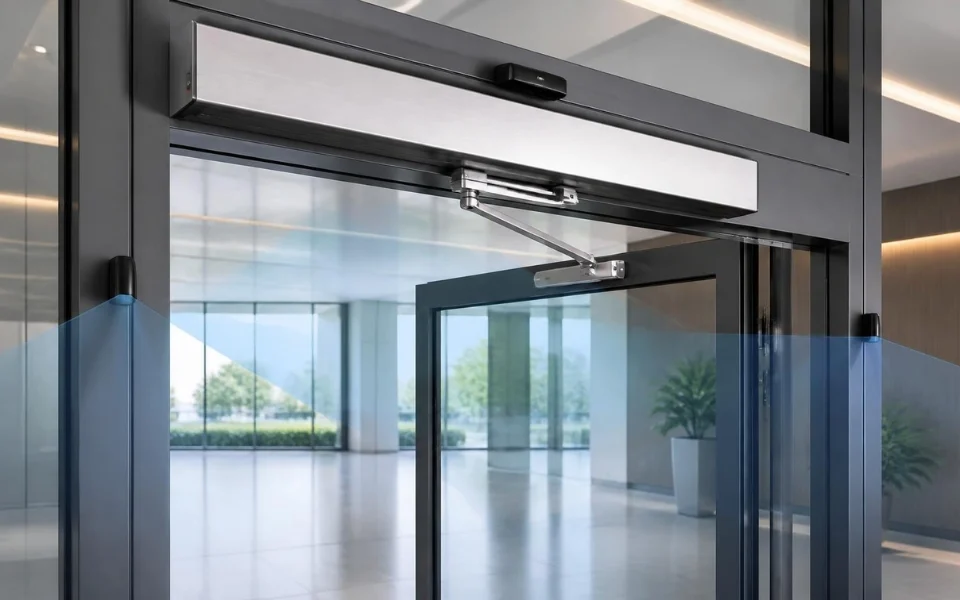
An automatic swing door opener with sensor is a complete access automation package comprising an electro-mechanical drive operator, microprocessor controller, and an integrated network of activation and safety sensors. The system automatically detects approaching traffic to actuate the door leaf while continuously monitoring the leaf swing arc to prevent pedestrian impact, fulfilling compliance under AS 5007:2007 and AS 1428.1.
- System Integration: An automatic swing door opener with sensor combines an electro-mechanical drive operator with integrated motion and active infrared safety sensors
- Dual Sensor Protection: Activation sensors detect approaching pedestrians, while monitored presence sensors continuously scan the door sweep path to prevent impacts
- Australian Standards Compliance: Mandatory alignment with AS 5007:2007 (Powered pedestrian doors) and AS 1428.1 (Design for access and mobility / DDA standards)
- Operational Logic: Microprocessor controllers process sensor triggers, calculate dynamic braking profiles, and interface with electric lock delays for seamless opening
- DHS Field Recommendation: Correct sensor height, masking angle calibration, and routine AS 5007 safety inspections are essential to prevent false triggers and ensure safety
What Is an Automatic Swing Door Opener with Sensor and How Does It Function?
An automatic swing door opener with a sensor operates by linking detection sensors directly to an electro-mechanical drive mechanism on the doorway header. When an activation sensor detects a pedestrian, it sends a low-voltage pulse to the microprocessor control board, which signals the motor to rotate the door open while presence-monitoring safety sensors actively scan the moving path to hold or stop movement if an obstacle is detected.
An automatic swing door opener combines sensors, a controller and an electro-mechanical operator to coordinate automatic opening and safety monitoring. For a broader explanation of automatic door operation, see How Do Automatic Doors Work?

How Does the Activation Signal Reach the Door Operator?
- Microwave or Radar Detection: Overhead sensors continuously monitor the entry footprint using high-frequency electromagnetic waves
- Pedestrian Approach: Movement within the configured detection range triggers a change in signal frequency through the Doppler effect
- Signal Transmission: The sensor instantly translates this motion into a low-voltage activation signal
- Controller Input: The low-voltage pulse is sent directly to the microprocessor controller inputs to initiate the opening sequence
How Does the Motor and Gearbox Open the Door?
- Brushless DC (BLDC) Motor: Receives power from the controller, offering smooth acceleration, high torque, and quiet operation
- Reduction Gearbox: Transfers rotational energy from the motor to increase torque output for heavy commercial door leaves
- Kinetic Arm Assembly: Drives the door leaf open through either a standard push or slide pull arm configuration
- Internal Return Spring: Compresses during the opening cycle, storing mechanical energy used for closing or manual operation
- Controlled Movement: The system monitors encoder feedback to maintain precise speed curves throughout the cycle
For a practical example of an automated swing-door operator, see the Automatic Swing Door Opener 250kg product range.
How Do Active Safety Sensors Protect the Door Sweep?
Active Infrared (AIR) sensors are mounted directly onto the face or header of the door leaf. They project a dense curtain of infrared light beams across the entire door leaf sweep area. By analysing the reflected light, these sensors achieve real-time presence detection.
If an obstacle, pedestrian, or wheelchair is detected within the swing arc, the safety sensor sends an immediate stop or hold signal to the controller, preventing impact.
How Does the Door Control Its Closing and Latching?
- Microprocessor Control: Manages the full cycle using pre-programmed parameters for speed, force, and timing
- Deceleration: Smoothly ramps down speed near the end of the swing cycle to avoid mechanical shock
- Hold-Open Time: Maintains the door at 90° for an adjustable period, typically 2 to 5 seconds, to allow safe passage
- Spring-Assisted Closure: Uses spring tension combined with controlled motor braking to guide the door shut gently
- Latching Sequence: Applies a final latching pulse or mechanical pull-in to securely re-engage electric locks or seals
What Types of Sensors Are Integrated with Automatic Swing Door Openers?
Sensors integrated with automatic swing door openers fall into three primary categories: motion activation sensors, active infrared safety presence sensors, and combination sensors that house both microwave motion detection and presence curtain arrays within a single overhead unit.
Sensor selection should be considered together with the overall door configuration, safety requirements and installation environment. See our guide to Automatic Door Safety Requirements in Australia for additional safety considerations.

What Is a Microwave or Radar Sensor?
Microwave and radar sensors operate on the Doppler effect principle, transmitting high-frequency radio waves to detect movement within a designated approach zone. They excel at detecting approaching pedestrians from a distance to trigger early door opening.
However, because they rely purely on motion, static pedestrians remaining stationary in front of the door will not be detected, necessitating supplementary safety protection.
What Is an Active Infrared (AIR) Curtain?
Active Infrared (AIR) sensors emit invisible light beams towards the floor and analyse the reflected light intensity. If an object or person interrupts these beams, the sensor registers presence, even if the target is completely static.
These curtains are mounted directly to the door leaf or transom to safeguard the door leaf sweep area and meet safety requirements.
What Is a Combination Sensor?
A combination sensor integrates both microwave/radar motion detection and AIR presence detection into a single overhead housing.
Mounted directly on the header transom, it provides a dual-zone coverage pattern:
- Outer motion zone for approach activation
- Inner active infrared curtain for threshold safety
What Is a Touchless Infrared Wave Switch?
Touchless infrared wave switches utilise short-range proximity sensing, typically within 50mm–200mm, to register intentional hand gestures.
By eliminating physical contact, these switches offer a highly hygienic activation method ideal for healthcare facilities, cleanrooms, and accessible public amenities compliant with AS 1428.1.
What Is a Passive Infrared (PIR) Sensor?
Passive Infrared (PIR) sensors detect changes in thermal radiation, or body heat, relative to the surrounding environment.
While effective at detecting human presence within a defined spot zone near the doorway threshold, they are primarily used for supplementary presence loops or secondary safety applications rather than primary high-speed approach activation.
Sensor Technology Comparison With Automatic Swing Door Opener
| Sensor Type | Operating Principle | Primary Function | Sweep Coverage Area | AS 5007 Safety Requirement |
| Microwave / Radar Sensor | Doppler effect frequency shifts | Pedestrian approach activation | Broad directional zone in front of entry | Activation only; requires supplementary presence safety |
| Active Infrared (AIR) Curtain | Emitted light beam reflection analysis | Presence protection on leaf face | Continuous curtain along door sweep path | Mandatory on full-power automatic swing paths |
| Combination Sensor | Dual Radar + AIR technology | Combined activation and presence | Dual-zone coverage | Approved for header-mounted door threshold safety |
| Touchless Infrared Wave Switch | Short-range proximity sensing | Intentional manual activation | 50mm–200mm localized target zone | Compliant for hygienic / AS 1428.1 touchless access |
| Passive Infrared (PIR) | Thermal emission detection | Static presence / approach activation | Spot zone near doorway threshold | Supplementary presence / secondary safety loop |
Combining motion activation with active infrared presence technology ensures the automatic swing door opener meets strict pedestrian safety thresholds without sacrificing operational efficiency or opening speed.
How Do Sensors Interface with the Door Controller and Electric Locks?
Sensors communicate with the automatic swing door controller via supervised dry-contact relay loops or digital bus communication. When an integrated electric lock such as a magnetic lock or electric strike is present, the control unit executes a pre-programmed relay delay sequence to release mechanical locking hardware prior to motor engagement.

How Does the Pre-Opening Lock Relay Delay Work?
- Signal Intake: The controller receives an opening signal from an activation sensor or access control system
- Lock Release: The controller energises or de-energises the electric lock relay, releasing the latch bolt or magnetic plate
- Relay Timing: A pre-programmed millisecond delay, typically 100ms–300ms, is held to ensure complete physical release
- Motor Activation: Power is applied to the BLDC motor to begin driving the door open
- Binding Prevention: This precise sequencing prevents the motor from pulling against an active lock latch, eliminating mechanical binding and equipment wear
Automatic doors can also be connected to Access Control Systems to coordinate authorised entry, electronic locking and automatic door operation.
How Does the Controller Monitor the Safety Sensor Circuit?
Modern automatic door operators utilise a supervised safety bus circuit. Prior to initiating any opening or closing cycle, the controller sends a test pulse to the safety sensors to check circuit continuity and operational status.
If a sensor fails to respond or reports an internal fault, the operator defaults to a safe low-energy mode or stops operation entirely until the fault is rectified.
How Does Obstacle Reversal Logic Work?
If a presence sensor triggers during the closing cycle due to an obstruction in the swing path, the safety sensor instantly interrupts the closing command.
The microprocessor calculates a dynamic braking profile, halts leaf movement, and immediately executes a full-open response to prevent injury or damage.
How Does Compliance with Australian Standards (AS 5007 & AS 1428.1) Dictate Sensor Configuration?
Australian regulations mandate that sensor placement, field coverage, and opener forces align with AS 5007:2007 (Powered doors for pedestrian access) and AS 1428.1 (Design for access and mobility). Proper sensor setup prevents pinch points, provides barrier-free entry, and enforces safe dynamic force thresholds across commercial facilities.
Sensor configuration is only one part of the overall automatic swing-door system. Understanding the complete Automatic Swing Door Mechanism can help explain how the operator, sensors, motor and mechanical components work together.

What Does AS 5007:2007 Require for Sensor Configuration?
- Presence Detection: Fully monitored presence sensors must cover the complete leaf sweep area on full-power doors
- Safety Zones: Sensors must detect a test object across the entire width of the door leaf up to a height of 1500mm
- Dynamic Force Considerations: Kinetic energy limits must be strictly calibrated to ensure user protection in the event of primary safety bypass
How Does AS 1428.1 Affect Sensor and Activation Positioning?
- Accessibility Heights: Manual push pads or touchless wave switches must be installed between 900mm and 1100mm above the finished floor level
- Clear Opening Width: Opener arms, header units, and sensor bodies must not encroach into the required minimum 850mm clear continuous accessible path
- Extended Hold-Open Time: Sensors and controllers must allow sufficient hold-open time to facilitate unhindered passage for mobility devices
Accessible activation and door movement should be considered as part of the overall entrance design. AS 1428.1:2021 provides minimum design requirements for new building work to support independent and dignified access for people with mobility and sensory disabilities. 1 Standards Australia — AS 1428.1:2021 Design for access and mobility. Date of access on 09/10/2026↓
How Does the NCC Affect Sensor and Fire-System Integration?
Under National Construction Code (NCC) provisions, automatic swing doors installed along fire-isolated exits or required egress paths must interface directly with the building’s Fire Indicator Panel (FIP).
Upon fire alarm activation, emergency signals override normal sensor logic according to the applicable building fire strategy.
AS 5007 & AS 1428.1 Sensor & Opener Configuration Checklist
- Safety Sensor Coverage: Active Infrared curtain covers leading leaf edge and entire swing arc
- Clear Opening Width: Opener arm and sensors do not encroach on required clearance
- Low Energy Force: Dynamic impact force limits adhere to applicable standard thresholds
- Touchless Activation: Wave switch positioned according to applicable accessibility requirements
- FIP Fire Signal: Fire alarm signal overrides normal sensor logic according to the building fire strategy
Detailed Compliance Breakdown
- AS 5007:2007 Requirements: Specific presence sensor detection zones, testing criteria, operator duty cycles, and operating-force limiters
- AS 1428.1 Accessibility Requirements: Operational forces, accessible actuation zone positioning, door opening delays, and clear doorway margins
- NCC Provisions: Building classification, emergency egress, fire resistance, smoke sealing, and integration with life-safety systems
For official standard guidelines, reference the resources provided by Standards Australia and the Australian Building Codes Board (ABCB).
How Can You Improve Automatic Swing Door Sensor Installation and Calibration?
Correct sensor installation, structural mounting, sensitivity tuning, and environmental calibration are important for reliable automatic swing door operation. Incorrect sensor field masking and door leaf vibration can contribute to false triggers and operational faults.
Installation and commissioning should form part of the overall risk-management process for powered equipment. Safe Work Australia recommends considering risks throughout the plant lifecycle, including installation, commissioning, operation, inspection, maintenance and repair. 2Safe Work Australia — Managing Risks of Plant in the Workplace. Date of access on 09/10/2026↓

How Can Incorrect Sensor Masking Cause False Triggers?
When overhead sensors are installed without accurate masking angle adjustments, their detection fields can spill over onto reflective glass panels, adjacent HVAC air diffusers, or passing corridor traffic.
This incorrect detection zone can cause the sensor to register false activations, keeping the door constantly cycling or held open unnecessarily.
Why Is Header Transom Rigidity Important?
Flexible or unreinforced aluminium transoms can vibrate during motor acceleration and braking. Because optical active infrared sensors move along with the frame, frame flexing can cause the sensor light beams to shift relative to the floor and trigger false presence faults.
Structural transom reinforcement with steel plates can help maintain sensor stability.
How Should Sensors Be Calibrated for Weather and Environmental Conditions?
- Rain and Moisture: Outdoor AIR sensors require appropriate sensitivity adjustment to reduce interference from moisture and rain
- Direct Sunlight: High ambient infrared light from direct sunlight can affect optical receivers; sun-shield covers or appropriate sensor settings can help
- Fog and Drafts: Environmental fluctuations near entrance foyers require suitable threshold compensation to distinguish environmental changes from actual pedestrian movement
How Should an Automatic Swing Door Opener with Sensor Be Installed and Configured?

Pre-Installation Inspection
- Verify structural integrity of frame and transom mounting point
- Check door leaf condition, weight, hinges, and clear swing arc
- Confirm operator configuration, including push arm or pull arm and opening direction
- Ensure correct electrical supply and signal wiring are available at the header
Sensor Installation & Tuning
- Mount activation and safety presence sensors at the specified height
- Adjust physical masking angles to isolate the detection zone to the intended path of approach
- Verify that the Active Infrared presence curtain covers the full leading edge of the leaf
- Check the surrounding environment for reflective surfaces, HVAC diffusers, or moving plants
Commissioning & Testing
- Test low-voltage activation responsiveness and touchless switch range
- Fine-tune opening speed, closing speed, latching speed, and hold-open duration
- Verify pre-opening electric lock relay delay to eliminate latch binding
- Perform obstacle reversal testing across multiple points in the door leaf sweep
- Confirm FIP emergency signal override logic triggers correctly
What Are the Most Common Problems with Automatic Swing Door Opener Sensors?

Why Does the Automatic Swing Door Open by Itself?
- Moving HVAC Air / Flags: Drafts moving nearby items within the microwave field
- Reflections: Sunlight or headlights reflecting off nearby polished tile floors or glass
- Adjacent Traffic: Detection pattern extending too far into a public corridor
- Incorrect Masking: Sensor lens not properly masked to ignore structural obstructions
Why Does the Automatic Swing Door Reverse Unexpectedly?
- Self-Detection: The safety sensor beam catches the leading edge of the moving door leaf
- Header Vibration: Loose transom causes the optical sensor to shake during motor drive
- Loose Cable Harness: Intermittent wiring connection in the dynamic door loop cable
- Mechanical Obstruction: High wind pressure or binding hinges exceeding torque limits
Why Does the Sensor Fail to Detect a Person?
- Incorrect Sensitivity: Sensor DIP switches set to minimum sensitivity mode
- Mounting Height Exceeded: Sensor installed above the maximum rated height parameter
- Environmental Lens Contamination: Dust, mud, or grease coating the optical window
- Circuit Failure: Supervised safety loop lockout due to an internal component fault
Why Does the Automatic Swing Door Keep Opening and Closing?
“Ghosting” occurs when the motion sensor triggers an open cycle, but as the door swings open or shut, the sensor detects the door leaf itself or a reflection created by the leaf’s movement.
This creates a perpetual cycle of opening and closing until sensor positioning or masking curtains are adjusted.
Automatic Swing Door Opener with Sensor: Safety & Performance Comparison
| Feature | Activation Sensor | Safety Sensor | Combination Sensor |
| Primary Function | Detect approaching users | Detect presence / obstacles | Activation + safety |
| Typical Technology | Radar / microwave | Active infrared | Radar + AIR |
| Main Detection Area | Approach zone | Door sweep | Multiple zones |
| Main Purpose | Trigger opening | Prevent impact | Combined operation |
| Typical Application | Entry activation | Safety protection | Integrated automation |
FAQs
Yes. Retrofit kits allow surface-mounted electro-mechanical openers and overhead sensors to be installed onto existing timber, aluminium, or glass doors, provided the frame transom can support the structural weight.
During power loss, high-quality swing openers use internal spring-return mechanisms to act as standard door closers, while backup batteries (if fitted) maintain sensor power and access control functionality for a set duration.
Under AS 5007:2007 guidelines, presence sensors and safety systems should undergo preventive maintenance inspections at least once every four months by certified technicians.
Low Energy openers operate at reduced speeds and forces, where safety sensors are optional under specific low-risk conditions. Full Power openers operate faster and mandate fully monitored presence sensors on both sides of the door leaf.
Continuous cycling (“ghosting”) usually occurs when motion sensors detect moving objects nearby, when active infrared curtains pick up the door leaf’s own leading edge, or when header transom vibration triggers the sensor.
Final Thoughts
An automatic swing door opener with sensor combines automated door movement, activation detection and safety monitoring to provide controlled, hands-free access for commercial buildings. Reliable performance depends on correct sensor positioning, accurate masking, appropriate calibration and stable integration between the operator, controller, electric lock and safety systems. For Australian commercial installations, sensor configuration and door operation should also be considered against applicable AS 5007:2007, AS 1428.1 and NCC requirements. Regular inspection, environmental calibration and preventive maintenance can help reduce false triggers, improve operational reliability and support safer long-term performance. For safety-critical installation, commissioning and maintenance, facility managers and building owners should work with qualified access automation professionals.




