
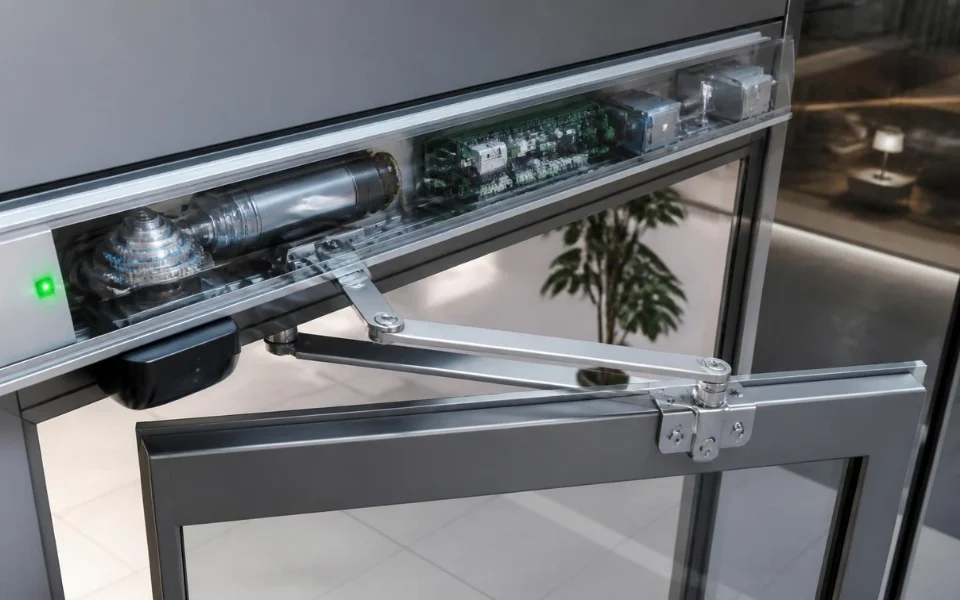
An automatic swing door mechanism is an electro-mechanical or electro-hydraulic operator installed on a doorway header to drive a door leaf open and closed automatically. The system uses a motor, gearbox, spring assembly, arm mechanism, sensors and microprocessor control logic to manage controlled door movement.
For Australian commercial buildings, the mechanism should be selected, installed and maintained according to the requirements applicable to the specific installation, including relevant Australian Standards, accessibility requirements and NCC provisions. Door weight, traffic frequency, frame strength, wind conditions, swing direction and access-control integration should all be considered before selecting an operator.
- Automatic Swing Door Mechanism: An electro-mechanical or electro-hydraulic system that automates pedestrian door movement
- Core Components: Motor, precision gearbox, microprocessor control board, spring assembly and arm mechanism
- Mechanical Operation: Converts electrical energy into controlled rotary torque to move the door leaf through its swing arc
- Safety Integration: Activation and presence-monitoring sensors help control door movement and reduce collision or pinch-point risks
- Australian Compliance: Applicable requirements may include AS 5007:2007, AS 1428.1 and relevant NCC provisions
- High-Traffic Durability: Spring-close mechanisms can provide mechanical return movement when electrical power is unavailable
- Arm Configuration: Push and pull arm assemblies are selected according to lintel depth, frame geometry and swing direction
- Project Considerations: Wind pressure, header strength, frame geometry and access-control integration can affect system performance
What Is an Automatic Swing Door Mechanism and How Does It Operate?
An automatic swing door mechanism converts electrical energy into controlled rotary torque, pushing or pulling the door leaf along a curved swing arc. When a motion sensor, push button or access-control unit sends a trigger signal, the motor energises a precision reduction gearbox. The gearbox turns the output shaft connected to the arm assembly while the internal return spring is compressed.

The microprocessor control system regulates acceleration, opening speed, deceleration, latch-check and closing behaviour throughout the operating cycle.
For a broader overview of how detection, control, motors and safety devices work together, see our guide to How Do Automatic Doors Work?
What Is the Mechanical Drive Train?
The mechanical drive train translates electrical power into controlled rotational force through several components:
- Brushless DC Motor (BLDC): Provides efficient torque generation, low heat production and durability for commercial pedestrian traffic
- Reduction Gearbox: Converts high-speed motor rotation into the controlled torque and speed required to move the door leaf
- Arm Assembly: Transfers the operator output force to the door leaf while distributing movement through the frame and door structure
What Is the Difference Between Spring-Close and Motor-Close Mechanisms?
A spring-close mechanism uses an internal steel spring that is compressed during the motor-driven opening cycle. When the hold-open period ends or electrical power is interrupted, stored mechanical energy can drive the door closed without continuous electrical power.
A motor-close mechanism uses motor power for both opening and closing. This can provide precise electronic control against draft or wind resistance, but continued operation during a power failure may require an appropriate battery or UPS arrangement.
How Does Microprocessor Control Logic Work?
Modern swing door operators use microprocessor control units to monitor door position and motor behaviour. Typical functions include:
- Self-Learning Stroke Calibration: Learns door travel, stop positions, inertia and mechanical resistance during setup
- Opening and Closing Profiles: Controls acceleration, sweep speed, latch-check and final closing movement
- Obstacle Detection: Detects abnormal motor current or obstruction conditions and can stop or reverse movement
- Safety Input Monitoring: Checks connected safety sensor circuits before and during door operation
What Are the Key Components of a Swing Door Operator Assembly?
A complete automatic swing door mechanism can include the motor and gearbox, control electronics, arm assembly, activation and safety sensors, electric locking integration and emergency power or release functions. For a practical example of these components in a commercial operator, see the Automatic Swing Door Opener 250kg.

What Is the Drive Unit and Reduction Gearbox?
The drive unit converts incoming electrical power into the operating power required by the motor and control electronics. Because the motor operates at relatively high rotational speed, a planetary or multi-stage gearbox reduces speed while increasing output torque.
The gearbox allows the operator to control heavy commercial door leaves while maintaining controlled and repeatable movement.
What Are the Main Swing Door Arm Assemblies?
Arm selection depends on frame reveal depth, transom configuration and swing direction:
- Articulated Push Arm: Uses a jointed linkage to push the door away from the operator housing and can suit deeper reveal installations
- Slide Channel Pull Arm: Uses a roller block inside a door-mounted channel and can provide a compact arrangement for suitable flush-frame installations
What Role Do Activation and Safety Sensors Play?
Sensors provide important inputs for automatic door operation:
- Activation Sensors: Microwave radar or passive infrared sensors can detect approaching pedestrians and initiate opening
- Presence and Safety Sensors: Active infrared systems can monitor the door’s operating area and help prevent the door from opening or closing into a person or obstacle
How Are Integrated Electric Locks Used?
Automatic operators can interface with electric strikes, magnetic locks or motor-driven latch bolts through programmable relay outputs. A typical sequence involves releasing the lock before the operator applies significant movement force, followed by controlled closing and final latch-check movement.
What Is the Role of Emergency Battery Backup?
Battery backup systems can maintain automatic operation during a power interruption, depending on the building’s life-safety configuration. The system may be configured for continued operation for a defined period or for a specific opening and closing sequence before returning to the required fail-safe or fail-secure condition. For more information about operation during power failures and emergency conditions, see our guide to Emergency Manual Operation of Automatic Swing Doors.
How Do Electro-Mechanical and Electro-Hydraulic Mechanisms Compare?
Electro-mechanical mechanisms use a direct motor-and-gearbox drive with electronic control and, depending on the design, a mechanical return spring. Electro-hydraulic mechanisms combine an electric motor with hydraulic fluid, a pump and piston to provide controlled damping.

| Feature / Criterion | Electro-Mechanical Swing Operator | Electro-Hydraulic Swing Operator | Manual Hydraulic Door Closer |
| Operating Principle | Electric BLDC motor + reduction gearbox + spring | Electric motor + hydraulic pump + piston | Mechanical fluid resistance + spring |
| Energy Use | Requires electrical power during powered operation | Requires electrical power during powered operation | No electrical power |
| Wind Resistance & Control | Electronic resistance compensation and backcheck can be configured | Hydraulic resistance provides damping | Mechanical fluid damping |
| Compliance Consideration | Applicable requirements depend on the system and installation | Applicable requirements depend on the system and installation | Manual closer rather than an automatic operator |
| Maintenance Profile | Electronics and mechanical checks | Fluid, seals and mechanical checks | Mechanical inspection |
| Typical Application | Hospitals, retail, offices and schools | Demanding or high-wind applications | Standard manual pedestrian doors |
What Are the Main Advantages of Electro-Mechanical Mechanisms?
Electro-mechanical operators can provide compact header installations, quiet operation and extensive digital adjustment. Opening speed, hold-open delay, acceleration curves and sensor responses can often be configured electronically.
They also avoid hydraulic fluid leakage and viscosity changes associated with hydraulic systems.
What Are the Main Advantages of Electro-Hydraulic Mechanisms?
Electro-hydraulic operators can be considered for demanding environments involving high wind loads, substantial pressure differences or particularly heavy door leaves. Hydraulic damping can provide additional resistance and shock absorption against dynamic external forces.
The appropriate mechanism should still be selected following an assessment of door weight, traffic frequency, frame capacity and environmental conditions.
How Do Australian Standards Affect Automatic Swing Door Mechanism Design?
Australian automatic swing door installations may need to address applicable requirements under standards such as AS 5007:2007, AS 1428.1 and relevant NCC provisions. The exact requirements depend on the door, building classification, access conditions and installation configuration.

What Does AS 5007:2007 Cover?
AS 5007:2007 addresses powered doors for pedestrian access and egress and includes safety considerations relating to powered door operation. The source material identifies areas such as closing force, monitored safety zones and maintenance/testing requirements.
How Does AS 1428.1 Affect Automatic Swing Door Design?
AS 1428.1 addresses design for access and mobility. For automatic swing doors, relevant considerations can include:
- Accessible paths of travel
- Effective clear opening width
- Activation-device positioning
- Hold-open timing and safe pedestrian passage
AS 1428.1:2021 provides technical requirements for access and mobility in new building work, including requirements relevant to doorways and accessible movement. The standard is referenced by the NCC and the Disability (Access to Premises — Buildings) Standards. 1Standards Australia — AS 1428.1:2021 Design for access and mobility, Part 1. Date of access on 03/10/2026↓
How Does the NCC Affect Automatic Swing Door Installation?
NCC requirements can affect automatic doors used in commercial buildings, particularly where fire, smoke, structural or egress provisions apply. Fire-rated door assemblies may require compatible certified operators and appropriate interfacing with building fire systems.
What Installation Factors Affect Automatic Swing Door Performance?
Selecting the operator is only one part of a successful installation. Header strength, wind conditions, door geometry, electrical supply, access control and ongoing maintenance can all influence long-term performance.

How Does Header Beam Reinforcement Affect Installation?
Lightweight aluminium transoms or glass sidelight frames can experience deflection when a heavy swing operator engages. Excessive movement can contribute to output-shaft misalignment, gearbox wear, arm noise and poor latching.
The installation may therefore require suitable structural reinforcement within the transom before surface-mounting the operator.
Safe Work Australia recommends considering hazards and risk controls across the full lifecycle of plant, including installation, commissioning, operation, inspection, maintenance and repair. This is particularly relevant when an automatic swing door mechanism is installed in a commercial environment with moving components. 2Safe Work Australia — Plant: Managing risks. Date of access on 03/10/2026↓
How Does Wind Load Affect Operator Calibration?
External doors can experience resistance from onshore winds, building draft effects and pressure differences. Operator setup may therefore require appropriate adjustment of motor force, spring tension and wind-load compensation.
Incorrect calibration can contribute to incomplete closure or unwanted obstruction detection.
How Does Access Control Integration Affect the System?
Automatic swing mechanisms can integrate with card readers, biometric scanners, intercoms and building management systems. Automatic swing doors can also be integrated with broader access-control solutions where controlled entry and user authentication are required. Explore our Access Control Systems for related access-management solutions. The integration should provide:
- Signal Compatibility: Correct electrical or communication interfaces between access-control equipment and operator inputs
- Sequenced Unlocking: Lock release before the operator applies movement force
- Interlock Protocols: Coordinated door operation where two or more doors must operate in sequence
Automatic Swing Door Mechanism Comparison Table
| Consideration | What to Check | Why It Matters |
| Door Weight | Leaf weight and dimensions | Determines required operator capacity |
| Traffic Frequency | Low, medium or high pedestrian traffic | Influences duty cycle and durability requirements |
| Swing Direction | Push or pull configuration | Determines suitable arm assembly |
| Frame Strength | Header and transom construction | Prevents excessive flexing and mounting movement |
| Wind Exposure | Exterior wind and building pressure | Affects operator force and calibration |
| Safety Sensors | Activation and presence monitoring | Supports controlled and safer door movement |
| Access Control | Locks, readers, intercoms and BMS | Determines interface and sequencing requirements |
| Power Backup | Battery or UPS requirements | Supports required operation during power interruptions |
| Fire/Egress Requirements | Door certification and building requirements | Helps maintain the required life-safety configuration |
| Maintenance | Inspection, testing and servicing | Supports long-term reliability and safety |
Practical Automatic Swing Door Mechanism Considerations
A suitable automatic swing door mechanism should be selected according to the actual site rather than motor capacity alone. Door leaf weight, traffic volume, frame construction, wind exposure, swing direction, safety sensors, access control and power-failure requirements should all be reviewed before installation.
If you are comparing different automatic door configurations, see our guide to Automatic Swing Door vs. Automatic Sliding Door for differences in space, traffic flow, installation conditions and building requirements.
Who Should Prioritise a Commercial Automatic Swing Door Mechanism?
Automatic swing door systems are particularly relevant to commercial and public environments where controlled pedestrian access, accessibility, frequent traffic or integration with access-control systems is required.

Applications can include:
- Hospitals and healthcare facilities
- Retail environments
- Commercial offices
- Schools and educational facilities
- Public buildings
- Secure commercial entrances
- High-traffic pedestrian access points
FAQs
Many electro-mechanical operators can function as manual door closers during a power interruption, depending on the operator design and configuration. The internal spring can continue to provide closing force after manual opening.
Low Energy operators generally use reduced speed and kinetic-energy settings and are intended for suitable lower-risk pedestrian environments. Full Power operators can provide faster movement for higher-traffic applications and may require more comprehensive monitored safety protection.
Preventive maintenance should be carried out periodically according to the manufacturer’s recommendations, site traffic and applicable requirements. Higher-traffic environments may require more frequent inspection than lower-use locations.
They may be suitable where the operator is compatible with the certified fire-door assembly and the installation meets the applicable fire, egress and building requirements. The certification and configuration of the complete door assembly should be checked before installation.
Possible causes include incorrect latch-check settings, worn arm connection components, incorrect spring preload, door alignment problems or building air-pressure effects near the closing position.
Final Thoughts
An automatic swing door mechanism is an integrated system rather than simply a motor. The motor, gearbox, spring assembly, arm linkage, safety sensors and microprocessor control logic must work together to provide controlled pedestrian access.
Selecting between electro-mechanical and electro-hydraulic mechanisms requires consideration of door weight, traffic density, frame geometry, wind exposure, access-control requirements and applicable Australian requirements. Proper site preparation, installation, commissioning and ongoing maintenance are important for reliable long-term operation.




