
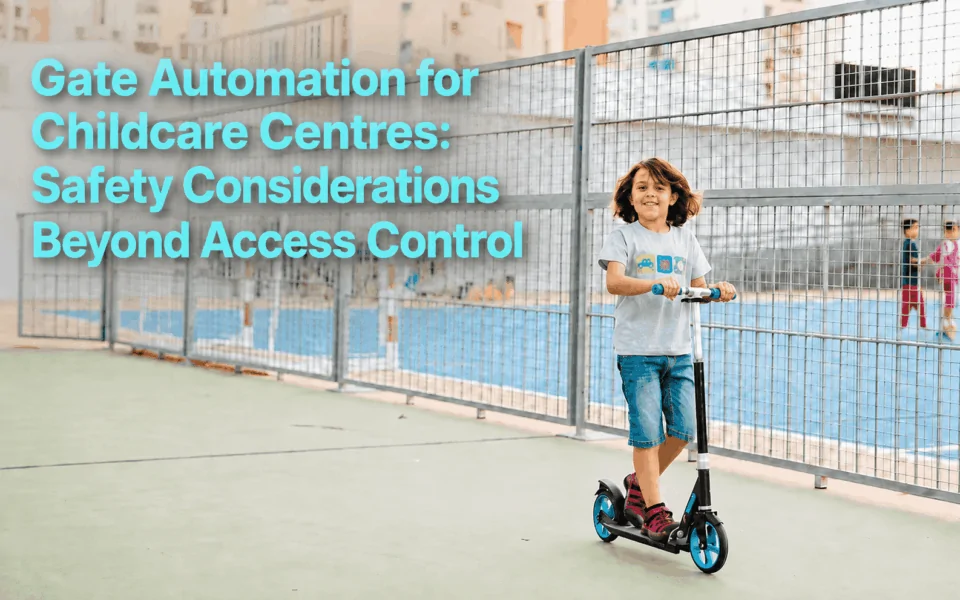
- Gate automation for childcare centres must prioritise child safety, not just access control. Systems should be designed around unpredictable child behaviour, frequent pedestrian movement and the higher duty of care required in childcare environments.
- Physical gate safety is critical. Photoelectric beams, obstacle detection, auto-reverse functions, force limitation, soft start/stop operation and secure locking can help reduce crushing, trapping and contact risks.
- Pedestrian and vehicle access should be treated as different safety zones. Where practical, separating pedestrian entrances from vehicle gates can reduce conflicts between children, moving vehicles and large automated gate leaves.
- The gate should form part of the complete child-containment boundary. Gaps underneath or beside the gate, climbable features, uneven ground, closing alignment and manual-release arrangements all need to be considered during system design.
- Drop-off and pick-up periods require careful planning. Operators need an appropriate duty rating, reliable closing sequences and suitable access logic to handle concentrated traffic without leaving gates open longer than necessary.
Gate automation for childcare centres ensures convenience and restricts entry. Also, it’s about protecting vulnerable occupants and ensuring a secure environment. In facilities where young children are constantly moving and interacting with their surroundings, entry and exit points are among the highest-risk zones.
This guide explores the critical safety considerations behind gate automation for childcare centres, helping builders, operators, and installers make informed decisions for their projects in these specialised spaces.
Why Childcare Centres Demand More Than Just Basic Access Control
Young children are naturally curious and unpredictable. They often lack awareness of potential dangers. Even a brief lapse in access control can lead to risky situations. Whether it’s a child wandering towards an open gate or standing too close during operation, the system must be designed to anticipate and prevent these behaviours.
Childcare centres also experience frequent movement throughout the day. According to the Australian Government Department of Education, 1,413,870 children used approved childcare services across 15,393 locations during the March quarter of 2026, attending for an average of 27.8 hours per week (1 New Child Care Subsidy data: March quarter 2026..Date of access on 17/08/2026↓). These figures demonstrate the scale and frequency of daily activity that childcare access systems may need to support.
When designing gate automation for childcare centres, it’s essential to recognise that these environments operate very differently from standard residential or commercial properties. The level of vulnerability is significantly higher, and the consequences of system failure can be far more serious.
At the same time, childcare centres experience constant movement throughout the day. Parents arriving for drop-offs, staff transitions, visitors, and delivery drivers all contribute to high traffic volumes. This creates pressure on entry systems to operate smoothly without compromising safety.
There are also strict regulatory and duty-of-care obligations placed on childcare providers(2 A simple guide to understanding duty of care in childcare centres in NSW..Date of access on 17/08/2026↓). Operators are legally and ethically responsible for maintaining a secure environment. Entry points are also a critical part of that responsibility.
This is where the concept of layered security becomes essential. Gate automation for childcare centres should not function as a standalone solution but as part of a broader system. It helps control movement, monitors access, and reduces reliance on human intervention.
The Main Safety Risks Around Automated Childcare Gates
Understanding the risks associated with entry points is the first step in designing an effective system. Gate automation for childcare centres must actively mitigate these common hazards:
- Tailgating and unauthorised access. One of the most frequent issues is when an unauthorised person enters immediately after an authorised user. Parents or visitors may unintentionally allow others to follow them through the gate, bypassing security protocols. Without proper controls, this can compromise the entire facility.
- Child escape risks. During busy drop-off and pick-up periods, supervision can be stretched thin. Children may attempt to follow their parents or slip through open or slow-closing gates. Automated systems must ensure gates close promptly and cannot be easily bypassed.
- Gate closing hazards. Moving gates pose a physical risk, particularly to small children who may not recognise danger. Without proper safety mechanisms, there is a risk of injury from contact with the gate during operation.
- Vehicle and pedestrian interaction. Many childcare centres share access points between vehicles and pedestrians. This increases the likelihood of accidents, especially when drivers are distracted or visibility is limited. Poorly designed entry systems can worsen this risk.
- Manual gate errors. Traditional gates rely heavily on human behaviour. Gates may be left open, improperly secured, or delayed in closing. Automation reduces these risks, but only when properly configured and maintained.
Addressing these risks requires a safety-first approach tailored specifically to childcare environments.

Safety Features to Consider for Automated Childcare Gates
To effectively reduce risk, gate automation for childcare centres must incorporate a range of advanced safety features. These components work together to ensure safe and reliable operation at all times.
- Obstacle detection and auto-reverse mechanisms: These systems detect resistance or contact during gate movement and immediately stop or reverse direction. This is critical in preventing injuries, especially when children are nearby.
- Photoelectric safety beams: Safety beams create an invisible detection line across the gate path. If the beam is interrupted, the gate will not close or will reverse if already moving. This feature is essential in environments where small children may unexpectedly enter the gate zone.
- Soft start and stop motors: Sudden movements can be dangerous. Soft start and stop functionality ensures the gate accelerates and decelerates gradually, reducing mechanical force and minimising risk.
- Speed control and force limitation: Adjustable speed and force settings allow installers to fine-tune the gate’s operation for safer performance. Lower force levels are particularly important in childcare settings.
- Fail-safe operation during power outages: Power failures should not compromise safety. Battery backup systems or manual override options ensure the gate can still operate securely when needed.
- Secure locking mechanisms: Automated gates must remain securely closed when not in use. Robust locking systems prevent forced entry and reduce the likelihood of accidental opening.
Why Pedestrian Gates and Vehicle Gates Need Different Safety Strategies
Childcare centres often have both pedestrian and vehicle access points, but these entrances present different risks. Treating them as separate safety problems can make the overall gate design clearer and more effective.
Automated Pedestrian Entry Gates
Pedestrian gates should focus on child containment, controlled release and supervision. The gate should be easy for authorised adults to operate while remaining difficult for young children to release unintentionally. Closing behaviour is also important so the gate returns reliably to its secure position after use. Designers should also consider hinge areas, latches and other pinch or trapping points, particularly where children may stand close to the gate while adults are entering or leaving.
Automated Vehicle Gates
Vehicle gates require greater attention to vehicle detection, pedestrian separation and the gate travel area. Drop-off and pick-up periods can be especially challenging because parents and children may walk between or around parked vehicles while the gate is operating. Good driveway visibility and clear separation between pedestrian paths and vehicle movements can reduce these conflicts.
Why a Separate Pedestrian Entrance Is Often Easier to Manage
Where the site layout allows it, providing a separate pedestrian entrance away from the vehicle gate can simplify the risk environment. It can reduce interaction between children, moving vehicles and large automated gate leaves.
This is not necessarily mandatory for every childcare centre, but it is a design option worth assessing during the early planning stage.
Choosing the Right Gate Type and Operator for a Childcare Centre
Selecting gate automation for a childcare centre requires more than choosing a motor that can open and close the gate. The gate type, movement path, traffic pattern, physical size and available safety functions all need to be considered together. The safest and most practical gate solution depends on the actual site layout rather than assuming one gate style is automatically better for childcare environments.

Sliding vs Swing Gates
A sliding gate moves parallel with the fence line, which can be useful where the driveway area needs to remain clear of a swinging leaf. However, the gate also creates a run-back area beside the opening. That movement zone needs to be considered carefully so children, staff and other pedestrians cannot easily access pinch, trapping or crushing areas.
A swing gate operates through an arc. This can work well where sufficient clear space is available, but the entire sweep area needs to remain controlled and unobstructed. Pedestrian paths, parking areas and waiting zones should not conflict with the gate movement.
Neither design should be considered inherently “childcare-safe”. What matters is how the gate is installed, protected and integrated with appropriate safety devices.
Pedestrian Gate Automation
Pedestrian entrances deserve separate consideration from vehicle gates. A childcare centre may need controlled pedestrian access for parents, staff, contractors and visitors while also maintaining a secure boundary for children.
An automated pedestrian gate may use an intercom, keypad, access credential, push button or other release method. The opening force, closing behaviour, latching arrangement and detection of people within the movement area should all be assessed around frequent pedestrian use.
Duty Cycle During Drop-Off and Pick-Up
Childcare centres often experience short periods of very high gate activity rather than evenly distributed operation throughout the day. Morning drop-off and afternoon pick-up may result in repeated opening cycles over a relatively short period.
This should influence:
- Operator duty rating. The operator should be capable of handling concentrated usage without excessive wear.
- Opening speed. Faster operation may help reduce vehicle queues, provided safety requirements remain satisfied.
- Heat and load. Repeated cycles can increase motor and control-board temperatures.
- Reliability requirements. A gate failure during peak arrival or departure periods can quickly create access and supervision problems.
Gate Weight, Size and Wind Loading
Gate dimensions are also critical. Long, heavy or fully sheeted gates place greater loads on the operator and supporting structure. Solid privacy gates can experience substantial wind loading, particularly on exposed sites, so operator selection should consider the real forces acting on the gate rather than weight alone.
Operator Safety Functions
The selected operator should support the safety strategy for the site. Depending on the system, useful functions may include obstacle response, adjustable force and speed parameters, monitored safety inputs and compatibility with photocells, safety edges or other protective devices.
These functions should complement good gate geometry and physical guarding rather than compensate for a poorly designed installation.
Power Failure and Backup Strategy
Power-loss behaviour should be planned during specification, not treated as an optional extra after installation. Consider whether the gate needs battery backup, manual release or another method of maintaining safe entry and exit during an outage.
For childcare sites, DHS can assess the gate layout, traffic patterns, access-control requirements and operator safety features as one integrated system rather than treating the motor, gate and safety devices as separate decisions.
How to Design Safer Gate Flow During Drop-Off and Pick-Up
A well-designed system should prioritise clear separation between pedestrian and vehicle access points. This reduces the likelihood of children crossing paths with moving vehicles and creates a more controlled flow. Peak periods present one of the biggest challenges for gate automation for childcare centres. The concentration of people and vehicles during drop-off and pick-up times increases the risk of congestion and accidents.
Digital Home Systems (DHS) consistently applies a Separate, Control and Verify principle when planning busy entry points:
- Separate pedestrian movement from vehicle access wherever the site allows.
- Control who can enter, when the gate opens and how long it remains open.
- Verify that safety devices, access credentials and closing sequences operate correctly under peak traffic conditions.
This process helps ensure the complete entry flow is considered rather than focusing only on the gate motor.
Automation logic also plays a key role. Gates can be programmed to open and close at optimal times, reducing delays while maintaining strict access control. For example, timed closing sequences ensure gates do not remain open longer than necessary, even during high traffic.
Integration with intercoms, keypads, or credential-based systems enables controlled entry without constant staff intervention. Parents can be granted access via secure methods such as PIN codes or RFID tags, reducing bottlenecks at entry points.
By streamlining entry processes, automation not only improves safety but also reduces staff workload. This allows educators and administrators to focus on supervising children rather than manually managing access.

Designing the Gate as Part of the Child-Containment Boundary
In a childcare centre, the automated gate should be treated as part of the overall child-containment boundary, not simply as an access point with a motor attached. The gate, fencing, posts, ground conditions and surrounding structures all need to work together so that automation does not introduce new gaps or weak points.
Gaps Under and Around the Gate
Clearances beneath and beside the gate should be reviewed carefully. Excessive gaps can undermine an otherwise well-designed fence line, particularly where the driveway slopes, the ground is uneven or the gate needs additional movement clearance.
Automation should therefore be designed around the containment strategy rather than forcing the fencing layout to accommodate unsuitable gate geometry.
Gate and Fence Geometry
The complete boundary should be assessed for potential vulnerabilities, including:
- Openings between the gate, posts and adjacent fencing
- Nearby structures that may create unintended access points
- Climbable elements such as rails, hardware or adjoining features
- Changes in ground level that alter clearances beneath the gate
These details are especially important where the gate moves differently from the fixed fence around it.
Closing and Latching
After every cycle, the gate needs to return consistently to its intended closed and secure position. Alignment, stops, latching hardware and operator settings should work together so that the gate does not remain partially open or fail to secure properly after repeated use.
Manual Operation After a Fault
A fault or power failure should not turn the gate into an easily bypassed opening. If the operator is disengaged for manual movement, the gate should still have a practical way to be closed and secured.
This is why manual release, backup power, locking arrangements and fault procedures should be considered during the original design. In childcare applications, the gate must remain part of the containment boundary even when the automation is temporarily unavailable.
Integrating the Gate With Intercom, Access Control and CCTV
A childcare centre gate can form part of a broader entry-management system that helps staff identify visitors, manage authorised access and review activity around the entrance. However, integration should support the site’s safety procedures rather than replace them.
- Video intercom for visitor verification. A video intercom allows reception or authorised staff to see and speak with visitors before opening the gate. This is particularly useful at childcare entrances where staff need to confirm who is requesting access before granting entry.
- Access control for staff and authorised users. Staff, contractors or other approved users may be given cards, fobs, PINs or mobile credentials, depending on the site’s operational requirements. Access permissions can be managed so that different users have appropriate entry rights.
- CCTV at the entry point. CCTV can improve visibility around the gate and provide useful footage for incident review and operational oversight. Camera placement and recording practices should be planned in line with the centre’s privacy policies and other applicable requirements.
- Door and gate release from reception. Connecting the gate to a reception station can allow staff to verify a visitor through the intercom and then release the entrance remotely. This can reduce unnecessary movement away from supervised areas while maintaining controlled access.
- Event logging. Integrated access-control systems may record events such as credential use, authorised entry requests or gate releases. These records can assist with access management, troubleshooting and reviewing unusual activity.
The important point is that integration can improve control, visibility and convenience, but it does not replace physical gate safety or active supervision. Access control, CCTV and intercoms should complement appropriate gate design, safety devices, staff procedures and supervision practices rather than being treated as a substitute for them.

What are Childcare Gate Compliance and Supervision Requirements
Gate automation at a childcare centre should be considered within the broader regulatory framework for fencing, supervision and child safety. There is not one single “childcare gate automation standard” that can be satisfied simply by installing a particular motor, sensor or lock. The complete entrance needs to support the service’s fencing, supervision and risk-management obligations.
Regulation 104 – Fencing
Under Regulation 104 of the Education and Care Services National Regulations(3 Regulation 104 of the Education and Care Services National Regulations..Date of access on 17/08/2026↓), outdoor spaces used by children must, where the provision applies, be enclosed by a fence or barrier of a height and design that children of preschool age or under cannot go through, over or under.
For an automated entrance, the gate effectively becomes part of that boundary. Its closed position, gaps beneath and beside the leaf, adjoining fencing and surrounding structures therefore need to be considered as part of the overall containment design.
Regulation 115 – Premises Designed to Facilitate Supervision
Regulation 115 requires the approved provider of a centre-based service to ensure that the premises are designed and maintained in a way that facilitates supervision of children while they are being educated and cared for.
ACECQA reinforced this principle with new national guidance released on 12 August 2026(4 Communications toolkit: Facilitating Supervision and Child Safety through Building Design: Regulation 115..Date of access on 17/08/2026↓), specifically addressing how building design can support effective supervision and help identify and mitigate design-related risks.
For gate design, this means considering issues such as sightlines, visitor entry points and how staff can supervise areas around the entrance rather than assessing the automation equipment in isolation.
Quality Area 2 – Children’s Health and Safety
Quality Area 2 of the National Quality Standard focuses on safeguarding children’s health and safety, minimising risks and protecting children from harm and injury(5 Quality Area 2 – Children’s health and safety..Date of access on 17/08/2026↓).
Gate safety should therefore be approached through risk minimisation. Hazards such as crushing, trapping, unauthorised exit, unexpected gate movement and conflicts between pedestrians and vehicles should be considered during design and operation.
This is more accurate than assuming compliance can be achieved through a standard list of automation components.
Site-Specific Requirements
Every childcare entrance also has its own project conditions. Depending on the property and scope of work, these may include:
- Building requirements, including how the gate relates to the approved premises layout.
- Emergency egress, so access-control arrangements do not create inappropriate restrictions during an emergency.
- Electrical requirements for power supplies, cabling and installed equipment.
- Local approval conditions imposed through planning, building or service approvals.
- Workplace safety requirements, particularly around vehicle and pedestrian movement.
- Manufacturer installation requirements for the gate operator and compatible safety equipment.
The safest approach is therefore to assess the gate, automation, fencing, access control and supervision strategy as one system. Installing a photocell, intercom or particular operator does not by itself make an entrance compliant; the complete installation still needs to suit the service, site and applicable requirements.

To Sum Up,
Gate automation for childcare centres should ensure a secure, controlled environment where children can learn and play safely. It helps address risks such as unauthorised access, child escape, and physical hazards. Well-designed systems provide critical protection at key entry points.
A safety-first approach combines advanced features and system integration to deliver reliable performance in even the busiest environments. When paired with proper maintenance and compliance, these systems support operational efficiency and duty of care.
For builders, operators, and specifiers, investing in high-quality gate automation for childcare centres can deliver lasting benefits – enhancing safety, improving workflows, and providing peace of mind for everyone involved. Contact DHS today for an ultimate gate & door solution for your property!
FAQs
A childcare gate should include photocells, obstacle detection, automatic stop and reverse, controlled opening speeds, secure locking and backup operation during power outages.
Sliding gates are often preferred because they use less opening space and provide controlled horizontal movement. However, suitability depends on site layout, pedestrian routes and safety clearances.
Prompt closing, secure credentials, monitored entry and well-positioned safety sensors can reduce tailgating while ensuring the gate does not close on a child or adult.
Yes. Integration with video intercoms, access control, surveillance, alarms and access logs improves visitor verification, staff oversight and accountability across the childcare facility, creating a complete security solutions.
The system should receive routine visual checks and scheduled professional servicing. Sensors, motors, locks, controls and emergency functions must be tested regularly to maintain safe operation.




