
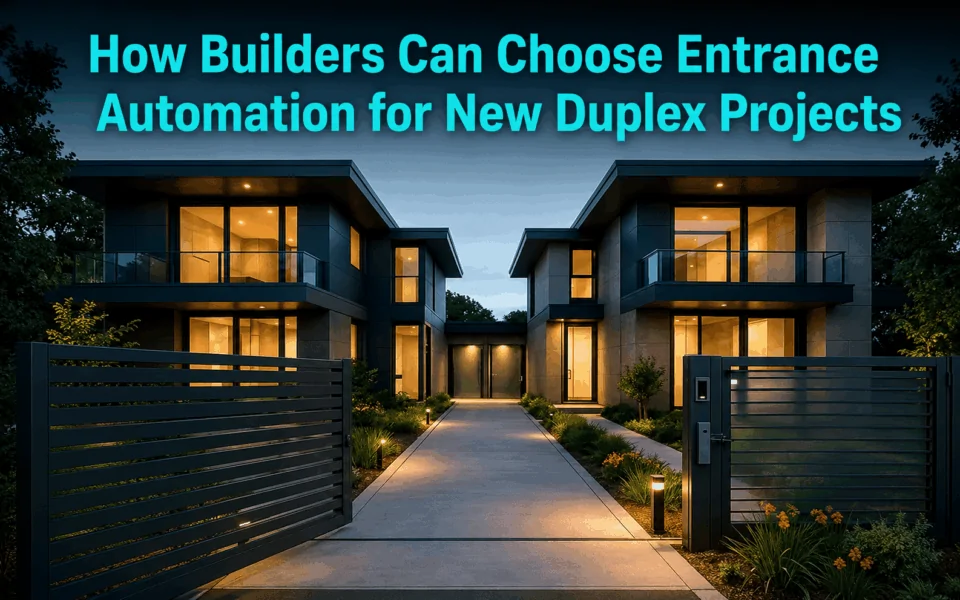
- Plan entrance automation early so power, conduits, intercom cabling, gate geometry and landscaping can be coordinated before concrete and paving are completed.
- Define shared vs independent access for each dwelling, including driveway gates, pedestrian entries, intercom routing and resident credentials.
- Match the gate and motor to the site, considering frontage space, slope, gate weight, wind exposure and privacy infill design.
- Prioritise reliable infrastructure, including underground conduits, suitable power supplies, battery backup and weather-resistant equipment.
- Integrate access control intelligently with multi-tenant intercoms, keypads, RFID, smartphone access and compatible smart home systems.
- Build safety into the specification with correctly positioned photocells, obstruction detection, auto-reverse functions and appropriate commissioning.
When planning modern dual-occupancy homes, entrance automation for duplex projects is a practical necessity. Builders today are expected to deliver homes that balance privacy, convenience, and security. At the same time, they need to maximise space and long-term value. Duplex developments, in particular, present unique access challenges that require thoughtful planning and the right automation systems.
By integrating duplex gate automation and new build automatic doors early in the design phase, builders can create seamless living environments.
Why Entrance Automation Should Be Planned Early in a Duplex Project
Entrance automation is much easier to integrate when it is considered during the early design and construction stages of a duplex rather than treated as a final add-on.
Several common installation problems can be avoided when entrance automation for duplex projects is coordinated before landscaping, fencing and external electrical work are completed. These include:
- Insufficient gate run-back. Sliding gates need enough clear space beside the driveway for the gate leaf, motor and associated hardware.
- Unsuitable posts or footings. Gate operators, hinges, guides and access-control equipment need suitable structural support.
- Missing conduits. Conduits should be planned for power, safety devices, intercoms, access control and communication cabling before concrete or paving is installed.
- No power at the entrance. Gate motors and related equipment require an appropriate power supply positioned according to the system design.
- Poor intercom cabling routes. Planning cable pathways early makes it easier to connect entrance stations with each dwelling, network equipment and access-control hardware.
- Gate operators conflicting with landscaping. Garden beds, retaining walls, letterboxes and driveway finishes can restrict the space required for motors, arms, tracks or safety devices.
- Two dwellings unintentionally sharing access hardware. Duplex projects should clearly define whether gates, pedestrian entrances, intercoms and access credentials are shared or independently controlled.
Gate automation should therefore be treated as a complete entrance system rather than simply selecting a motor near the end of construction. Automatic gate FAAC manufacturers’ installation examples also show that operators, control boards, photocells, power and low-voltage cabling all need to be coordinated as part of the complete installation rather than added independently afterward.(1 Automatic gate FAAC manufacturers’ installation examples.Date of access on 22/08/2026↓).
From DHS’s experience with residential gate, intercom and access-control projects, problems often arise when entrance automation is considered after driveways, fencing or landscaping are already finished. Common issues include missing conduits, poor cable routes, insufficient motor space and unclear separation between shared and private access for each dwelling.

Site and Layout Planning for Duplex Entrance Automation
Before selecting a gate motor or access-control system, builders should assess how the duplex frontage will actually function. The available space, driveway arrangement, gate size and relationship between the two dwellings can all affect which automation system is practical.
Decide Between Shared and Independent Entries
Start by determining whether both dwellings will use a shared vehicle entrance or have completely independent access.
A duplex may have one automated driveway gate serving both residences, while pedestrian gates, intercoms and access credentials remain separate. Other developments may have individual driveways and gates for each dwelling.
This decision should be made early because it affects:
- the number of gate operators and control systems required;
- intercom and access-control configuration;
- cabling and conduit routes;
- visitor access arrangements;
- remote controls, keypads or mobile credentials;
- future maintenance responsibilities between residents.
Where one gate is shared, the system should still allow each household to manage its own users without unnecessarily sharing other entrance hardware.
Read more: Automatic Gate Planning for Multi-Unit Developments and Shared Driveways
Match Gate Geometry to the Available Frontage
The physical layout of the site often determines which gate type will work best.
Sliding gates can be well suited to compact duplex frontages because they do not require an opening arc across the driveway. However, adequate run-back space beside the opening is essential.
Cantilever gates may be considered where ground conditions, drainage or driveway geometry make a conventional ground track undesirable, although they require additional side space and suitable structural support.
Swing gates can provide a clean residential appearance where sufficient arc clearance is available. Builders need to check that the leaves will not interfere with parked vehicles, footpaths, landscaping or sloping ground.
For sloping sites in particular, gate geometry should be confirmed before posts, retaining walls and driveway levels are finalised.
Consider Gate Weight and Wind Load
Gate weight is only part of the motor-selection equation. Builders should also consider how much wind the gate surface will capture.
Open picket or widely spaced slat gates allow more air to pass through, while dense privacy slats and solid infill panels can behave like a large sail in strong winds. This places greater load on the gate structure, hinges or rollers and the automation equipment.
A motor that appears adequate based on gate weight alone may therefore be unsuitable for a large, solid gate exposed to prevailing winds.
Privacy requirements, gate dimensions, infill density and site exposure should be reviewed together so the gate structure and operator can be specified with sufficient capacity. Allowing for these factors during design helps builders avoid an automation system that operates reliably in calm weather but struggles under real site conditions.

Power and Infrastructure Planning for Duplex Entrance Automation
Reliable entrance automation depends just as much on the infrastructure behind the system as it does on the gate motor itself. For builders, power, conduits, control cabling and equipment locations should be coordinated during the rough-in stage, ideally before driveways, pathways, fencing and landscaping make changes more difficult.
Good infrastructure planning also makes future maintenance and upgrades easier, particularly where a duplex has multiple gates, intercom stations or separate access systems for each dwelling.
Rough-In Power and Control Cabling Early
Underground conduits should be installed before concrete driveways, paving or finished landscaping is completed. Retrofitting cables later may require saw-cutting concrete, lifting pavers or using less desirable surface-mounted cabling.
Depending on the entrance design, builders may need pathways for:
- mains power to the gate operator or nearby control equipment;
- low-voltage gate and safety-device wiring;
- photocells and other gate safety sensors;
- intercom and data cabling;
- keypads, card readers or other access-control devices;
- pedestrian gate locks and release hardware;
- communication between shared entrance equipment and each dwelling.
Power and low-voltage services should be appropriately separated and installed in accordance with applicable electrical requirements. Spare conduit capacity can also be valuable if the owner later wants to add CCTV, additional access control or other entrance technology.
Read more: Power Procurement on Construction Sites: Pre-Wiring for 24V vs. 240V Gate Operators
Plan for Operation During Power Outages
A power outage should not leave residents without a practical way to operate the entrance. Depending on the selected gate system, builders can specify a battery backup that allows the operator to continue functioning for a limited number of cycles when mains power is unavailable.
The appropriate backup arrangement depends on gate weight, operator type, expected usage and how long outages are likely to last. A manual release should also remain accessible where required so the gate can still be operated if the battery is depleted or the automation system develops a fault.
Backup power should therefore be considered as part of the overall access strategy rather than simply added as an optional accessory at handover.
Choose Equipment Suitable for the Outdoor Environment
Entrance automation equipment is continuously exposed to outdoor conditions, so environmental suitability should be considered when specifying both the gate and its automation hardware.
Motors, control enclosures, intercoms, junction boxes and access-control devices should have appropriate weather protection for their installation location. Materials and hardware should also offer suitable corrosion resistance, particularly where equipment is exposed to rain, moisture or coastal conditions.
By coordinating power, cabling, backup operation and environmental protection during construction, builders can provide entrance automation that is cleaner to install, easier to service and better prepared for long-term use.
For builders who want to coordinate these elements before construction is locked in, Digital Home Systems (DHS) can assist with entrance automation design, product specification and installer coordination. DHS can help review gate operators, power and conduit requirements, intercoms, access control and safety devices as one integrated system, reducing the risk of incompatible equipment or missing infrastructure later in the project.

Access Control and Smart Integration for Duplex Entrances
Entrance automation for a duplex should do more than open and close a gate. Builders should also consider how residents, visitors and service providers will identify themselves, request access and move between the shared or separate entry points.
The best approach is to design the gate automation, intercom and access control as one coordinated system rather than installing each component independently.
Use Intercoms Designed for Two Households
For a shared pedestrian gate or driveway entrance, a multi-tenant video intercom can provide a clear way for visitors to contact the correct dwelling.
Depending on the system, this may include two dedicated call buttons, a small digital directory or separate mobile app routing for each household. Each resident should be able to answer calls and release the appropriate gate or door without unnecessarily giving the neighbouring dwelling control over their private access points.
Where the duplex uses independent entrances, separate intercom stations may be more practical.
Provide Flexible Resident Credentials
Residents may not want to rely on a single entry method. A well-designed system can combine several credential types, such as:
- PIN access through a keypad;
- RFID cards, tags or fobs;
- smartphone-based digital keys;
- intercom-based remote release;
- conventional transmitters for vehicle gates.
Providing multiple methods allows residents to choose the most convenient option while also making it easier to issue or revoke access for family members, cleaners, trades or other authorised users.
Check Smart Home Compatibility Early
If smart home integration is part of the duplex specification, compatibility should be confirmed before the entrance hardware is selected.
Gate operators, intercoms and access-control systems may communicate through IP networks, Wi-Fi, dry-contact inputs, relays or hardwired building-automation buses. The most suitable method depends on the wider system being installed in each dwelling.
Builders should therefore identify the intended smart home platform and required functions early. This makes it easier to coordinate cabling and choose equipment that can support functions such as remote gate control, visitor notifications and automation scenes without relying on awkward retrofits later.

Safety and Compliance for Duplex Gate Automation
Safety should be treated as a core part of entrance automation design, particularly in duplex projects where gates may be used frequently by residents, visitors, children, pets and multiple vehicles. Builders should make sure the selected gate automation system includes suitable safety devices and that these are considered during the design stage rather than added after installation.
Use Photocells and Safety Sensors
Photocells, also known as safety beams, are commonly installed across the gate opening to detect vehicles, people or other objects in the travel path. If the beam is interrupted, the control system can prevent the gate from closing or trigger an appropriate safety response.
Automatic-gate manufacturer packages commonly include photocells as part of the automation system. FAAC’s current sliding and swing gate kits(2 FAAC’s current sliding and swing gate kits. Date of access on 07/09/2026↓), for example, include photocell pairs as safety accessories.
Sensor placement is important. The system should account for the actual gate movement, driveway layout and potential trapping or crushing zones, rather than relying on a single device without considering the wider entrance.
Specify Obstruction Detection and Auto-Reverse Functions
Modern gate control boards may include adjustable force settings, soft-start and soft-stop operation, and obstruction detection that can stop or reverse the gate when abnormal resistance is detected.
These settings should be correctly configured for the gate’s weight, geometry and operating conditions. Excessive force can increase safety risks, while settings that are too sensitive may lead to unreliable operation.
Builders should ensure the complete gate system, including the operator, safety devices, control settings and installation method, is specified and commissioned in line with applicable Australian requirements and the manufacturer’s instructions.
Where Builders Should Spend the Budget – and Where Not to Cut Corners
For builders, controlling project cost does not mean choosing the cheapest gate motor or access system. The better approach is to spend on the parts that are difficult or expensive to change later, while keeping the overall specification practical for the duplex.
- Prioritise infrastructure first. Conduits, power supplies and cable routes are relatively inexpensive to install during construction. Retrofitting them after the driveway, paving or landscaping is complete can be far more disruptive and costly.
- Get the gate structure right before increasing motor size. A larger operator cannot compensate for poor gate geometry, weak posts, misaligned tracks or excessive friction. The gate should move freely and be structurally suitable before the motor is selected.
- Compare shared and duplicated systems carefully. One shared driveway gate may reduce the initial equipment cost, but it can also create long-term questions around shared maintenance, control permissions and responsibility for repairs. Separate systems cost more upfront but may simplify ownership.
- Allow for future expansion. Spare conduit and accessible equipment locations can make later upgrades much easier. Builders may not need to install every feature during the initial project, but they can prepare for additions such as upgraded video intercoms, CCTV cameras, automatic number-plate recognition, or additional pedestrian gate automation.
The strongest specification usually invests in good infrastructure, gate construction and system planning first, while leaving room for technology upgrades later.

Final Thoughts,
Thoughtful planning is the foundation of successful entrance automation for duplex projects. By considering layout, access requirements, system types, and integration opportunities early in the design process, builders can deliver solutions that meet the needs of modern homeowners.
The right automation system improves usability, enhances safety, and adds long-term value to the property. Whether through advanced duplex gate automation or integrated new build automatic doors, these features are quickly becoming standard expectations in today’s market.
For builders looking to stay competitive, the message is clear: plan early, choose reliable systems, and work with experienced partners. Explore DHS Gates and Door Solutions or consult with automation specialists to ensure your next duplex project delivers both performance and appeal.
FAQs
A shared gate can reduce upfront cost and suit a common driveway, while separate gates provide clearer ownership, independent access control and simpler long-term maintenance responsibilities.
The system should be planned before the driveway is completed. Conduits, power, foundations and gate geometry are much easier to coordinate before concrete, paving and landscaping are finished.
Allow suitable conduits for mains power, low-voltage controls, photocells, intercoms, access control and data connections. Spare conduit can also make future upgrades easier.
Yes. Multi-tenant video intercom systems can route visitors to separate indoor monitors or mobile apps so each household receives its own calls.
Yes, where the selected intercom or access-control platform supports mobile access. Each household can typically have separate authorised users and credentials.
It depends on the site. Sliding gates suit limited driveway depth, while swing gates work well where there is sufficient opening arc and suitable ground clearance.




