
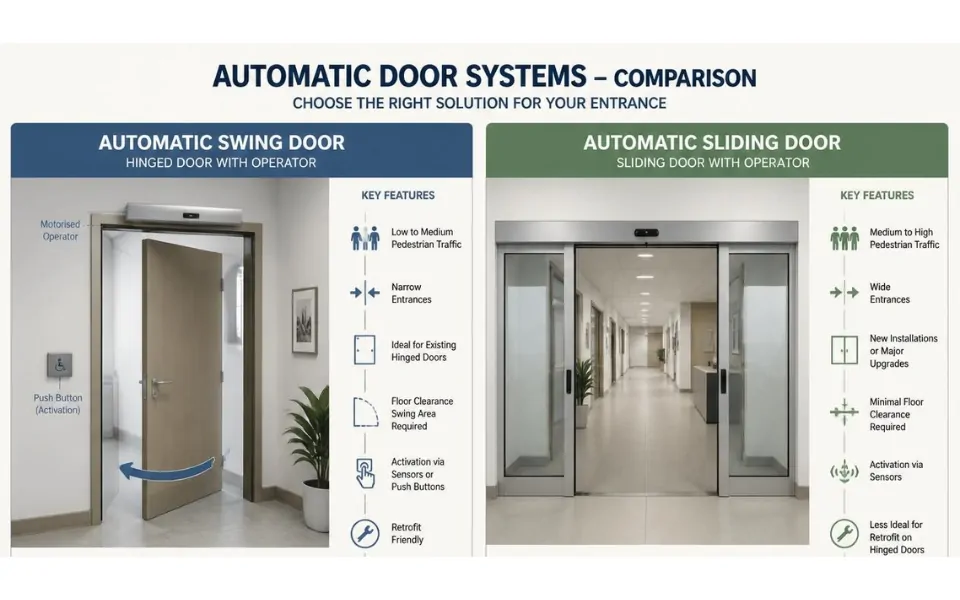
Automatic doors provide hands-free access while helping buildings manage pedestrian movement, accessibility and security. The two common options are automatic swing doors and automatic sliding doors, but they are designed around different space and operating requirements.
Automatic sliding doors are generally well suited to wider, higher-traffic entrances, while automatic swing doors can be practical for narrower entrances and existing hinged doors. The right choice depends on the available space, traffic flow, door configuration, accessibility requirements and installation conditions.
- Traffic Volume: Use Sliding for heavy crowds (malls/hospitals); use Swing for low-to-medium traffic (offices/small retail).
- Space Needs: Sliding doors need side-wall width; Swing doors need floor depth (the “sweep” area).
- Cost: Swing doors are significantly cheaper and easier to retrofit onto existing doors.
- Safety: Sliding doors are safer as they move away from users; Swing doors require sensors to avoid hitting people in the path.
- Climate: Sliding doors are better for energy efficiency because they open and close faster.
Key Differences at a Glance
| Factor | Automatic Sliding Door | Automatic Swing Door |
| Space Required | Requires side space for panels to slide and park | Requires clearance within the door swing area |
| Traffic Volume | Suitable for higher-traffic entrances | Generally suited to low–medium traffic |
| Installation | May require more structural and framing coordination | Often suitable for retrofit applications |
| Operation | Panels slide horizontally | Door rotates on its hinges |
| Best Use Case | Busy entrances, lobbies and large openings | Offices, corridors and existing hinged doors |
| Automation | Sensors activate horizontal movement | Sensors or switches activate the swing operator |
Automatic Sliding Doors: Best for High-Traffic Lobbies
Automatic sliding doors move horizontally along a track and are commonly used at entrances where people need to move through the doorway efficiently. Because the panels remain within the door’s opening and side area, they do not require the same swing zone as a hinged door. 1Automatic Door Sliding Control System. Date of access on 06/09/2026↓

How They Work
An automatic sliding door uses an operator, track, rollers and activation devices to control the opening cycle.
When a person approaches, a motion or presence sensor can send an activation signal to the controller. The operator then moves the door panels along the track to the programmed open position. Safety sensors can monitor the doorway and help prevent the door from closing when a person or object is detected within the monitored area.
Once the opening cycle is complete, the door can close automatically according to its programmed settings.
Pros of Sliding Doors
- Efficiency: Sliding doors can support frequent pedestrian movement because people do not need to manually push or pull the door.
- Space-saving floor design: The panels move horizontally rather than swinging into the pedestrian area, which can make them useful where the entrance has a busy circulation path.
- Hands-free access: Sensors can activate the door automatically, while access-control systems can be integrated where controlled entry is required.
- Suitable for larger openings: Multi-panel sliding systems can provide wider entrance openings than many conventional hinged doors.
- Indoor comfort: Automatic opening and closing can help control the amount of time the entrance remains open, although actual energy performance depends on the complete building and door system.
Cons of Sliding Doors
- Side space required: Sliding panels need sufficient space beside the opening to move and park.
- Higher installation complexity: Larger systems may require additional framing, electrical work, structural coordination and specialist installation.
- Track and hardware maintenance: Rollers, tracks, belts and other operating components require regular inspection and maintenance.
- Existing-door limitations: Not every existing sliding door is suitable for automation. Panel weight, roller condition, track alignment and mechanical resistance should be checked first.
Automatic Swing Doors: Best for Narrow Spaces & Retrofitting
Automatic swing doors use a motorised operator to open and close a hinged door. They can be particularly practical where there is insufficient side space for sliding panels or where an existing hinged door is being automated. 2Intelligent Swing Door System | Lund University. Date of access on 06/09/2026↓

How They Work
An automatic swing-door operator is typically mounted above the door and connected to the door leaf. For more information about operator types, activation methods and installation considerations, see our guide to the automatic swing door opener.
When an activation device sends a signal, the operator drives the door through its opening cycle. Depending on the application, activation can come from motion sensors, push buttons, access-control devices or other authorised inputs.
Safety devices can monitor the door’s operating area and help manage the opening and closing cycle.
Pros of Swing Doors
- Retrofit friendly: Existing manual hinged doors may be suitable for automation following an assessment of the door, hinges, frame and operating force.
- Narrow entrance solution: A swing door does not need the side parking area required by a sliding door.
- Flexible applications: Automatic swing doors can be used in offices, corridors, commercial buildings and other areas where hinged doors are already installed.
- Integration options: Swing operators can be combined with activation sensors, access control, electric locking and other building-entry systems.
Cons of Swing Doors
- The “Sweep” Factor: The door needs sufficient clearance within its swing path. This area should remain clear during operation.
- Traffic limitations: Swing doors can be less suitable for locations with continuous or very high pedestrian traffic where the swing path may interfere with circulation.
- Safety considerations: Appropriate activation and safety devices should be selected according to the door configuration and intended application.
- Existing-door condition: Hinges, door alignment, latch resistance and door weight can affect whether an existing door is suitable for automation.
Automatic Swing Door vs. Automatic Sliding Door
Choosing between an automatic swing door and an automatic sliding door should start with the building layout and intended use, rather than the appearance of the operator alone.

Available Space & Footprint
The most important spatial difference is the area required for the door to move.
A sliding door needs sufficient side space for its panels to travel and park. A swing door instead needs a clear sweep area in front of or behind the doorway, depending on the opening direction.
Consider walls, columns, furniture, corridors, pedestrian routes and other nearby obstacles before selecting the system.
Traffic Volume & Flow
Consider how frequently the entrance is used and how people move through it.
High-traffic entrances may benefit from sliding doors because the panels move away from the pedestrian path and can support continuous two-way movement. Automatic swing doors may be more appropriate for offices, internal corridors and entrances with lower or more controlled traffic.
Traffic direction is also important. A building with frequent simultaneous entry and exit may require a different configuration from an entrance primarily used in one direction.
Accessibility & ADA Compliance
For Australian projects, accessibility should be assessed against the applicable Australian requirements, rather than relying on US ADA requirements.
AS 1428.1:2021 covers design requirements for access and mobility, including doorways, clear openings, circulation spaces and controls.
The appropriate door should therefore be assessed for factors such as:
- Clear opening width
- Operating force
- Door speed
- Activation controls
- Circulation space
- Safety sensors
- Accessibility of the entrance approach
The exact requirements depend on the building classification and project circumstances.
Aesthetic & Modern Appeal
Both automatic swing and sliding doors can be integrated into modern commercial and residential environments.
Automatic sliding doors can create a wide, open entrance with large glazed areas, while swing-door operators can be surface-mounted or concealed depending on the door and operator system.
The final appearance depends on the door leaf, frame, glazing, operator, sensors and surrounding architectural design.
Estimated Costs: Installation & Maintenance
Installation cost varies according to the door size, existing conditions, automation hardware, electrical requirements and level of integration required. Rather than presenting a universal price, compare the complete system cost and ongoing maintenance requirements.
The table below compares the estimated 2025–2026 price ranges for a standard single-door commercial installation. Actual costs can vary depending on the door size, site conditions, automation hardware, electrical requirements and level of integration.
| Component | Automatic Swing Door (Retrofit) | Automatic Sliding Door (New) |
|---|---|---|
| Door and Frame | $0 – $1,500 (existing door) | $2,000 – $5,000 (header and panels) |
| Automatic Operator | $1,500 – $3,500 | $2,500 – $6,000 |
| Activation Sensors | $250 – $600 (push plates/radar) | $400 – $800 (motion/directional) |
| Safety Sensors | $400 – $1,000 (presence/pinch) | $600 – $1,200 (threshold/side) |
| Electric Locking | $400 – $900 (electric strike) | $600 – $1,200 (fail-secure/maglock) |
| Electrical Work | $300 – $800 (nearby power) | $500 – $1,200 (power and logic) |
| Structural Mods | Low (minor reinforcement) | High (wall modifications/sidelight framing) |
| Labour & Commissioning | $800 – $1,500 | $1,500 – $3,500 |
| Total Project Range | $3,650 – $10,000+ | $8,100 – $20,000+ |
Installation Considerations
The main cost driver for sliding doors is the physical space required for installation. The system needs a suitable header and enough lateral clearance for the panels to travel and park, which can make structural modifications necessary, particularly for new installations or wider openings.
By comparison, swing doors are often more suitable for retrofit projects. When a structurally sound hinged door is already in place, the installation may only require an operator, activation and safety sensors, electrical work and associated locking hardware. However, costs can increase when the system needs to interface with fire alarm systems or when a standard low-energy operator is not suitable for high-wind external applications.
Ongoing Maintenance & Service
Maintenance requirements are influenced by factors such as traffic volume, operating cycles and environmental conditions. While both systems require regular inspection, the components most likely to require attention differ between sliding and swing doors.
- Automatic Sliding Doors:
- Common Issues: Track debris, worn rollers and sensor misalignment can affect smooth and reliable operation
- Maintenance Schedule: Quarterly cleaning and inspection of tracks and thresholds can help prevent debris-related operating problems
- Service Cost: Typically $100–$300 per visit. A poorly maintained sliding door may eventually require track or roller replacement, which can cost around $500–$1,200
- Automatic Swing Doors:
- Common Issues: Operator arm loosening, pivot or hinge wear and unwanted activation, sometimes referred to as “ghosting”
- Maintenance Schedule: Bi-annual checks of operator arm tension, hinges and sensor safety zones can help identify developing faults
- Service Cost: Typically $150–$350 per visit. Severe mechanical wear in the hinges or pivots can transfer additional load and vibration to the operator, potentially contributing to premature operator failure
Total Cost of Ownership (TCO)
When comparing automatic swing and sliding doors over a five-year period, the initial installation price is only part of the total cost. Energy consumption, component lifespan, maintenance and emergency servicing can all affect the Total Cost of Ownership (TCO).
- Energy Efficiency: Sliding doors can be more energy-efficient in high-traffic applications because their opening and closing cycles can reduce the time an entrance remains open. The actual energy savings depend on factors such as traffic patterns, climate, door configuration and the building’s HVAC system
- Replacement Cycle: Premium sliding door systems designed for high-traffic environments may be rated for 1 million+ cycles, while retrofit swing-door systems may require more frequent component replacement when operated beyond their intended duty cycle
- Service Contracts: Many commercial facilities use an Annual Maintenance Contract (AMC), which may cost around 5–10% of the system’s original value per year. Regular servicing can help reduce unexpected breakdowns and the additional costs associated with emergency or after-hours repairs
FAQs
Yes, an existing hinged door may be suitable for automation, but the door, hinges, frame, opening force and surrounding conditions should be assessed before selecting an operator.
Both automatic swing and sliding doors can be configured with appropriate safety devices. The suitable solution depends on the door layout, operating conditions and required safety functions.
Neither door type should be selected based on a general assumption about wind performance. External doors should be assessed according to the specific door system, site conditions and applicable performance requirements.
Not necessarily in every project. A simple swing-door retrofit may require fewer modifications, while a larger sliding system can involve additional framing, tracks, operators and sensors. The total cost depends on the specific installation.
Yes. Both automatic sliding and swing doors can be integrated with suitable access-control systems, depending on the operator and project requirements. Integration may include authorised entry, electric locking, sensors and other control devices.
Final Verdict: Which One Should You Choose?
There is no universal winner between an automatic swing door and an automatic sliding door. The right choice depends on the entrance layout, available space, traffic volume, existing door configuration and required level of access. For a broader comparison of these two solutions, see our guide to automatic swing and sliding doors.
- Choose Automatic Sliding Doors for high-traffic entrances, wider openings and applications where efficient pedestrian flow is important.
- Choose Automatic Swing Doors where side-wall space is limited or an existing hinged door is suitable for retrofit automation.
- Consider accessibility and safety requirements for both systems.
- Assess the existing door and mechanical condition before adding automation.
- Compare the complete system, including operators, sensors, locking, access control and installation requirements.
For Australian projects, the final selection should also consider the applicable NCC requirements and Australian Standards, including accessibility provisions where relevant. AS 1428.1:2021 provides guidance on accessible doorways, circulation spaces and controls.
Need help choosing the right automatic door system? Digital Home Systems can assess your entrance requirements and help coordinate the appropriate operator, sensors, access control and safety equipment for your project.




