
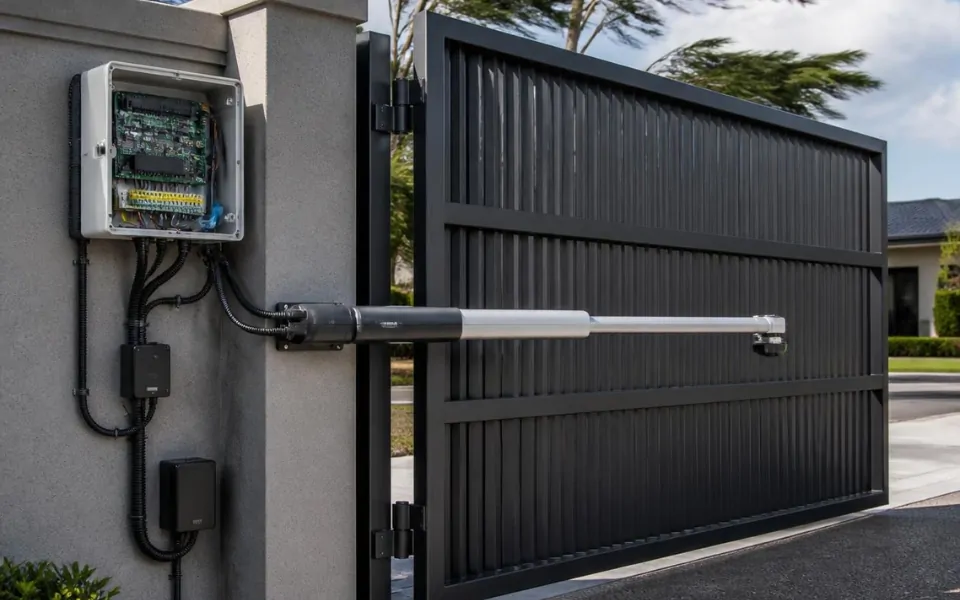
Swing gates remain one of the most popular choices for residential driveways, commercial properties, and rural entrances. They are elegant, familiar, and widely compatible with modern automation systems. However, one critical factor is often underestimated during planning and purchasing: wind load.
Wind pressure can significantly affect the performance, lifespan, and safety of any Swing Gate Automation system. Gates that operate perfectly in calm conditions may struggle, stall, or even suffer structural damage when exposed to strong winds. For buyers, installers, and property managers, understanding wind load is essential to selecting the right automation setup.
This comprehensive buyer’s guide explains how wind load impacts swing gate automation, what technical factors matter most, and how to future-proof your installation against harsh environmental conditions.
- The “Sail” Effect: Solid gate panels can catch and concentrate wind forces, creating substantial torque on the gate and operator. Open designs such as pickets or mesh can significantly reduce wind resistance.
- False Obstructions: Strong wind pressure can activate the safety anti-crush system as if an obstacle were present, causing the gate to stop or reverse unexpectedly during operation.
- Leverage Advantage: Linear (piston-style) actuators can provide better mechanical leverage in windy conditions because they are typically mounted farther from the hinge point than articulated arms.
- Mechanical Wear: Repeated wind buffeting can place continuous stress on the gate, hinges and operator, potentially accelerating gear wear and metal fatigue over time.
- The Lock Fix: An electric solenoid lock can help secure the gate in the closed position, reducing movement caused by wind and limiting unnecessary loads on the operator and its internal braking components.
- Hydraulic vs. Electric: Hydraulic operators can be well suited to demanding, high-wind applications because they can provide strong holding force and controlled movement, depending on the gate design and installation requirements.
What Is Swing Gate Automation
Swing Gate Automation refers to a motorised system that opens and closes hinged gates automatically. Unlike sliding gates, swing gates pivot inward or outward from hinge posts, typically using linear actuators or articulated arm motors.

A standard automated swing gate system includes:
- Gate leaves
- Gate hinges and posts
- Gate motors or actuators
- Control board
- Safety devices
- Access control inputs
- Power supply
While many buyers focus on gate weight, the surface area exposed to wind is often the more important performance factor.
Understanding Wind Load in Gate Systems
Wind load is the force exerted by moving air on a surface. For swing gates, the gate panel acts like a sail. When wind pushes against it, the motor must overcome both the gate’s weight and the additional wind resistance.
Wind load depends on several factors:
- Gate surface area
- Gate design (solid vs open)
- Wind speed
- Installation location
- Gate orientation
- Exposure level
Even moderate winds can dramatically increase the force required to move a gate.
Comparison: Wind Load Performance Factors
| Feature | Low Wind Resistance (Poor Performance) | High Wind Resistance (Best Performance) | Impact of Wind Load |
| Gate Infill Design | Solid / Privacy Panels (Wood, vinyl, or solid metal sheets). | Open / Porous (Pickets, mesh, wrought iron, or perforated plate). | Solid gates act as “sails,” creating massive torque that can stall motors or snap brackets. |
| Operator Type | Articulated Arm: Mounted close to the hinge; lacks leverage. | Linear Actuator (Piston): Mounted further from the hinge; superior leverage. | Articulated arms often “chatter” or shake violently in high winds, leading to gear failure. |
| Drive System | Electromechanical: Uses plastic or metal gears to hold position. | Hydraulic: Uses fluid pressure to hold the gate steady. | Hydraulic systems offer much higher “locking” force and absorb wind “buffeting” without stripping gears. |
| Safety Settings | High Sensitivity: Motor stops at the slightest resistance. | Adjustable “Force” Margins: Calibrated for environmental drag. | High sensitivity causes “ghost” reversals during gusts. High force settings improve reliability but decrease pedestrian safety. |
| Locking Method | Internal Motor Brake: Relies on the gearbox to stay shut. | Electric Solenoid / Maglock: Physically locks the gate to a post or ground. | Without a physical lock, wind can force a gate open, stripping the motor’s internal gears or “back-driving” the system. |
| Gate Geometry | Single Long Leaf: (e.g., one 16ft gate). | Dual Short Leaves: (e.g., two 8ft gates). | Wind force increases exponentially with leaf length. Shorter dual leaves experience much less leverage/torque per motor. |
| Hinge Hardware | Standard Barrel Hinges: Small surface area for welding/bolting. | Heavy-Duty Ball Bearing Hinges: Large plates with high weight/load ratings. | Wind creates lateral (side) pressure that can cause standard hinges to sag or pull out of the gate post. |
Why Wind Load Matters for Swing Gate Automation
Wind is one of the most common causes of premature failure in swing gate systems. When wind load is underestimated, the automation system may experience:
- Slow or incomplete opening
- Motor strain and overheating
- Excessive gearbox wear
- Nuisance obstacle detection trips
- Structural stress on hinges and posts
- Increased maintenance costs
Properly sizing Swing Gate Automation for wind conditions is critical for long-term reliability.

How Wind Affects Gate Movement
Increased Starting Force
Swing gates require the most torque at the start of movement. Wind pressure adds resistance at exactly the moment the motor is under maximum load.
If the motor is marginally sized, the gate may fail to start moving in windy conditions.
Continuous Resistance During Travel
Unlike weight, which remains constant, wind force fluctuates. Gusts can suddenly increase load mid-cycle, causing jerky movement or triggering safety reversals.
Closing Cycle Challenges
Closing against the wind is often the most demanding scenario. In exposed locations, the motor must work harder to achieve full closure and proper latching.
Solid vs Open Gate Designs
Gate design dramatically affects wind performance.
Solid Panel Gates
Solid gates present the highest wind resistance. They act like a wall, capturing full wind pressure across the surface.
These gates require:
- Higher torque motors
- Stronger posts and hinges
- Careful automation sizing
Slatted or Perforated Gates
Gates with gaps allow air to pass through, reducing wind load significantly.
This design improves automation performance and reduces mechanical stress. For windy areas, partially open designs are often recommended.
Decorative Bars or Tubular Gates
These offer the lowest wind resistance and are generally easier to automate reliably in exposed environments.
Key Technical Factors in Wind Load Calculations

Gate Surface Area
The larger the gate leaf, the greater the wind force. Double swing gates compound this effect because each leaf experiences independent pressure.
Wind Speed Ratings
Wind pressure increases exponentially with speed. A gate that operates fine at 20 km/h winds may struggle significantly at 60 km/h gusts.
Buyers in coastal, rural, or elevated locations must plan conservatively.
Gate Length and Leverage
Longer gate leaves create more leverage against the motor arm. Wind force applied at the outer edge creates higher torque demand at the hinge.
This is why wide gates require careful automation sizing.
Installation Exposure
Protected suburban driveways experience lower wind loads than open rural properties or coastal sites.
Factors that increase exposure include:
- Hilltops
- Coastal locations
- Wide-open rural land
- Long driveway approaches
- Industrial yards
Exposure level should always be considered when selecting Swing Gate Automation.
Motor Sizing for Wind Conditions
One of the most important buyer decisions is choosing the correct motor capacity.
Why Weight Alone Is Not Enough
Many buyers select motors based only on gate weight. However, wind load can exceed the force created by gravity alone.
In windy regions, torque requirements should be based on:
- Gate weight
- Gate width
- Surface area
- Expected wind conditions
When to Overspec the Motor
Oversizing the motor is often recommended when:
- Gates are solid panel
- Sites are exposed
- Gate leaves exceed 2.5–3 metres
- Commercial reliability is required
- Wind gusts are common
A modest overspec can dramatically improve reliability.
Properly sizing Swing Gate Automation for wind conditions is critical for long-term reliability. Before increasing motor capacity, it is also important to ensure the gate is correctly balanced and moves freely. Read our guide on how to balance a swing gate to reduce motor strain.
Linear Actuators vs Articulated Arm Motors
Motor type also affects wind performance.

Linear Actuators
Linear motors provide strong direct pushing force and are generally better suited to heavy or wind-exposed gates.
They are often preferred for:
- Solid gates
- Wide leaves
- High-wind environments
Articulated Arm Motors
These are easier to install but provide less mechanical advantage under heavy wind load.
They work best for:
- Lightweight gates
- Decorative open designs
- Sheltered residential sites
Choosing the wrong motor type is a common cause of poor Swing Gate Automation performance.
Control Board and Obstacle Detection Tuning
Modern systems include obstacle detection to improve safety. However, high wind resistance can sometimes mimic an obstruction.
If the system is poorly tuned, you may experience:
- False reversals
- Incomplete closing
- Nuisance faults
Proper force calibration and high-quality control boards help manage wind-induced resistance.
Structural Considerations Beyond the Motor
Automation performance is only as good as the gate structure itself.
Gate Posts
Wind load transfers directly into hinge posts. Undersized or poorly concreted posts can flex, causing misalignment and automation strain.
Hinges
Heavy-duty hinges with proper bearings reduce friction and improve reliability under wind pressure.
Gate Frame Rigidity
Flexible gate frames can twist under wind load, increasing motor effort and causing long-term wear.
A well-built gate is essential for successful Swing Gate Automation.
Safety Implications of Wind Load
Wind does not only affect performance — it also affects safety.
Strong gusts can:
- Accelerate gate movement unexpectedly
- Increase closing force
- Affect obstacle detection timing
- Cause latch misalignment
Proper system sizing and safety device configuration are essential to maintain compliance and user safety.
Proper system sizing and safety device configuration are essential to maintain compliance and user safety. For additional information on automated gate operator safety, see 1UL Solutions — Door, Gate and Window Access Systems. Date of access on 02/09/2026↓
Real-World Residential Scenario
Consider a coastal home with a 3-metre solid aluminium swing gate.
On calm days, a mid-range motor may perform adequately. During strong coastal winds, however, the gate may struggle to open fully or may reverse during closing.
In this case, a higher-torque Swing Gate Automation system and possibly a partially open gate design would provide better long-term reliability.
Commercial and Rural Applications
Industrial sites and rural properties often face the highest wind exposure.
For these environments:
- Heavy-duty linear actuators are recommended
- Larger safety margins should be applied
- Wind-permeable gate designs should be considered
- Posts and hinges must be robust
Commercial buyers should always plan conservatively.
Maintenance Considerations in Windy Environments
Wind-exposed gates typically require more frequent inspection.
Maintenance should include:
- Checking hinge wear
- Inspecting motor mounts
- Verifying obstacle detection settings
- Confirming full open/close limits
- Inspecting structural alignment
Preventive maintenance significantly extends system life.
UL Solutions also highlights the importance of proper installation, use and maintenance, including correctly installed safety devices such as photoelectric sensors and reversing-edge switches. 2UL Solutions — UL 325 50th Anniversary & Key Safety Issues. Date of access on 02/09/2026↓
Common Buyer Mistakes
Many buyers underestimate wind impact during planning.
Frequent mistakes include:
- Choosing motors based only on weight
- Installing solid gates in exposed areas without overspec
- Using residential-grade motors for rural sites
- Ignoring post rigidity
- Failing to tune obstacle detection properly
Avoiding these mistakes is key to reliable Swing Gate Automation.
Future-Proofing Your Installation
Weather patterns and property usage can change over time.
Future-proofing strategies include:
- Selecting slightly higher torque capacity
- Using wind-permeable gate designs
- Installing quality control boards
- Ensuring strong structural foundations
A small upfront investment often prevents costly upgrades later.
Buyer’s Checklist
Before selecting Swing Gate Automation, confirm:
- Gate width and weight
- Gate surface type (solid vs open)
- Site wind exposure
- Motor torque rating
- Post and hinge strength
- Safety device configuration
- Future usage expectations
Matching the system to real-world conditions ensures long-term success.
FAQs
Most automatic gate operators include anti-crush safety protection. During strong winds, increased resistance can be detected by the operator as a potential obstruction, causing the gate to stop or reverse as a safety response.
Use caution. Increasing the Force setting may help the gate overcome additional wind resistance, but it can also reduce the sensitivity of the obstruction-detection system. If the gate encounters a person, vehicle or other obstacle, excessive force can increase the risk of injury or damage. From practical commissioning experience, adjusting force should not be the first solution. It is better to check gate balance, hinges, operator mounting and wind loading first. See our guide on balancing a swing gate to reduce motor strain for more information.
Yes. An electric solenoid lock or suitable ground lock can help secure the gate when closed, reducing unwanted movement caused by wind and limiting unnecessary loads on the operator.
Gate length has a direct effect on the forces acting on the operator. A longer gate leaf generally presents greater wind exposure and mechanical leverage than a shorter one. On exposed sites, using two shorter leaves can sometimes provide a more manageable configuration than one very long leaf. During site assessment, gate dimensions are considered together with the panel design, wind exposure and operator position. A long solid gate can place substantially more demand on the automation system than a shorter or more open configuration.
Inspect the hinges, mounting bolts, gate alignment and limit switches for signs of movement or damage. Check that the gate still moves smoothly and lubricate the appropriate moving components according to the manufacturer’s maintenance instructions.
Final Thoughts
Wind load is one of the most overlooked yet most critical factors affecting Swing Gate Automation performance. While many systems are sized based on gate weight alone, real-world reliability depends heavily on how the gate interacts with environmental forces.
By understanding wind resistance, choosing appropriate motor capacity, and ensuring strong structural support, buyers can avoid common performance issues and extend the lifespan of their automation system. Whether for residential driveways, coastal homes, or commercial entrances, properly planned Swing Gate Automation delivers smooth, safe, and dependable access control even under challenging wind conditions.




