
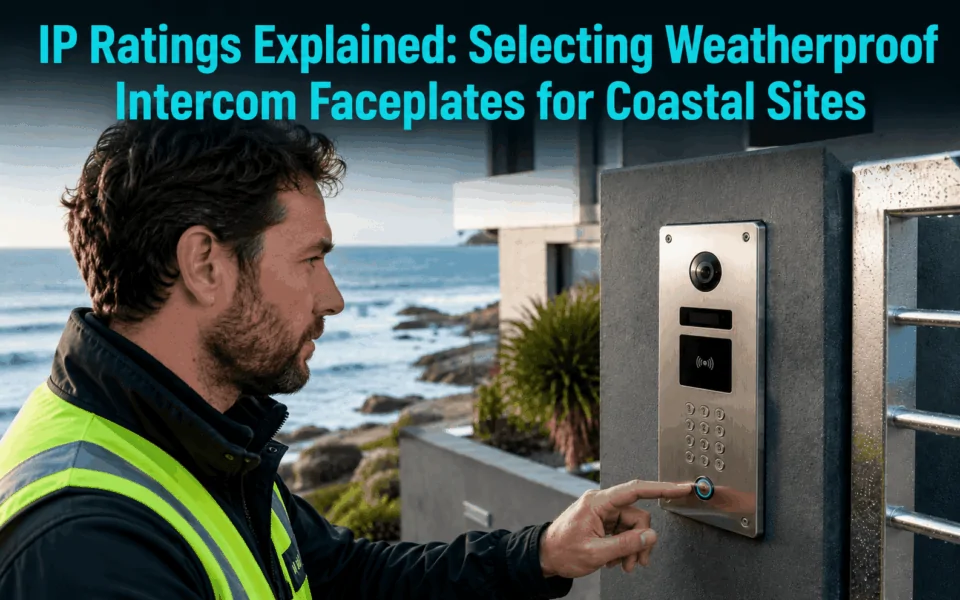
IP ratings help determine how well an intercom is protected from dust and water, but they do not measure resistance to coastal corrosion. IP65 may suit sheltered outdoor entries, while IP66 is better for more exposed locations with heavy rain and wind-driven moisture. For coastal sites, salt exposure, faceplate material, fasteners and finishes must also be considered, with corrosion-resistant materials such as 316-grade stainless steel often preferred for harsher environments.
Coastal environments present some of the most challenging operating conditions for access control equipment. Constant exposure to salt-laden air, wind-driven rain, intense UV radiation, humidity, and airborne contaminants can shorten the lifespan of poorly specified intercom systems.
One of the most important considerations is choosing appropriate weatherproof IP rated intercoms that can withstand the environmental demands. However, while IP ratings are an essential part of the specification process, they are only one piece of the puzzle. This guide explains how to evaluate weatherproof IP rated intercoms for different coastal applications, helping installers deliver long-term reliability and performance.
Why Coastal Locations Are Tough on Intercom Hardware
Coastal installations experience more severe environmental stresses than those in typical suburban environments. Even when an intercom is installed under cover, the surrounding atmosphere can accelerate wear and corrosion.
Salt particles carried by sea breezes settle on exposed surfaces and gradually attack metals, connectors, seals, and electronic components. Unlike simple rain exposure, salt contamination remains active long after surfaces appear dry.
Wind-driven rain presents another challenge. Moisture can be forced into tiny openings and vulnerable points that would otherwise remain protected during normal rainfall. UV radiation can also degrade plastics, rubber seals, and protective coatings over time, reducing their effectiveness.
Humidity and condensation create additional risks. Temperature fluctuations can cause moisture to form inside enclosures, potentially damaging circuit boards and electronic assemblies. These combined environmental factors make coastal projects particularly demanding for installers specifying access control equipment.
Certain components are especially vulnerable in coastal environments:
- Speaker grilles
- Microphone openings
- Call buttons
- Cable entry points
- Mounting hardware
- Faceplate seals
Understanding IP Ratings and What They Actually Mean
When it comes to weatherproof IP rated intercoms, the IP rating shows how well the enclosure protects against solid particles and water under defined test conditions. It does not measure corrosion resistance, UV exposure or overall coastal durability.
Each IP rating contains two digits:
- First digit – solids: A rating of 6 means the enclosure is dust-tight, helping protect against sand, dust and coastal grit.
- Second digit – water:
- IP65: Protected against low-pressure water jets and suitable for rain and moderate wind-driven moisture.
- IP66: Protected against more powerful water jets, making it better suited to exposed locations with heavy rain and severe weather.
For coastal installations, the IP rating should be considered alongside faceplate materials, corrosion resistance, sealing and the intercom’s actual exposure to salt spray.
Common Intercom IP Ratings Explained
Several IP ratings are commonly found on outdoor intercom systems, including:
| Rating | Dust protection | Water protection | Typical relevance |
|---|---|---|---|
| IP54 | Limited dust ingress | Splashing water | Protected/semi-covered locations |
| IP55 | Dust protected | Water jets | Moderately exposed outdoor areas |
| IP65 | Dust-tight | Water jets | Common outdoor intercom level |
| IP66 | Dust-tight | Powerful water jets | More exposed façades/gate posts |
| IP67 | Dust-tight | Temporary immersion | Special exposure conditions |
For most coastal projects, installers typically select weatherproof IP rated intercoms with ratings between IP65 and IP67, depending on the level of environmental exposure. Additionally, the exact wording should track IEC terminology rather than inventing labels like “fully waterproof.” IEC itself cautions that IP codes describe defined enclosure test conditions rather than an unlimited guarantee of waterproofness.(1 The IEC has developed the ingress protection (IP) ratings.Date of access on 24/08/2026↓).
Read more: IP-Based Intercom Systems: A Comprehensive Guide (2026 Updated)

Why Higher Isn’t Always Better
A common misconception is that the highest available IP rating automatically provides the best solution. In reality, installation conditions, mounting position and product design often matter just as much.
An intercom installed beneath a deep canopy may have far less exposure than a unit mounted on an open gate post facing prevailing coastal winds. For this reason, the required protection level should be based on the actual site rather than simply choosing the highest number available.
From DHS’s experience with intercom, access control and gate & door solution projects, the installation environment often determines whether a product performs reliably over time. We regularly assess factors such as direct rain exposure, wind-driven moisture, mounting surface, cable entry points and whether water can collect behind the unit before recommending a suitable intercom.
Maintenance also remains important regardless of IP rating. Salt accumulation, damaged seals and ageing components can gradually reduce protection.
Mechanical durability should be considered as well. A highly rated enclosure may still be vulnerable to impact, vandalism or corrosion if unsuitable materials, fixings or finishes are used. This is why DHS looks at the complete installation, not just the IP number on the datasheet, when helping specify intercom equipment for coastal sites.
Coastal Site Selection Criteria for Weatherproof Intercom Faceplates
Selecting weatherproof IP rated intercoms for coastal sites involves more than choosing an appropriate IP rating. Faceplate material, sealing and drainage also affect how well an intercom performs when exposed to salt air, rain, UV and moisture.
Corrosion Resistance of the Faceplate and Hardware
An IP rating measures resistance to dust and water ingress, not salt corrosion. For highly exposed coastal and marine locations, 316-grade stainless steel faceplates and corrosion-resistant fixings may provide better long-term durability than standard metals.
The complete assembly should still be assessed, including trims, screws, brackets and finishes, as these components can deteriorate even when the enclosure has a high IP rating.
Weather-Resistant Gaskets and Seals
The intercom’s seals are essential for maintaining its weather protection. Gaskets should be suitable for prolonged outdoor exposure, particularly where strong UV, heat and salt-laden air may gradually affect sealing materials.
Always follow the manufacturer’s specified sealing system rather than assuming additional sealant will improve the product’s IP performance.
Drainage Behind the Intercom Faceplate
Good drainage is particularly important for flush-mounted and recessed intercoms. The backbox and mounting arrangement should allow condensation or incidental moisture to escape rather than collect behind the faceplate.
Preventing trapped moisture helps protect terminals, cabling and internal electronics and supports the long-term performance of the intercom in coastal conditions.

Choosing an Intercom by Coastal Exposure Level
Not every coastal property has the same exposure conditions. The required level of protection depends on where the intercom is installed, how sheltered it is and whether it is exposed to rain, wind, salt spray, dust or physical impact. Distance from the coast alone does not determine the required IP rating.
Sheltered Apartment Entries Near the Coast
An apartment building may be close to the ocean while its intercom is recessed under an awning, inside a lobby entrance or otherwise protected from direct weather.
In these locations, the actual exposure to rain and spray may be relatively low. The IP rating should therefore be selected according to the installation position and environmental exposure rather than postcode or distance from the shoreline alone.
Related: Intercom Gate Door Release Workflows For Apartment Entry
Exposed Residential Gate Intercoms
Gate-mounted intercoms are often more exposed than building-mounted stations. Depending on the site, they may regularly encounter:
- direct rain;
- wind-driven moisture;
- airborne salt or spray; and
- dust and debris.
These conditions may justify a higher level of ingress protection, together with careful attention to sealing, mounting and corrosion-resistant materials.
Waterfront and Marina Sites
Marinas and waterfront facilities generally represent a more aggressive environment because equipment may be exposed to frequent salt-laden air, moisture and direct weather.
Here, ingress protection and corrosion resistance should be assessed separately. A high IP rating can help prevent water and dust entering the enclosure, but the faceplate, fasteners, coatings and other exposed components also need to be suitable for the corrosive environment.
Commercial Coastal Sites
Commercial coastal installations may need to withstand more than weather alone. Intercoms at offices, retail sites, apartment developments and industrial properties can also experience:
- frequent daily use;
- public exposure;
- accidental or deliberate impact; and
- regular servicing requirements.
For these sites, the most suitable specification may need to consider IP rating, corrosion resistance, IK impact rating, installation accessibility and long-term serviceability together rather than selecting the product based on one rating alone.

Why an IP Rating Does Not Tell You About Salt Corrosion
A high IP rating does not automatically mean an intercom is suitable for a harsh coastal environment. IEC 60529 focuses on ingress protection against solids and water, while corrosion from salt-laden air is a separate issue.
Coastal environments can expose intercom hardware to airborne salt, moisture and repeated wet-dry cycles. As a result, a unit may have a strong IP rating while its external fasteners, trims, coatings or faceplate finish still deteriorate over time.
ISO 9223 addresses atmospheric corrosivity separately, using environmental conditions to classify how aggressive an atmosphere may be toward metals.(2 ISO 9223:2012 – Corrosion of metals and alloys.Date of access on 24/08/2026↓).
For coastal intercom projects, this means installers should assess both ingress protection and corrosion resistance. Faceplate material, fastener grade, protective coatings, mounting location and exposure to direct salt spray can be just as important as the IP rating itself.
Materials and Finishes That Matter in Coastal Intercom Installations
IP protection is only one part of coastal durability. The materials, finishes and smaller hardware components used around the intercom can also influence how well the system withstands salt-laden air, moisture and long-term exposure.
Stainless Steel Faceplates
Stainless steel is a common choice for exposed intercom faceplates because it offers good corrosion resistance and a durable appearance. However, it should not be treated as corrosion-proof.
Performance can vary depending on:
- the stainless steel alloy grade;
- the surface finish;
- the level of chloride and salt exposure;
- contamination from other metals or site conditions; and
- cleaning and maintenance.
For highly exposed coastal sites, material grade and finish should therefore be checked rather than relying on the term “stainless steel” alone.
Coated or Powder-Coated Metal
Powder-coated and other coated metal faceplates can provide effective protection when the coating system is appropriate for the environment.
Long-term performance depends on factors such as coating quality, surface preparation and installation. Scratches, damaged edges or exposed cut surfaces can create weak points where corrosion may begin, particularly in aggressive marine conditions.
Plastics and Polymer Housings
Plastic and polymer housings avoid some of the corrosion mechanisms associated with exposed metal components, making them useful for certain coastal installations.
However, they still need to be assessed for UV stability, impact resistance, colour degradation and sealing performance. A housing that resists corrosion may still deteriorate if it is not designed for prolonged outdoor exposure.
Fasteners and Small Components
Small components are easy to overlook when specifying a coastal intercom system. Even where the main faceplate is highly corrosion resistant, deterioration can begin around:
- screws and fixings;
- mounting brackets;
- springs;
- terminals; and
- other exposed hardware.
These components should be selected with the same environmental conditions in mind as the intercom itself. In coastal installations, the durability of the complete assembly matters more than the faceplate material alone.

IP Rating vs IK Rating: Weather Protection Is Only Half the Story
For outdoor intercoms, weather resistance is important, but physical durability can matter as well. IP and IK ratings measure different types of protection:
- IP rating: Protection against solids such as dust and against water ingress.
- IK rating: Resistance to mechanical impact.
Manufacturers often specify both separately. For example, some outdoor intercoms are rated IP66 and IK08, indicating strong weather protection alongside a defined level of impact resistance.(3 AXIS I8307-VE Network Video Intercom.Date of access on 24/08/2026↓).
IK rating can be particularly relevant for intercoms installed at public apartment entrances, exposed gate posts, commercial properties and locations where accidental damage or vandalism is more likely.
For these applications, selecting an intercom based on IP rating alone may overlook an important part of the installation environment.
Installation Practices That Preserve Weather Resistance
The weather performance of an intercom depends on more than the rating printed on the product. The installed system, not simply the product in its box, determines how well it performs in real coastal conditions. Mounting, cable routing, sealing and external connections can all affect resistance to water ingress.
Use the Manufacturer-Specified Mounting Method
Flush, surface, pole and recessed mounting arrangements may require different brackets, back boxes, seals or accessories. Manufacturers often provide separate mounting solutions because each installation method creates different exposure and drainage conditions.
Using the specified mounting hardware helps preserve the weather protection achieved during product testing.
Seal Cable Entries Correctly
A weather-rated faceplate provides limited protection if water can enter through an incorrectly sealed cable penetration. Cable glands, conduit entries and rear penetrations should be installed according to the manufacturer’s instructions and suited to the environmental conditions.
Prevent Water Tracking Down the Cable
Cable routing should prevent rainwater or condensation from travelling along the cable and into the enclosure. Where appropriate, cables should be routed to encourage water to drain away from the unit rather than toward cable entries and terminals.
Avoid Creating Water Traps Behind the Intercom
This is particularly important for recessed installations. Poorly designed cavities or mounting surfaces can allow water to collect behind the intercom, increasing the risk of moisture reaching seals, cables or connections. The installation should allow appropriate drainage and avoid unnecessary areas where water can accumulate.
Protect Terminations and Junction Points
Moisture problems do not always begin at the faceplate. External junction boxes, connectors, terminals and cable transitions can also become points of water entry or corrosion. These components should be appropriately protected and positioned for the site’s exposure conditions.
Follow Manufacturer Installation Requirements
Installers should avoid assuming that adding more sealant automatically improves weather resistance. Extra or incorrectly applied sealant can interfere with gaskets, drainage paths, ventilation or future servicing and may alter the manufacturer’s tested installation configuration.
For coastal intercom installations, the best approach is to follow the specified mounting, sealing and drainage requirements rather than relying on additional sealant as a substitute for correct installation.
For projects where exposure conditions or mounting requirements are more complex, Digital Home Systems (DHS) can assist with intercom product selection, system design, mounting requirements and integration with access control, automatic gates and doors. DHS works with installers and project teams to assess the complete installation, including location, cabling, mounting and environmental exposure.

How to Maintain Outdoor Intercoms in Salt-Exposed Environments
Coastal intercom systems should be included in a scheduled preventive maintenance program rather than inspected only after faults occur. Even premium weatherproof IP rated intercoms require regular maintenance in coastal environments. Salt accumulation and environmental exposure gradually affect all equipment.
Salt carried by coastal winds can gradually accumulate on exposed intercom surfaces, accelerating corrosion and degrading protective coatings. Even weatherproof equipment will experience increased wear when exposed to constant humidity, airborne salt particles, and seasonal storms.
A structured maintenance program helps identify small issues before they develop into costly equipment failures. Regular cleaning removes salt deposits that can attack exposed metals and compromise seals, while routine inspections allow installers to detect early signs of moisture ingress or component deterioration.
Key inspection areas include:
- Faceplate condition and protective coatings
- Gasket and seal integrity
- Fastener corrosion
- Speaker and microphone openings
- Audio and call button performance
Finally, discolouration, rust staining, intermittent audio performance, and visible deterioration around cable entry points often indicate that environmental protection is beginning to fail. Addressing these warning signs early can significantly extend the service life of weatherproof IP rated intercoms installed in coastal locations.
Specifier Checklist for Coastal Intercoms
Choosing weatherproof IP rated intercoms for coastal sites requires more than checking a single number on a datasheet. Before specifying a product, assess the actual installation environment, mounting method and long-term maintenance requirements.
- Exposure to direct rain: Determine whether the intercom is fully exposed, partially sheltered or installed under an awning or recess.
- Wind-driven spray: Consider whether strong winds can drive rain or salt spray directly onto the faceplate and cable-entry points.
- Salt-air exposure: Assess how frequently the unit may be exposed to salt-laden air, particularly at beachfront, waterfront and marina locations.
- Required IP rating: Select an IP rating appropriate for the expected dust and water exposure rather than automatically choosing the highest available rating.
- Material and surface finish: Check the faceplate material, coating, finish and corrosion suitability, including exposed trims and fasteners.
- IK rating where impact is a risk: For public entrances, gate posts and commercial sites, consider impact resistance where accidental damage or vandalism is possible.
- Flush vs surface mounting: Confirm that the mounting method is suitable for the location and whether dedicated back boxes, brackets or seals are required.
- Cable entry method: Plan cable glands, conduit entries and penetrations to minimise opportunities for water ingress.
- Operating temperature: Check that the manufacturer’s specified operating temperature range suits the site conditions.
- Existing wall or post material: Consider how the intercom will interface with masonry, metal posts, rendered walls or other substrates.
- Maintenance access: Make sure the unit can be inspected, cleaned and serviced without unnecessarily disturbing weather seals.
- Manufacturer environmental requirements: Check the manufacturer’s installation instructions, approved mounting accessories, sealing methods and any limitations for coastal or exposed locations.
Using this checklist helps specifiers assess the complete installation, rather than relying on IP rating alone.
Learn more: Apartment & Strata Solutions With 2-Wire Intercoms

Using this checklist helps specifiers assess the complete installation, rather than relying on IP rating alone.
If you are planning an intercom system for a coastal residential, apartment, commercial or access-control project, Digital Home Systems (DHS) can help with product selection, system design, intercom integration and installer support. Explore DHS’s range of intercom and access control solutions, or contact the team for assistance selecting equipment suited to your site’s exposure, mounting requirements and operating environment.
FAQs
IP65 can be suitable for many coastal installations, particularly when the intercom is mounted under some form of shelter. However, highly exposed locations such as open gate posts and beachfront sites may benefit from IP66 or IP67 protection.
IP66 protects against powerful water jets, while IP67 adds protection against temporary immersion in water. Both offer excellent weather resistance, but IP67 provides an additional level of moisture protection.
No material is entirely immune to corrosion. However, marine-grade stainless steel offers significantly better resistance than standard steel and remains one of the best choices for coastal environments.
Yes. Damaged seals, improper installation, ageing components, or modifications can compromise the original level of protection and reduce weather resistance over time.
Quarterly inspections are generally recommended for coastal installations, although highly exposed sites may benefit from more frequent maintenance checks.




