
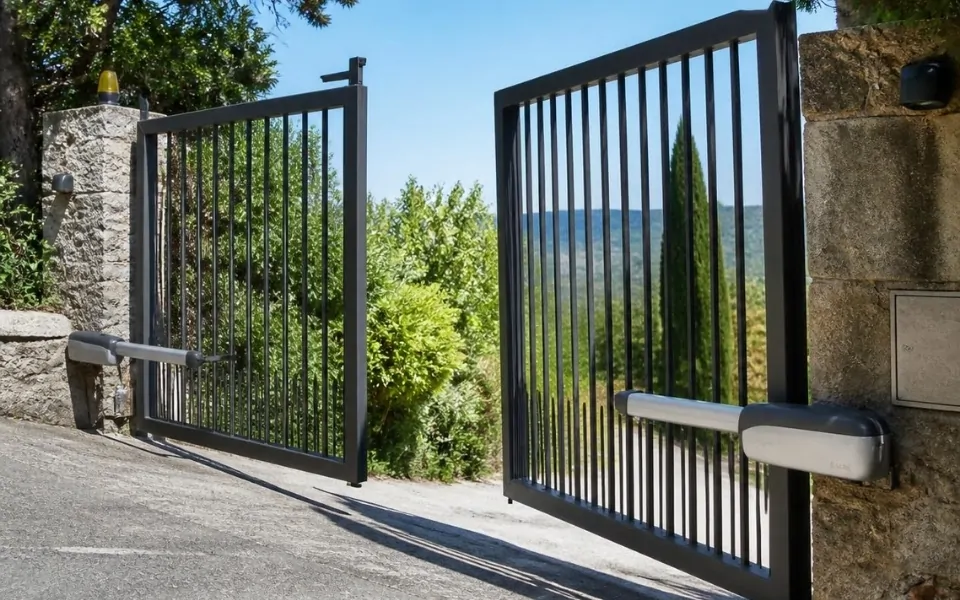
Automated gates are a proven way to enhance property security, convenience, and property value. However, not every site offers ideal installation conditions. Sloped driveways, uneven paving, rising ground, and irregular post alignment can all complicate what might otherwise be a straightforward project. In these situations, selecting and configuring the right swing gate automation system becomes especially important.
Unlike sliding gates, swing gates travel in an arc. That arc must clear the ground surface throughout the entire opening and closing cycle. When the terrain is uneven, the gate may scrape the surface, bind under load, or place excessive strain on the operator if the installation is not carefully engineered. Many premature failures in automated gates can be traced back to poor planning for ground conditions.
The good news is that most uneven sites can be successfully automated with the right approach. This comprehensive guide explains how swing gate automation performs on uneven ground, what design factors matter most, how to choose the right equipment, and what best practices ensure long-term reliable operation
- Hands-Free “Drive-Up” Entry: Uses UWB (Ultra-Wideband) or AI License Plate Recognition to identify an approaching vehicle and automatically open the gate, removing the need to use traditional visor-mounted remotes.
- Universal Standards (Matter): Modern gate controllers can support the Matter protocol, enabling compatible gates to work alongside smart lights, locks and other devices through Apple Home, Google Home or Alexa without requiring additional hubs.
- Aliro Digital Keys: Support for the Aliro standard can enable temporary Digital Keys to be shared with guests through compatible smartphone wallets, providing convenient one-time access to the driveway.
- Solar-First Engineering: High-efficiency Brushless DC motors can reduce power consumption and make solar-powered gate automation more practical, with battery storage providing additional operating capacity during periods of limited sunlight.
- “Virtual” Safety Curtains: Traditional physical driveway loops can be supplemented or replaced in some applications by LiDAR and Radar sensors, creating a detection zone around the gate to help prevent contact with vehicles, pets or pedestrians.
- Hidden Automation: Modern designs increasingly use tubular motors installed within gate posts or underground operators, keeping the automation hardware discreet while maintaining the property’s overall visual appearance.
- AI Perimeter Security: Integrated cameras with AI-based detection can classify different types of activity, such as delivery vehicles, familiar visitors or potential intruders, and send more specific security alerts to the homeowner.
What Is Swing Gate Automation?
Swing gate automation refers to the motorised operation of a hinged gate leaf. Instead of manually pushing the gate open, an electric operator drives the gate through its swing arc when triggered by a remote control, keypad, intercom, or smart access system.
Swing gates typically open inward toward the property for safety and compliance reasons, although outward-opening designs are sometimes used where permitted. The automation system converts electrical energy into controlled mechanical motion, allowing the gate to move smoothly and consistently.
A standard swing gate automation setup includes the gate operator (either linear or articulated), a control board, safety devices such as photocells, limit controls, and the mechanical gate structure itself. While the concept is simple, the geometry becomes more complex when the ground is not level.

Before selecting an operator, it is also important to understand how the gate’s hinges, structure and mounting points affect automation performance. See our guide to installation tips for swing gate automation.
Swing Gate Automation Comparison
| Feature | Linear Actuator (The Standard) | Underground Operator (The Invisible) | Articulated Arm (The Versatile) |
|---|---|---|---|
| Best For | Standard residential gates with narrow pillars | Luxury homes where aesthetics are the top priority | Heavy gates or very thick stone/brick pillars |
| Visual Impact | Visible: Modern, slim metal arm attached to the gate | Invisible: Motor is buried in a protective box under the hinge | Visible: Uses a “folding elbow” arm with a more industrial appearance |
| 2026 Tech Tier | Mid-to-High: Usually features Matter-over-Thread & UWB | Premium: Includes AI LPR (License Plate Recognition) & LiDAR | High: Heavy-duty brushless motors for high-traffic use |
| Max Gate Width | Up to 5m (16ft) per leaf | Up to 4m (13ft) per leaf | Up to 6m (20ft) per leaf |
| Installation | Easiest: Bolts directly to pillar and gate; no digging required | Complex: Requires excavation and drainage for the motor box | Moderate: Requires space on the pillar for the wider motor base |
| Reliability | High; easy to access for maintenance | High, but drainage problems can affect underground equipment | Exceptional; handles wind-loading better than others |
| Safety Sensors | Wireless safety edges & photo-eyes | Integrated LiDAR “virtual safety curtain” | Dual-sensing inherent obstacle detection |
| Power Source | AC with battery backup or solar-ready | Primarily AC with high-capacity battery backup | High-efficiency Brushless DC; solar-preferred |
| Relative Cost | $ — Affordable / Mid-Range | $$$ — High-End / Premium | $$ — Mid-to-High |
Why Is Uneven Ground a Major Challenge?
Understanding Swing Geometry and Clearance
To successfully automate a gate on uneven ground, it is critical to understand how the gate moves through space. The bottom edge of a swing gate follows a circular arc centered on the hinge axis. Any rise in ground level within that arc reduces available clearance.
Several measurements are especially important. These include the hinge height relative to the ground, the length of the gate leaf, the slope angle of the driveway, and the desired opening angle. Even small errors in these measurements can result in the gate contacting the ground during operation.
Professional installers often perform a manual swing test before automation. By physically moving the gate through its full arc, they can identify potential interference points early in the process. This step is one of the most effective ways to avoid costly rework later.

Common Types of Uneven Ground Conditions
Not all uneven sites behave the same way. The specific slope profile determines which solutions will work best.
One of the most common scenarios is an upward-sloping driveway inside the property. As the gate opens inward, the bottom edge moves closer to the rising surface. This often limits the achievable opening angle and increases motor load.
Downward slopes are generally less problematic, but they can create large gaps under the gate when closed, which may affect security or aesthetics. Side slopes, or crossfall conditions, introduce uneven loading on the hinges and can cause the gate to twist slightly during movement.
Some properties also have surfaces that shift over time, such as gravel drives or poorly compacted paving. These sites require additional clearance margin because conditions may change after installation.
Understanding which type of uneven ground is present is the first step toward selecting the correct swing gate automation strategy.
How to Choose the Right Operator for Uneven Sites?
Operator selection has a major impact on performance in challenging environments. While many installations use linear ram operators due to their clean appearance and strong pushing force, these units are less forgiving when geometry is tight.
Linear operators work best when hinge positions and clearances closely match the manufacturer’s recommended mounting dimensions. On uneven ground, where the gate path may already be compromised, linear systems can sometimes struggle.
Articulated arm operators are often a better choice for difficult sites. Because they use a jointed arm rather than a straight push rod, they can accommodate more variation in mounting geometry and are generally more tolerant of uneven movement. Although they are slightly more visible and sometimes more expensive, their flexibility can make them the safer option when ground conditions are less than ideal.
Selecting the correct operator early can prevent many performance issues later.

Managing Ground Clearance Effectively
Maintaining adequate clearance between the gate and the ground is the central challenge of swing gate automation on uneven terrain. There are several proven strategies to address this.
The simplest approach is to increase the bottom gap of the gate. While effective, this can create security concerns and may not meet aesthetic expectations. A large visible gap under the gate is often undesirable in residential settings.
Another common solution is the use of rising hinges. These specialised hinges lift the gate slightly as it opens, helping the bottom edge clear a sloped driveway. Rising hinges allow the gate to maintain a lower closed position while still achieving adequate clearance during opening. However, they must be carefully aligned and may slightly alter the automation geometry.
In some cases, installers may adjust the vertical position of the gate on the posts to gain additional clearance. Each of these methods must be evaluated against the specific site conditions and client requirements.
Proper hinge positioning is also essential when modifying clearance. For more guidance, see our article on top and bottom hinge installation for swing gate automation.
Opening Angle Limitations on Sloped Driveways
Uneven ground often reduces the maximum opening angle that a swing gate can achieve. As the gate swings uphill, the bottom edge moves closer to the surface. Beyond a certain point, the gate will contact the ground unless clearance has been engineered into the design.
This limitation can affect vehicle access if the required clear opening width is not achieved. Installers must therefore calculate the achievable opening angle early in the design phase.
Possible solutions include slightly raising the gate, limiting the programmed opening angle, using rising hinges, or in some cases regrading the driveway surface. Each option involves trade-offs between cost, appearance, and performance.
Careful measurement and planning are essential to avoid surprises during commissioning.

Motor Power and Load Considerations
Uneven ground typically increases the mechanical load on the automation system. When a gate swings uphill, the operator must work against gravity in addition to normal hinge friction and wind resistance.
For this reason, it is important to select a swing gate automation system with sufficient torque margin. Undersized motors are a common cause of slow operation, nuisance safety reversals, and premature gearbox wear on sloped installations.
Modern operators with soft start, soft stop, and encoder-based force control perform much better in these conditions. They can manage load changes more smoothly and provide more reliable obstacle detection.
When in doubt, choosing a slightly higher-capacity operator often improves long-term reliability.
Safety Considerations on Uneven Ground
Safety planning becomes even more critical when the gate path is irregular. Uneven terrain can create unusual pinch points or areas where the gate moves closer to fixed objects.
Photocells should be positioned to protect the full closing path, and additional safety devices may be required on wide or high-risk entrances. Force limitation and automatic reversal features must be properly configured and tested under real operating conditions.
Installers should pay particular attention to areas where the gate passes close to the ground or adjacent structures. These zones may require extra safeguards to ensure compliance with safety expectations.
Photoelectric sensors and other external safety devices can provide additional protection against entrapment and obstruction during gate operation. 1UL Solutions — UL 325 External Entrapment Protection Devices. Date of access on 02/09/2026↓

Best Practices for Installation
Successful swing gate automation on uneven ground begins with a thorough site survey. Accurate measurements of slope, post spacing, gate dimensions, and required opening angle should be taken before equipment is selected.
Mechanical preparation is equally important. The gate must swing freely by hand through its full arc without binding. Hinges should be heavy-duty, perfectly aligned, and securely mounted.
Operator brackets must be installed according to the manufacturer’s geometry charts. Even small deviations can affect performance. After installation, the control board should be configured with appropriate soft start, soft stop, and force settings.
Finally, the system must be fully tested under real conditions, including multiple open and close cycles and safety device verification.
Proper installation, commissioning and testing are essential to ensure that the gate operator and its safety devices function correctly under real operating conditions. 2UL Solutions — UL 325 Key Safety Issues and Installation Guidance. Date of access on 02/09/2026↓
Common Mistakes to Avoid
Many uneven-ground problems are preventable. One of the most common mistakes is installing automation without first performing a full manual swing test. This often leads to unexpected ground interference.
Choosing the wrong operator type is another frequent issue. Linear arms are sometimes used in situations where articulated operators would perform better.
Underestimating the required motor capacity can lead to long-term reliability problems, especially on uphill openings. Poor photocell placement and ignoring potential ground movement are also common oversights.
Avoiding these mistakes significantly improves the success rate of swing gate automation projects.
Maintenance for Long-Term Reliability
Gates installed on uneven ground typically require closer monitoring than those on flat sites. Monthly visual checks should confirm that the gate clears the ground properly and that no new scraping or strain is evident.
Quarterly maintenance should include hinge lubrication, inspection of operator mounts, and verification of safety settings. Over time, ground surfaces can shift, and early detection helps prevent major issues.
An annual professional service is recommended to check force levels, structural alignment, and overall system performance. With proper maintenance, swing gate automation can remain reliable even in challenging environments.
When to Consider Alternatives
In some situations, the terrain may be too extreme for a practical swing solution. Very steep driveways, extremely wide gates, or severely uneven surfaces may make sliding gate automation a better long-term choice.
However, many sites that initially appear challenging can still be successfully automated with swing gates when proper engineering techniques are applied. A professional assessment should always be performed before changing gate type.
Future Trends in Swing Gate Automation
Technology continues to improve the performance of swing gates on difficult sites. Brushless motors are delivering smoother torque control, while smart force learning systems automatically adjust for changing loads.
Advanced encoders are improving obstacle detection accuracy, and connected controllers are beginning to provide diagnostic feedback that can alert installers to developing mechanical issues.
As these innovations mature, swing gate automation will become even more adaptable to uneven terrain conditions.
FAQs
Yes, compatible gate automation systems can integrate with Apple Home, Google Home, or Alexa. Support depends on the specific controller, smart-home platform and connectivity standards available on the system. In practice, one of the first checks is to move the gate manually through its full opening and closing arc. This simple test can reveal where the bottom edge may contact the driveway before the automation equipment is installed.
Aliro is an emerging standard designed to support interoperable digital keys for access-control applications. With compatible hardware and smartphone platforms, it can allow users to share digital credentials with guests without relying entirely on a proprietary access app.
Modern gate systems can support different delivery-access methods, including temporary access codes, remote unlocking and integrated delivery services. Some advanced systems may also use vehicle or license-plate recognition to identify authorised deliveries during a specified access period.
Solar-powered gate automation can be practical when the system is correctly sized for the gate weight, operating frequency, motor efficiency, solar exposure and battery capacity. High-efficiency Brushless DC motors can help reduce energy consumption, while battery storage provides additional capacity when sunlight is limited.
A suitable gate automation system can continue operating during a power outage when equipped with battery backup. The actual number of operating cycles depends on the motor, gate size, battery capacity, weather conditions and frequency of use. A manual release mechanism should also be available so the gate can be operated manually if electrical power is unavailable.
Conclusion
Installing swing gate automation on uneven ground requires careful planning, correct equipment selection, and precise installation. While sloped or irregular sites introduce additional complexity, most challenges can be successfully managed with proper engineering.
By understanding gate geometry, ensuring adequate clearance, selecting the right operator type, and performing thorough testing, installers and property owners can achieve smooth, reliable gate performance even in difficult conditions.
When designed and maintained correctly, swing gate automation on uneven ground can deliver the same security, convenience, and longevity expected from installations on perfectly level sites.




