
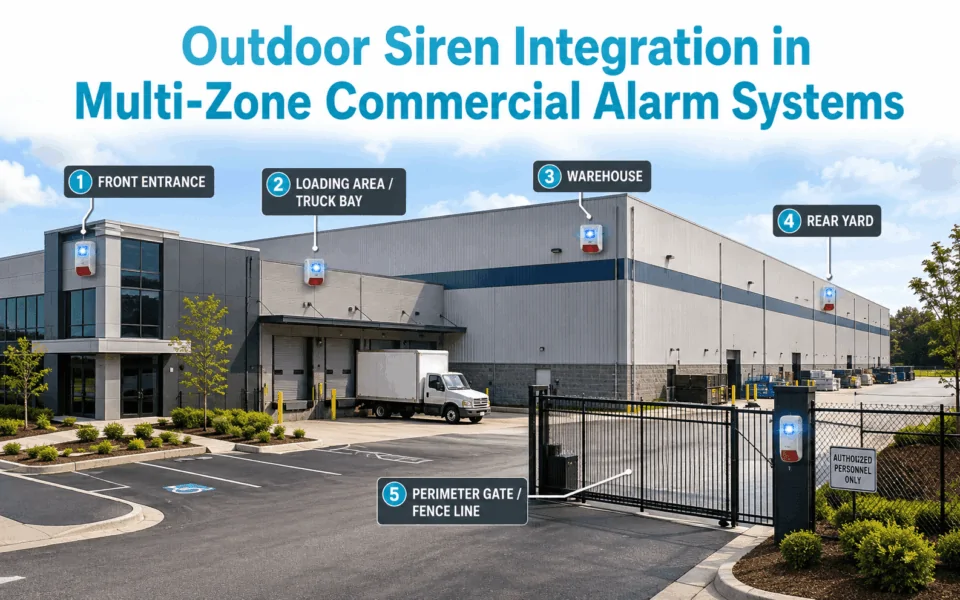
Outdoor siren integration in multi-zone commercial alarm systems works best when zone logic, siren outputs, placement, power, tamper protection and commissioning are designed together. Different zones can trigger local sirens, grouped sirens, strobes or monitoring-only responses depending on the event. Reliable performance also depends on suitable acoustic output, weather-resistant hardware, supervised circuits and backup power. Careful commissioning then confirms that every zone-to-siren pathway behaves correctly before the system is handed over.
In modern commercial security design, the multi-zone siren plays a strategic role. It’s not just about making noise when something goes wrong, but also about delivering zone-specific alerts that align with your broader security logic.
A multi-zone siren is an audible alert device, either indoor or outdoor, configured to respond to specific alarm zones within a commercial system. Instead of triggering every on-site siren for any event, zoning allows integrators to match alerts to the exact area of intrusion. Let’s see how this integration makes all the difference.
Where Outdoor Sirens Fit Into a Multi-Zone Alarm Workflow
In a multi-zone commercial alarm system, outdoor sirens sit after the detection and control stages of the alarm workflow. They act as output devices that respond to instructions from the alarm panel rather than interpreting individual detectors themselves.
A simplified architecture looks like this:
Detector / zone → alarm panel → programmed alarm logic → siren output → selected outdoor siren(s)
For example, a motion detector, door contact or perimeter sensor first reports an event to the alarm panel. The panel then identifies the relevant zone, checks the programmed alarm rules and decides what response should occur. If the event meets the programmed conditions for an external warning, the panel activates the appropriate siren output.
The siren normally responds to the alarm logic generated by the panel; it does not independently decide which physical zone has been breached.
This distinction is important when designing outdoor siren integration in multi-zone commercial alarm systems. The intelligence is primarily located in the control panel and its programmed logic. The sirens perform the response assigned to them.
Read more: Integrating Outdoor Sirens with Access Control & Intrusion Detection
How Can Different Zones Trigger Different Siren Responses?
The panel can be configured so different zones, event types and alarm priorities produce different external responses. Depending on the site design, an alarm event may trigger:
- One local outdoor siren near the affected zone;
- A selected group of sirens serving one building or perimeter area;
- All outdoor sirens across the site for a major security event;
- A siren and LED strobe together where both audible and visual signalling are required; or
- Remote monitoring without outdoor siren activation for events that require verification or a quieter response.
For instance, a rear loading-yard intrusion could activate only the sirens covering that area, while a confirmed after-hours perimeter breach might activate several external sirens and send an alarm to the monitoring centre.
The effectiveness of the system therefore depends on how zones, alarm priorities and outputs are programmed together. Once this workflow is established, integrators can move on to the practical considerations of power, connectivity, zone mapping, placement, supervision and siren hardware.

How Zone Mapping and Siren Routing Work in a Multi-Zone Commercial Alarm System
Effective outdoor siren integration in multi-zone commercial alarm systems depends on more than assigning detectors to individual zones. Integrators also need to decide which alarm outputs should respond to each zone, how loud the response should be, and whether the event requires an external siren at all. Well-planned routing logic helps a site respond proportionately to different incidents while reducing unnecessary noise and making alarm events easier to identify.
Map Perimeter Zones to the Correct Outdoor Sirens
Exterior security zones should be linked to sirens that cover the relevant part of the property. For example, yard boundaries, rear gates, loading areas and delivery doors can be assigned to specific outdoor siren outputs, allowing an intrusion in one area to trigger the nearest warning device.
This approach is particularly useful across warehouses, industrial sites and multi-building facilities where activating every siren for a single localised event may be unnecessary. Interior office or warehouse zones can instead remain linked to internal sounders, monitoring notifications or other response devices.
Use Selective Activation for Lower-Priority Events
Not every zone activation should immediately trigger a high-output outdoor siren. Delayed entry points, minor access events or preliminary alarm conditions can be programmed to generate keypad chimes, internal warnings or pre-alarm notifications first.
Selective activation allows the control panel to escalate the response only when predefined conditions are met. This can reduce nuisance activations while still ensuring serious perimeter breaches receive an immediate external warning.
Route Different Alarm Types to Different Outputs
Multi-zone systems should also distinguish between intrusion, fire, medical and other emergency events rather than applying one universal siren response.
Using programmable output logic such as Follow-1, Follow-2 or equivalent panel functions, integrators can associate particular zones or event types with different siren behaviours. Depending on the equipment used, this may include separate outputs, intermittent tones or different strobe patterns.
Clear zone-to-output mapping makes the alarm response more meaningful, helping occupants, security personnel and monitoring teams understand what type of event has occurred and where attention is required.

What Hardware and Acoustic Factors Matter for Outdoor Sirens in Commercial Alarm Zones
For reliable outdoor siren integration in multi-zone commercial alarm systems, the siren hardware must suit both the acoustic conditions of the site and the environmental exposure at each alarm zone. A siren that performs well in a quiet office complex may be inadequate around warehouses, loading docks, workshops or plant areas where machinery, traffic and building structures can reduce how effectively an alarm is heard.
Select Sufficient Decibel Output for the Site
Commercial and industrial environments often require high-output outdoor sirens, commonly around 115 dB, so alarm signals remain noticeable above normal operational noise.
However, output level should not be considered in isolation. Integrators should assess background noise, building layout, distance between sirens and occupied areas, and physical obstructions such as concrete walls, storage racks or plant equipment.
On larger sites, multiple strategically positioned sirens may provide better coverage than relying on one extremely loud unit to serve the entire property.
Combine Audible Sirens With Visual Strobes
In high-noise environments, audible alerts can be partially masked by machinery, vehicles or hearing protection. Pairing the siren with a high-visibility LED strobe provides a second method of alarm notification.
Visual indicators can also support nighttime identification by helping security staff quickly see which building, perimeter zone or loading area has generated the alarm.
Where the system supports programmable outputs, strobes can be assigned alongside specific siren responses as part of the overall zone-routing strategy.
Specify Weather-Resistant Outdoor Enclosures
Outdoor sirens must remain dependable despite continuous exposure to changing environmental conditions. Weather-resistant enclosures rated IP66 or appropriately rated for the installation environment can help protect internal electronics against dust, driving rain and moisture ingress.
Integrators should also consider direct sunlight, temperature variation, mounting position and potential physical impact when selecting equipment.
Matching acoustic performance, visual signalling and environmental protection to each zone creates a more reliable commercial alarm system and reduces the risk of weak coverage or premature equipment failure.

How Outdoor Sirens Remain Operational During Tampering or Power Disruption
In a multi-zone commercial alarm system, an outdoor siren should remain dependable even if an intruder attempts to disable it or the site experiences a power-related fault. Survivability and tamper protection should therefore be designed into the siren circuit, enclosure and power supply, particularly at exposed perimeter locations where devices are easier to access.
Supervise Siren Circuits and Communications
Hardwired outdoor sirens can use end-of-line (EOL) resistor supervision or other panel-supported monitoring methods to identify abnormal circuit conditions. Depending on the system design, this can help detect issues such as cut cables, short circuits or disconnected devices.
Wireless sirens should use supervised communication, such as regular encrypted heartbeat or polling signals, so the alarm panel can identify when a device stops communicating. Systems with suitable anti-jamming features can provide additional protection against deliberate wireless interference.
Enable Front and Rear Tamper Detection
Commercial outdoor sirens should include enclosure tamper protection wherever supported. Front-cover switches can detect attempts to open or damage the housing, while rear tamper switches can identify when the complete siren is pulled away from its mounting surface.
Tamper events can then be programmed to generate an immediate alarm, monitoring notification or other predefined response. This is particularly important for perimeter sirens installed at loading areas, gates or other locations that may be accessible from outside the secured building.
Provide Independent Backup Power
High-output horns and LED strobes can draw significant current, especially during extended alarm events. Dedicated secondary power supplies or high-capacity internal backup batteries can help maintain stable operation if mains power fails or the main alarm supply is heavily loaded.
Correct power sizing also helps prevent voltage drop or voltage sag when several sirens and strobes activate simultaneously across multiple zones.
Combining circuit supervision, physical tamper detection and appropriately sized backup power makes outdoor sirens more resilient and helps maintain alarm coverage when the system is needed most.
Key Integration Considerations for Outdoor Sirens
Integrating outdoor sirens into a multi-zone commercial system requires careful planning. It’s not just about selecting a loud device; it’s about ensuring the siren enhances the zoning logic rather than complicating it.
Power and Connectivity: Wired vs Wireless
Wired sirens remain common in traditional panel-based installations. They provide consistent power and are often preferred in new builds where cabling infrastructure is already planned.
However, wireless solutions, particularly those using Z-Wave, offer strong advantages for retrofit projects and facility expansions. Wireless sirens reduce installation time, eliminate trenching, and allow repositioning if site layouts change.
For integrators managing multi-building complexes, wireless flexibility can significantly reduce long-term labour costs.
Zone Mapping and Logical Assignment
Effective zone mapping is where a multi-zone siren truly shines. Each siren should be programmed to respond only to relevant zones.
For example, a breach of a perimeter fence may trigger an outdoor siren and strobe to draw immediate attention. An internal office motion event during business hours may only activate an internal alert.
By carefully aligning siren behaviour with zone logic, integrators can create layered responses that feel purposeful rather than chaotic.
Reducing False Activations
False alarms undermine credibility and can create compliance issues in some areas. Outdoor sirens should ideally be tied to verified triggers, such as dual-sensor activation or confirmed entry detection.
Smart configuration ensures the siren activates when it truly matters, preserving its deterrence value.
Placement Around Buildings and Perimeters
Placement plays a major role in performance. Outdoor sirens should be mounted high, visible, and positioned near likely entry points.
Avoid installing units behind signage, under deep eaves that block strobe visibility, or in areas where sound may be trapped. Even the best multi-zone siren cannot perform effectively if poorly positioned.
Bosch publishes different outdoor siren outputs across products, from around 90 dBA to 100 dB+ depending on model, showing why siren choice and placement should be based on the actual application rather than one universal output figure(1 Bosch publishes different outdoor siren outputs across products.Date of access on 07/09/2026↓).

Where Should Outdoor Sirens Be Positioned Across a Multi-Zone Site?
Outdoor siren placement in a multi-zone commercial alarm system should be based on how each part of the property is used, where an alarm needs to be heard or seen, and how exposed the device will be. There is no reliable universal “coverage radius” for an outdoor siren because actual performance changes considerably from one site to another.
When selecting locations, integrators should balance audibility, visual indication, tamper resistance, weather exposure and maintenance access. Background noise, distance, walls, neighbouring buildings, siren orientation and the overall site layout can all affect alarm effectiveness.
Main Building Façade
A main façade can provide a prominent location for an external siren and strobe, particularly where security personnel or responders need to identify the alarmed building quickly.
The siren should be mounted high enough to reduce casual tampering while remaining reasonably accessible for inspection, battery replacement and servicing. Visibility should not come at the expense of excessive weather exposure or difficult maintenance access.
Warehouse or Loading Areas
Loading docks, workshops and warehouse yards can have substantial background noise from forklifts, trucks and machinery. Sirens in these zones therefore need to be selected and positioned according to actual ambient noise and physical obstructions, rather than simply installing the loudest unit available.
A visual strobe may also provide useful secondary indication where operational noise can mask an audible alarm.
Detached Buildings
Separate workshops, storage buildings or plant rooms may require their own outdoor sirens rather than depending on a sounder mounted on the main building.
Linking these devices to the appropriate alarm zones allows localised activation, helping identify which part of a larger commercial property has generated an alarm.
Yard or Perimeter Areas
Perimeter sirens can support gates, fenced yards, delivery entrances and other exposed security zones. These locations require particular attention to weather resistance, mounting strength and protection against deliberate interference.
Siren specification should also reflect the particular application. Bosch documentation, for example, lists outdoor signalling products with different outputs: one outdoor siren is rated at a minimum of 90 dBA at 1 metre, while another Bosch outdoor sounder is specified up to 102.5 dB(A). This variation illustrates why output and placement should be selected for the specific environment rather than assuming one sound level suits every site.
Good placement is ultimately a site-design decision. Integrators should assess noise conditions, building geometry, zone priorities, visual signalling requirements and maintenance practicalities together before deciding how many outdoor sirens are required and where each should be installed.

Read more: Deployment Guide: Installing Outdoor Sirens on Large Commercial Sites
Example: Multi-Zone Warehouse and Office Alarm Layout
A multi-zone commercial alarm system can be easier to understand when the zones and siren outputs are mapped to actual areas of a site. The following hypothetical example shows how an office, warehouse and external yard could be divided into separate alarm groups while still operating through one coordinated control panel.
Zone Group A – Office
The office area may include:
- Front entry door contact
- Office PIR detector
- Side door contact
These devices can be programmed as one logical group because they protect the administration and staff areas of the property.
Zone Group B – Warehouse
The warehouse could include:
- Loading shutter contact
- Rear personnel door
- Warehouse PIR detectors
Because these areas may be separated from the office and exposed to different after-hours risks, they can follow their own alarm and siren-routing rules.
Zone Group C – Yard and Perimeter
Exterior protection could include:
- Vehicle or pedestrian perimeter gate
- External perimeter detection
- Other designated yard sensors
These zones may require a faster or more localised external response because an activation can occur before an intruder reaches the building itself.
How Could the Siren Logic Be Programmed?
The alarm panel might be configured so that:
- Office intrusion → front outdoor siren
- Warehouse intrusion → rear outdoor siren
- Confirmed or high-priority site-wide intrusion → both outdoor sirens
- Selected alarm conditions → siren and strobe together
- Low-battery or maintenance fault → monitoring notification only
The exact configuration will depend on the panel, risk assessment, site layout and required monitoring workflow. The purpose of zoning is not simply to create more alarm areas, but to make the response appropriate to where and what type of event has occurred.
DHS Experience: Improving Alarm Coverage in a Commercial Warehouse
Digital Home Systems has worked on a commercial warehouse alarm upgrade where the existing sirens were not providing consistent warning coverage across areas affected by machinery noise, physical obstructions and different site zones.
The upgrade focused on improving both coverage and system integration. Multiple high-output outdoor sirens were positioned around relevant areas, with visual strobes added where audible alarms could be difficult to notice. The intrusion system was also coordinated more closely with other security functions and central monitoring so alarm events could be identified and responded to more effectively.
This experience highlights why DHS approaches commercial siren projects as a system-design and integration task rather than simply adding a louder sounder. Zone layout, alarm logic, physical placement, monitoring and future servicing all need to work together for a dependable commercial alarm response.
Choosing the Right Outdoor Siren for Your Multi-Zone System
Selecting the right siren is central to system performance. Integrators need a device that offers reliability, flexibility, and durability.
One strong option for wireless commercial environments is the Vision Z-Wave Outdoor Siren. It is designed for dependable performance in demanding conditions and integrates seamlessly within Z-Wave automation systems.
Key advantages include high-decibel output, an integrated strobe light for visual reinforcement, tamper detection, battery backup, and a weather-resistant housing suitable for Australian conditions.
Compared to generic sirens, a professionally supported Z-Wave solution provides improved configuration flexibility for commercial alarm zoning. It enables precise zone mapping and remote management, where supported by the control platform.
If you’re planning a commercial upgrade or new installation, it’s worth reviewing the technical specifications and integration benefits.

Commissioning Checklist for Multi-Zone Siren Integration
Completing the wiring and mounting of outdoor sirens does not confirm that a multi-zone alarm system will behave correctly during a real event. Commissioning is where integrators verify that every zone, programmed rule, siren output, visual indicator and monitoring pathway operates as intended.
This is particularly important in multi-zone commercial systems because one programming error can cause the wrong siren to activate, trigger unnecessary site-wide alarms or prevent an important perimeter event from producing an external warning.
AS/NZS 2201.1:2007 specifically addresses the design, installation, commissioning and maintenance of intruder alarm systems, reinforcing the importance of testing the completed system rather than treating physical installation as the final stage.(2 AS/NZS 2201.1:2007 – Intruder alarm systems, Part 1: Client’s premises — Design, installation, commissioning and maintenance.Date of access on 24/08/2026↓).
Before handing over the system, integrators should work through each programmed zone and alarm scenario systematically. The commissioning process should include:
- Verify every siren output individually to confirm correct operation.
- Confirm zone-to-siren mapping so each detector or perimeter zone produces the intended response.
- Test local versus site-wide alarm logic, including events designed to activate one siren, a selected group or all site sirens.
- Test strobe operation and confirm visual indicators follow the correct alarm conditions.
- Test tamper inputs on siren housings, wiring and supervised circuits where applicable.
- Test power-failure behaviour to confirm the alarm remains operational when mains power is removed.
- Test battery backup under realistic alarm load, including sirens and strobes operating together.
- Test wireless supervision and loss-of-communication reporting for wireless devices.
- Confirm alarm restoration after each zone returns to its normal state.
- Verify monitoring-centre event reporting, including correct zone and event identification where monitoring is connected.
- Label and document outputs so future technicians can identify which siren serves each area.
- Record final programming, including zone assignments, output logic, delays, alarm types and any special escalation rules.
Read more: Commissioning & Testing Outdoor Sirens in Professional Alarm Systems
In Conclusion
Outdoor siren integration is not optional in commercial environments; it is a core element of effective commercial alarm zoning. A properly designed multi-zone siren system enhances deterrence, accelerates response times, and strengthens overall site security. More importantly, it transforms the alarm system from a passive notification tool into an active protective measure.
For security integrators, careful planning around siren selection, placement, and zone logic ensures clients receive maximum return on investment. When zoning and siren behaviour align, the entire system performs at a higher level.
If you’re reviewing your next project, take the time to evaluate whether your siren strategy truly supports multi-zone performance. Smart integration today will deliver stronger, more credible security outcomes tomorrow.
For commercial projects, Digital Home Systems (DHS) can assist integrators, security contractors and project teams with siren selection, system design and multi-zone integration. Rather than specifying an outdoor siren only by its maximum dB rating, DHS can help assess the alarm panel, zone structure, site layout, environmental exposure, power requirements and required siren or strobe behaviour. Contact us today for a project-focused approach for different alarm responses.
FAQs
Yes. Individual zones or zone groups can be mapped to specific siren outputs, allowing one area to trigger a local siren while another activates a different device.
No. Site-wide activation should be programmed only where appropriate. Lower-priority events may trigger local sounders, monitoring notifications or no external siren at all.
Yes, provided the alarm panel and connected modules support both technologies and supervision is configured correctly.
It depends on the panel’s output capacity, current limits, expansion modules and power supply design. Larger systems may require relay modules or dedicated power supplies.




