
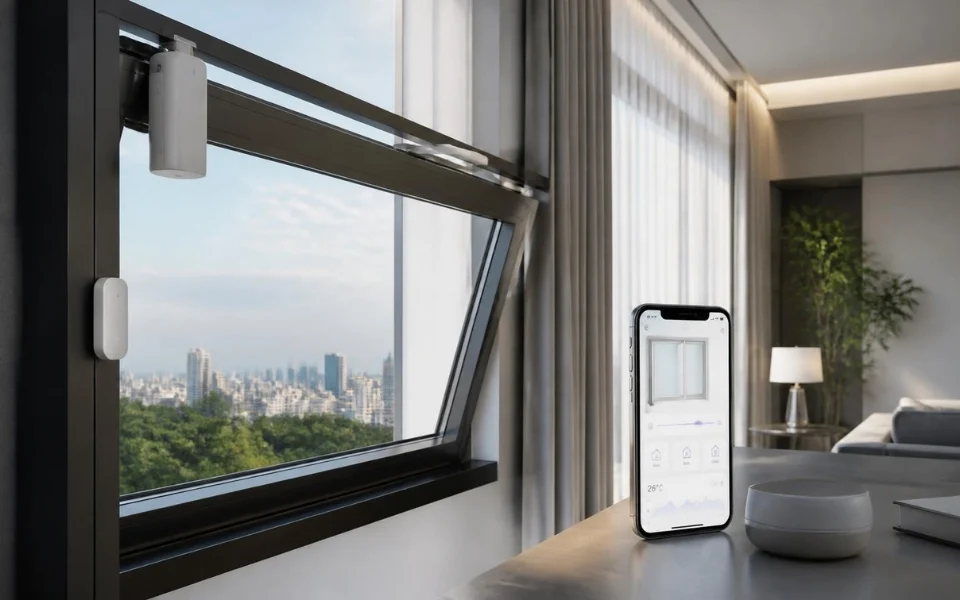
A Smart Window Control system can be integrated with weather sensors to automatically open, close, or adjust windows according to changing environmental conditions. Rain, wind, temperature, humidity, sunlight and air-quality sensors can provide real-time data that triggers predefined automation rules.
For example, windows can automatically close when rain or strong wind is detected, open when indoor air quality deteriorates, or adjust according to indoor and outdoor temperatures. When integrated with HVAC, shading and smart home systems, weather-responsive window automation can improve comfort, protection and energy efficiency while reducing the need for manual control.
- Smart Window Control systems can automatically respond to rain, wind, temperature, humidity and sunlight
- Weather sensors provide real-time environmental data that triggers predefined window automation rules
- Rain sensors help prevent water ingress through open windows, skylights and louvre systems
- Wind sensors can automatically close windows when wind speeds reach predefined safety thresholds
- Temperature and air-quality sensors can support natural ventilation and passive climate control
- Sunlight sensors can help manage solar gain and indoor comfort
- Smart windows can be coordinated with HVAC systems to reduce unnecessary heating and cooling
- Wired sensors generally provide reliable connectivity, while wireless sensors can simplify retrofit installations
- Professional installation is recommended when multiple sensors, actuators and automation rules are involved
- Manual override, obstacle detection and appropriate power-loss behaviour are important safety considerations
- Regular maintenance helps maintain sensor accuracy and reliable window operation
Why Should You Integrate Smart Window Control With Weather Sensors?
Windows contribute to ventilation, thermal comfort, indoor air quality and weather protection. However, manually controlling windows can become difficult when weather conditions change quickly or when a property is unoccupied.
A Smart Window Control system connected to weather sensors allows windows to respond automatically to environmental conditions. Instead of relying on occupants to monitor the weather, the system can use sensor data to execute predefined actions.
This makes the window part of a wider building automation strategy rather than an isolated motorised device. For a broader overview of the benefits, automation options and energy-efficiency considerations, see Smart Window Control Systems: Benefits, Automation & Energy Efficiency.
What Does Weather-Responsive Window Automation Do?
A typical system can:
- Close windows when rain is detected
- Close windows when wind speeds exceed a predefined threshold
- Open windows when outdoor conditions are suitable for natural ventilation
- Adjust window operation according to indoor and outdoor temperatures
- Respond to high humidity or poor indoor air quality
- Use sunlight information to manage solar heat gain
- Coordinate window operation with HVAC and shading systems
This makes the window part of a wider building automation strategy rather than an isolated motorised device. Australian Government guidance notes that windows, shading and natural ventilation can play an important role in managing indoor comfort and reducing reliance on heating and cooling. 1 Australian Government — Windows and energy efficiency. Date of access on 30/09/2026↓
How Does a Smart Window Control System Work With Weather Sensors?
A Smart Window Control system typically combines motorised window actuators, sensors and a central controller or smart home platform. For an example of a wireless actuator designed for awning and casement windows, see the Yale Aeron Wireless Actuator, which provides automated window operation through a connected control system. What Is the Basic Automation Process?
The process can be simplified into four stages:
- Sensor detection — Weather sensors collect real-time environmental information
- Data processing — The controller compares sensor readings with programmed thresholds
- Automation decision — The system determines which predefined action should occur
- Window operation — Motorised actuators open, close or adjust the windows
For example, if a rain sensor detects rainfall, the controller can instruct connected windows to close. If indoor CO₂ levels increase while outdoor conditions remain suitable, the system can open selected windows for ventilation.
Smart home controls can also be used to automate windows, vents, blinds and awnings as part of a broader approach to managing heating and cooling. 2 Australian Government — Smart homes. Date of access on 30/09/2026↓
Which Weather Sensors Can Be Used With Smart Window Control?
Different sensors can support different automation requirements. A system does not necessarily need every sensor type; the appropriate combination depends on the building, climate and intended automation strategy.

How Do Rain and Wind Sensors Protect Windows?
Rain sensors detect rainfall and can trigger immediate window closure. They are particularly useful for skylights, louvre windows and upper-level openings where rain can enter when occupants are asleep or away.
Wind sensors measure wind speed and, in some systems, wind direction. When wind reaches a predefined threshold, the Smart Window Control system can automatically close windows to reduce the risk of damage to glazing, frames and actuators.
Wind-responsive automation can be particularly relevant for:
- High-rise buildings
- Coastal properties
- Exposed residential sites
- Large glazed areas
- Buildings with motorised external openings
How Do Temperature, Humidity and Air-Quality Sensors Help?
Temperature sensors can support natural cooling by opening windows when outdoor conditions are favourable and closing them when external temperatures become unsuitable.
Humidity sensors can help manage condensation and indoor moisture. Air-quality sensors can also monitor indicators such as CO₂ or VOC levels, allowing windows to open when fresh air is required, provided external conditions remain suitable.
How Can Sunlight Sensors Improve Smart Window Automation?
Sunlight and solar radiation sensors can provide additional information for managing heat gain and daylight. When Should Windows Respond to Sunlight?
A Smart Window Control system may use sunlight data to:
- Reduce solar heat gain during periods of intense sunlight
- Support natural warmth when conditions are mild
- Coordinate window operation with blinds or shading systems
- Balance natural daylight with indoor comfort
Sunlight information becomes particularly useful when combined with temperature sensors and automated shading rather than being used as a standalone trigger. For more information about using automated window systems to manage sunlight and glare, see Managing Sunlight Glare Using Automated Window Systems.
Can Smart Windows Reduce HVAC Energy Waste?
When windows open for natural ventilation, the HVAC system can be temporarily paused to avoid heating or cooling air that is immediately being released outside.
When windows close, the HVAC system can resume its normal operation.
This coordination allows the building to use natural ventilation when appropriate while reducing unnecessary heating and cooling.
Which Connectivity Options Can Smart Window Control Use?
Modern systems can connect to central smart home or building automation platforms through different communication technologies.
What Platforms Can Smart Window Control Integrate With?
Depending on the system, window controls may support:
- KNX
- Z-Wave
- Zigbee
- Proprietary smart home platforms
- Wired automation systems
- Wireless automation systems
Platform compatibility affects how easily the window controls can communicate with weather sensors, mobile applications, HVAC systems, lighting and other smart building technologies.
For larger smart home and building projects, KNX can provide a centralised automation framework for integrating lighting, HVAC, ventilation, security and other building systems. See Planning and Designing a KNX-Based Smart Home System for more information.
Should You Choose Wired or Wireless Sensors?
Both approaches can be suitable.
| Feature | Wired Sensors | Wireless Sensors |
|---|---|---|
| Reliability | Generally high | Depends on signal quality |
| Installation | More complex | Easier to retrofit |
| New construction | Well suited | Suitable |
| Existing properties | May require additional wiring | Often easier |
| Power requirements | Usually fixed power connection | May require batteries or local power |
| Signal considerations | Less affected by wireless interference | Requires reliable wireless coverage |
| Best suited for | Larger or planned installations | Retrofit and flexible installations |
The choice should consider installation conditions, power availability, communication reliability and environmental exposure.
What Should You Consider Before Installing Smart Window Control?
Installation quality directly affects automation performance and safety.

How Should Window Actuators and Sensors Be Installed?
Window actuators should be compatible with the window’s:
- Type
- Size
- Weight
- Opening mechanism
- Frame construction
Weather sensors should also be positioned where they can accurately measure environmental conditions without being affected by unnecessary obstructions or artificial influences.
Professional installation is recommended for systems involving multiple actuators, sensors, controllers and automation rules.
Can Existing Windows Be Retrofitted?
Yes. Smart window automation does not necessarily require a completely new window installation.
Existing windows can potentially be upgraded with motorised actuators, while wireless weather sensors can reduce the need for extensive new wiring.
This makes retrofit Smart Window Control suitable for homeowners who want automation without replacing the entire window system.
How Can You Make Smart Window Control Safe and Reliable?
Because automated windows can affect building safety and weather protection, reliability should be considered during system design.
What Fail-Safe Features Should You Look For?
Useful features can include:
- Manual override
- Obstacle detection
- Appropriate power-loss behaviour
- Sensor fault handling
- Communication-loss protection
- Predefined safe operating states
If a sensor or communication connection fails, the system should respond according to a planned safe-state strategy rather than continuing uncontrolled operation.
Why Is Sensor Redundancy Important?
Critical automation should not necessarily depend on a single sensor. Redundancy can improve reliability, particularly where incorrect sensor readings could result in unwanted window operation.
Poor sensor placement can also create inaccurate readings and unexpected automation behaviour.
What Security Features Should You Consider?
When selecting a system, consider:
- Encrypted communication
- Strong authentication
- Regular software or firmware updates
- Reputable manufacturers
- Secure network configuration
- Controlled remote access
- Appropriate user permissions
The network used by the Smart Window Control system should also be secured using appropriate cybersecurity practices.
How Do You Maintain Smart Window Control Systems?
Regular maintenance helps ensure accurate sensor readings and smooth window operation.

What Should Be Checked Regularly?
Maintenance should include:
- Cleaning exposed rain sensors
- Cleaning sunlight sensors
- Inspecting motorised actuators
- Checking moving components for wear
- Testing automated opening and closing
- Testing manual override functions
- Checking sensor readings
- Reviewing automation rules
Sensors exposed to outdoor conditions can accumulate dirt or debris, which may affect their accuracy. Regular inspection helps maintain dependable operation.
What Is the Potential Return on Investment?
The value of Smart Window Control can come from several areas:
- Improved comfort
- Reduced manual operation
- Better weather protection
- Potential energy savings
- Reduced risk of weather-related damage
- Improved property functionality
- Integration with wider smart home systems
The original article identifies comfort, protection, efficiency and potential property value as key long-term considerations when evaluating the investment.
Where Can Smart Window Control Be Used?
Smart window automation can be applied across residential and commercial environments.
In larger residential and commercial projects, smart window automation can form part of a wider building management strategy. See KNX Gateway for BMS: Advanced Integration & Automation for more information about integrating building systems such as HVAC, lighting and shading.
Which Homes Benefit From Weather-Responsive Windows?
Residential applications can be particularly useful in homes with:
- Skylights
- Large glazed areas
- Multi-storey layouts
- Difficult-to-access windows
- Coastal or exposed locations
- Occupants who frequently travel
Automatic window management can provide convenience and peace of mind when occupants cannot manually monitor changing weather conditions.
What About Commercial and Architectural Projects?
Commercial buildings, offices and architectural projects can use weather-responsive window automation to support energy-efficiency strategies and centralised building management.
In larger buildings, centralised control can simplify window management while supporting occupant comfort.
What Are the Most Common Smart Window Control Mistakes?
Several design and installation mistakes can reduce the effectiveness of weather-responsive automation. What Should You Avoid?

- Relying on a single sensor for critical automation
- Installing sensors in unsuitable locations
- Choosing incompatible window actuators
- Ignoring wireless signal reliability
- Failing to coordinate windows with HVAC
- Not planning integration with shading systems
- Ignoring manual override and fail-safe requirements
- Neglecting regular sensor maintenance
A successful system should be designed around the building’s actual environmental conditions rather than simply adding sensors and actuators without an overall automation strategy.
Smart Window Control Comparison Table
| Factor | Basic Motorised Windows | Smart Window Control | Weather-Responsive Smart Window Control |
|---|---|---|---|
| Manual operation | Yes | Yes | Yes |
| Smartphone control | Limited/optional | Yes | Yes |
| Weather sensors | No | Optional | Yes |
| Rain protection | Manual | Possible | Automatic |
| Wind protection | Manual | Possible | Automatic |
| Temperature automation | No | Possible | Yes |
| Air-quality response | No | Possible | Yes |
| HVAC integration | Limited | Yes | Yes |
| Smart home integration | Limited | Yes | Yes |
| Remote monitoring | Limited | Yes | Yes |
| Automation complexity | Low | Medium | High |
| Best suited for | Basic window motorisation | Connected homes | Advanced weather-responsive automation |
Smart Window Control Solutions
A professionally designed Smart Window Control system can combine motorised window actuators, weather sensors and smart building platforms into a single automation strategy.
For residential and commercial projects, Digital Home Systems can help integrate automated windows with broader smart home and building automation technologies, allowing window operation to respond to environmental conditions while working alongside other building systems.

The focus should be on selecting compatible hardware, reliable sensors, appropriate automation rules and a control platform that can support future expansion.
A reliable Smart Window Control installation should be designed around the actual building environment rather than treating weather automation as a one-size-fits-all solution.
Important considerations include:
- Window type and actuator compatibility
- Local weather exposure
- Sensor positioning
- Wind and rain thresholds
- Indoor temperature and air quality
- HVAC coordination
- Wired or wireless connectivity
- Manual override requirements
- Fail-safe operation
- Cybersecurity
- Long-term maintenance
- Future integration requirements
For properties exposed to strong wind, heavy rainfall or significant temperature changes, professional system design becomes particularly important.
FAQs
Smart Window Control is an automated system that allows motorised windows to open, close or adjust using controllers, sensors, schedules or smart home platforms
Yes. When connected to a suitable rain sensor, the system can detect rainfall and automatically close connected windows
Yes. Wind sensors can measure wind conditions and trigger window closure when predefined safety thresholds are reached
It can support energy efficiency by using natural ventilation when outdoor conditions are suitable and coordinating window operation with HVAC systems
Many existing windows can be retrofitted with compatible motorised actuators and wireless sensors, although compatibility depends on the window type, size and mechanism
Final Thoughts
Integrating Smart Window Control with weather sensors transforms windows from passive building elements into responsive components of a smart home or building automation system.
Rain, wind, temperature, humidity, sunlight and air-quality data can be used to trigger automated window actions based on predefined conditions. When combined with HVAC, shading and broader smart home platforms, this approach can improve comfort, protection and energy efficiency.
For new construction or retrofit projects, the most important considerations are sensor selection, actuator compatibility, connectivity, installation, fail-safe operation and long-term maintenance. A well-designed system can provide practical automation while creating a foundation for future smart building integration.




