
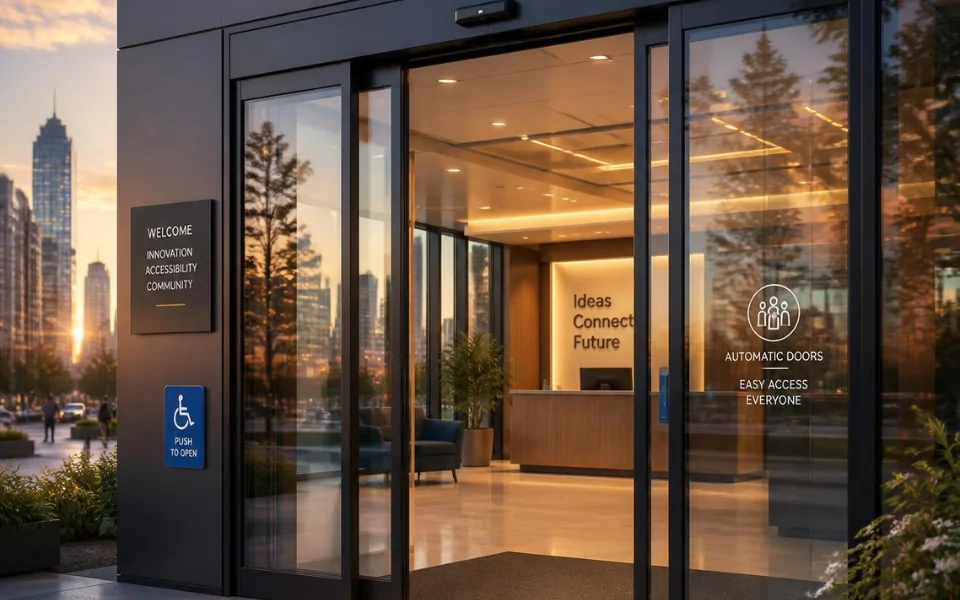
Automatic doors combine detection, control and motorised movement to open and close the door without manual operation. When an activation signal is detected, the controller processes it and tells the operator how to move the door. Safety devices then monitor the movement area throughout the cycle.
What Makes an Automatic Door Work?
-
- Activation: A sensor, push button or access-control device tells the system that the door needs to open.
- Control: The controller interprets the activation and safety signals, then manages the timing and movement of the door.
- Operation: A motorised operator transfers mechanical force to the door, moving sliding panels along a track or rotating swing leaves around their hinges.
- Safety: Sensors continuously monitor the doorway and can prevent, stop or reverse movement when an obstruction is detected.
- Integration: Automatic doors can connect with access control, intercoms and other building systems to provide controlled and convenient entry.
Automatic doors work by combining an activation device, control system, motorised operator and safety sensors to open and close a door without requiring manual force. When a person approaches or provides an authorised activation signal, the control system tells the operator to open the door. Safety sensors monitor the doorway during movement, while the controller manages the opening, hold-open and closing sequence.
Automatic doors can use different mechanisms depending on the door type, including sliding, swing, folding and other specialised configurations. The underlying principle remains similar: detect → process → move → monitor → close.
How Do Automatic Door Sensors Work?
Automatic door sensors detect movement, presence or an activation signal and communicate that information to the door controller. Depending on the system, sensors may use radar, infrared technology, photoelectric detection or other sensing methods.
There are two important functions to understand.
Activation
An activation sensor determines when the door should open.
Examples include:
- Radar motion sensors
- Push buttons
- Touchless switches
- Access-control readers
- Keypads
- Remote controls
- Intercom systems
GEZE notes that activation devices can include radar movement detectors, wireless activation, push buttons and switches.
Safety and presence detection
Safety sensors monitor the area around the moving door.
Their purpose can include:
- Detecting a person standing in the doorway
- Preventing the door from closing onto an obstacle
- Reopening or stopping the door when an obstruction is detected
- Monitoring the movement area during opening and closing
Some systems combine motion detection and presence detection in one sensor arrangement. ASSA ABLOY’s automatic sliding-door documentation describes combined sensors that can detect movement while also maintaining detection of a person or object near the door.
The important distinction is that the sensor does not normally “open the door” by itself. It sends information to the control system, which then determines what the operator should do.

What Does the Automatic Door Control Unit Do?
The control unit is the decision-making part of an automatic door system. It receives signals from activation and safety devices, applies the programmed operating logic and controls the motorised operator.
Depending on the system, the controller can manage:
- Opening commands
- Closing commands
- Opening speed
- Closing speed
- Hold-open time
- Safety responses
- Access-control signals
- Locking functions
- Operating modes
- Emergency functions
- Battery or backup functions
This is why an automatic door should be treated as an integrated system rather than simply a motor.
GEZE describes the control unit as the part that manages settings such as opening speeds, angles and hold-open time, while also coordinating additional safety and access-control functions where applicable.
How Does the Automatic Door Opening Sequence Work?
A typical automatic door opening sequence follows five basic stages: activation, processing, motor movement, safety monitoring and closing.
1. A person approaches
An activation sensor detects movement, or the user provides another opening signal such as a push button or access credential.
2. The signal reaches the controller
The controller receives the activation signal and checks the programmed operating conditions.
3. The operator starts moving
The motor and transmission mechanism move the door towards its programmed open position.
4. Safety sensors monitor the movement
Presence or safety sensors continue monitoring the doorway and surrounding area.
5. The door closes
After the user leaves the detection area and the programmed hold-open period has elapsed, the controller initiates the closing cycle.
A typical automatic sliding-door operating manual describes a similar sequence: activation causes the door to open fully, the system maintains the open position for a preset hold-open time, and the door then closes.
A complete automatic door combines activation sensors, a control unit, motorised operator and safety sensors to manage every stage of the door cycle.
How Do Automatic Sliding Doors Work?
Automatic sliding doors use a motorised operator to move one or more door leaves horizontally along a track. A sensor or access-control device provides the activation signal, the controller starts the operator, and the door moves to its programmed open position before closing when the opening cycle is complete.
The system typically includes:
- Sliding door leaves
- Operator and motor
- Drive belt or transmission system
- Control unit
- Activation sensors
- Presence or safety sensors
- Optional electric lock
- Optional battery backup
- Programme selector
Sliding doors are particularly useful where the door needs to move parallel to the wall rather than occupy the swing area of a hinged door.
DHS explains that automatic sliding doors can use motion sensors, push buttons, touchless switches or access-control systems for activation.

How Do Automatic Swing Doors Work?
Automatic swing doors use a motorised operator to rotate a hinged door leaf around its hinges. When the system receives an activation signal, the operator applies controlled force through an arm or other mechanical connection to open the door, then reverses or releases the mechanism for the closing cycle.
An automatic swing-door system generally includes:
-
- Hinged door leaf
- Automatic operator
- Motor and gearbox
- Arm mechanism
- Controller
- Activation device
- Safety sensors
- Optional access-control equipment
- Optional battery backup
DHS’s automatic swing-door guide describes the same basic architecture: sensors or access-control devices provide the activation signal, the controller manages the operation and the motor provides the force required to move the door.
What Is the Difference Between Automatic Sliding and Swing Doors?
The main difference is how the door leaf moves: sliding doors travel horizontally, while swing doors rotate around hinges. Both can use sensors, controllers, motorised operators and safety systems, but their space and installation requirements are different.
| Feature | Automatic Sliding Door | Automatic Swing Door |
| Door movement | Horizontal | Rotational |
| Main mechanism | Sliding operator and track | Swing operator and arm mechanism |
| Space requirement | Requires suitable side room | Requires swing clearance |
| Common activation | Radar, push button, access control | Radar, push button, access control |
| Safety monitoring | Presence and movement detection | Door-zone and movement detection |
| Typical application | High-traffic entrances, healthcare, retail | Offices, accessibility upgrades, internal and external entrances |
| Retrofit considerations | Opening and side-room requirements | Existing hinged-door compatibility |
| Key design issue | Door travel and clear opening | Swing path and clearances |
Neither system is universally better. The correct choice depends on the building layout, door size and weight, traffic level, accessibility requirements, structural conditions and intended use.
For a more detailed breakdown of operator configurations, see DHS’s guide to Automatic Door Opener Types.
Sensors detect movement, presence or an activation signal and send information to the controller, which determines when the door should open or remain open.
What Happens If Something Blocks an Automatic Door?
A properly configured automatic door uses safety detection and programmed control logic to respond when a person or obstacle is detected in the protected area. Depending on the system and configuration, the door may stop, reopen or prevent the closing cycle from continuing.
GEZE explains that presence detectors can detect people near the door and cause the closing process to stop or the passage to be released again.
However, sensor technology does not eliminate the need for correct installation, commissioning and maintenance. Sensor coverage, mounting position and configuration all affect system performance.

What Role Does Access Control Play in Automatic Doors?
Access control determines who is authorised to activate a door, while the automatic operator controls the physical movement of the door. These systems can work together through the door controller or an appropriate interface.
Access-control devices can include:
- Card readers
- Keypads
- Mobile credentials
- Intercoms
- Key switches
- Vehicle or building access systems
GEZE notes that key switches can be used to authorise access to restricted areas, while access-control devices can also be integrated into automatic door systems.
This distinction is important for commercial projects: access control decides whether the door should open for an authorised user; safety systems help determine whether it is safe for the door to move.
How Do Automatic Doors Work During a Power Failure?
The behaviour of an automatic door during a power failure depends on its design, operator, battery backup and the requirements of the specific application. Some systems include battery backup or emergency-opening functions, while others are designed to allow manual operation.
The correct behaviour should be established during specification and commissioning rather than assumed.
Potential functions include:
- Battery-backed operation
- Automatic opening
- Manual operation
- Emergency release
- Mechanical unlocking
- Controlled closing
- Break-out or escape functionality where applicable
For example, some automatic door systems include rechargeable battery systems for emergency opening, while other systems specify manual operation during power loss.
Fire doors, escape routes and other safety-critical applications require additional consideration and should be assessed against the applicable building and fire-safety requirements.
When a sensor detects a person, the activation signal reaches the controller. The controller then instructs the motorised operator to open the door at the programmed speed.
Are Automatic Doors Safe?
Automatic doors can be designed for safe operation when the correct operator, activation devices, safety sensors and control logic are selected, installed and maintained appropriately. Safety depends on the complete system rather than one sensor or one motor.
A safety-focused automatic door specification should consider:
- Door type and size
- Door weight
- Operating speed
- Closing force
- Sensor coverage
- Presence detection
- Activation zones
- Obstacle response
- Emergency operation
- Access-control interfaces
- Installation conditions
- Maintenance requirements
AS 5007 covers powered pedestrian door assemblies and includes requirements relating to design, installation, verification/testing, marking and commissioning of complete powered pedestrian door installations.

What Does Australian Compliance Mean for Automatic Doors?
In Australia, automatic pedestrian doors may need to satisfy several overlapping requirements depending on the building, door type and application. AS 5007 addresses powered pedestrian door assemblies, while the NCC and AS 1428.1 provide relevant accessibility requirements for applicable buildings and building work.
The ABCB states that AS 1428.1:2021 is now the referenced edition following the 2025 NCC Amendment 2 and amendments to the Premises Standards.
For builders and specifiers, this means automatic-door design should consider:
- Applicable NCC provisions
- AS 1428.1:2021 where referenced
- AS 5007 where applicable
- Door and hardware specifications
- Fire and emergency requirements
- Access-control requirements
- Project-specific certification
- Manufacturer installation instructions
The NCC 2022 Part D4 sets out requirements for access for people with a disability and specifies where accessible access must be provided in different building classifications(1 Australian Building Codes Board — NCC 2022 Part D4. Date of access on 17/08/2026↓).
The ABCB has clarified an inconsistency concerning manual controls for power-operated hinged doors. For the relevant accessibility requirement, manual controls must be located between 500 mm and 1 m from the arc of the hinged door leaf under AS 1428.1:2021 and the Access Code.
This is a good example of why Australian automatic-door specifications should be based on the current applicable requirements, rather than relying on generic installation rules.
Automatic pedestrian doors should be designed with applicable accessibility requirements in mind. AS 1428.1:2021 provides technical guidance for accessible building design, including requirements relating to doorways and controls(2 Standards Australia — AS 1428.1:2021. Date of access on 17/08/2026↓).
Why Does Automatic Door Installation Matter as Much as the Product?
An automatic door can only perform as intended when the door, operator, sensors, controls and surrounding structure are correctly installed and commissioned together.
Installation should account for:
- Door alignment
- Door weight and dimensions
- Operator mounting
- Structural support
- Sensor positioning
- Activation zones
- Electrical connections
- Access-control interfaces
- Safety-device coverage
- Final operating settings
Manufacturer documentation can specify detailed commissioning procedures. For example, an automatic door installation manual published by DHS includes preliminary checks, electrical verification, low-speed initial movement, obstacle detection and step-by-step connection of command and safety devices.
This is why choosing an automatic door based only on its motor specification is not enough.
After the user moves away from the doorway and the programmed hold-open period expires, the controller initiates the closing cycle while safety sensors continue monitoring the doorway.

How Should Automatic Doors Be Tested and Commissioned?
Commissioning should verify that the complete automatic door system responds correctly to activation, movement, obstruction, closing and other required operating conditions.
A practical commissioning process can include:
- Check the physical installation — confirm the door moves freely and the structure is secure.
- Check electrical connections — verify the system has been connected correctly.
- Test activation — confirm sensors, buttons and access-control signals trigger the intended response.
- Test opening and closing — verify movement and programmed positions.
- Test safety devices — confirm the system responds correctly to detected people or obstacles.
- Test operating modes — verify automatic, manual, locked or other configured modes.
- Document the result — provide operating and maintenance information to the building manager where required.
ASSA ABLOY’s user documentation, for example, includes checks for activation units, safety sensors and specific escape-route behaviour.
DHS Experience: What We See in Real Automatic Door Projects
Experience 1: The Door Operator Is Only One Part of the System
In practical automatic-door projects, the operator itself is rarely the only component that needs coordination. The final system may also include access-control readers, electric locks, intercoms, safety sensors and electrical interfaces.
A common project-planning issue is to finalise the door hardware first and consider automation afterwards. This can make it harder to provide suitable mounting points, cable pathways or control locations.
A better approach is to review the complete system before installation:
- Door and frame
- Operator
- Activation method
- Safety sensors
- Access control
- Locking
- Electrical supply
- Final clearances
The practical lesson is simple: automatic doors should be designed as complete entrance systems, not as standalone motors.
DHS Experience: Why Early Coordination Reduces Rework
Experience 2: Resolving Installation Constraints Before Handover
From a project-coordination perspective, problems are generally easier to resolve before the door and surrounding finishes are complete.
For example, an automatic door installation may require coordination between the builder, electrician, security contractor and automatic-door specialist. If the activation location changes after walls are finished, or if access-control equipment occupies the intended approach area, resolving the issue can require additional work.
Early coordination allows the team to confirm:
- Operator mounting
- Control locations
- Sensor coverage
- Cable routes
- Lock interfaces
- Access-control requirements
- Final floor conditions
The practical value of specialist involvement is not simply installing the motor; it is identifying system conflicts while there is still time to resolve them efficiently.
Automatic sliding doors use sensors or access-control devices to activate a motorised operator that moves the door leaves horizontally along a track.

What Does Technical Research Tell Us About How Automatic Doors Work?
Technical documentation from major automatic-door manufacturers consistently shows that modern automatic doors rely on coordinated activation, control, drive and safety systems rather than a single sensor or motor.
GEZE describes the automatic door architecture as an activation device sending a command to a control unit, which then operates the drive while safety sensors monitor the moving door and closing edges.
ASSA ABLOY’s documentation similarly demonstrates the interaction between motion detection, presence detection, opening movement and hold-open behaviour in automatic sliding doors.
This provides an important technical distinction:
The sensor detects. The controller decides. The operator moves. The safety system monitors.
That four-part model is a useful way for builders, facility managers and property owners to understand how automatic doors actually work.
How Do Automatic Doors Work?

The four core functions
| Function | Main component | Purpose |
| Detect | Activation sensor | Identifies an opening request |
| Decide | Control unit | Processes activation and safety signals |
| Move | Operator | Provides mechanical movement |
| Protect | Safety sensors | Monitors the door and surrounding area |
What Are the Most Common Automatic Door Problems?
Most automatic-door problems are related to installation, sensor configuration, mechanical wear, electrical issues or system integration rather than the basic concept of automatic operation.
Common issues include:
- Door opens intermittently
- Sensor fails to detect users
- Door closes too quickly
- Door remains open
- Door reverses unexpectedly
- Access control does not trigger the door
- Electric lock does not release correctly
- Safety sensor produces false detection
- Door movement becomes noisy or uneven
- Backup power does not operate as expected
The correct response is to identify whether the issue is associated with activation, control, mechanical movement, safety detection or another connected system.
Automatic swing doors use a powered operator connected to a hinged door leaf. When activated, the operator controls the opening movement, hold-open period and closing cycle.
How Often Should Automatic Doors Be Maintained?
Automatic doors should be inspected and maintained according to the manufacturer’s requirements, operating environment, usage level and applicable project or regulatory requirements. High-traffic entrances generally require closer attention than lightly used residential doors.
Maintenance should consider:
- Sensor operation
- Door movement
- Fixings and mechanical components
- Operator condition
- Electrical connections
- Locking systems
- Safety devices
- Battery backup where fitted
- Emergency functions where applicable
For commercial buildings, maintenance records can also help demonstrate that safety checks and servicing have been carried out consistently.

FAQs
Touchless automatic doors use sensors such as radar or other proximity technologies to detect a person and send an activation signal to the controller. The controller then operates the motorised door operator.
Yes. Automatic doors require an electrical power source to operate their control and motor systems. Some systems also include battery backup or other emergency-power arrangements depending on the application.
Automatic sliding doors typically use movement sensors, presence sensors, push buttons or access-control signals to determine when an opening cycle should begin.
The controller uses the programmed hold-open time and sensor information to determine when the closing cycle can begin. Safety sensors continue monitoring the doorway during operation.
It depends on the system design. Some systems have battery backup or emergency-opening functions, while others are designed for manual operation during a power failure.
Automatic doors can improve accessibility and controlled movement, but safety depends on correct system design, installation, sensor coverage, commissioning and maintenance. Automatic operation alone does not guarantee safe performance.
Yes. Automatic doors can integrate with card readers, keypads, intercoms, mobile credentials and other access-control systems, subject to the selected equipment and system design.
Not every accessible doorway is automatically required to be powered. The applicable NCC provisions, AS 1428.1:2021, building classification and project circumstances determine the relevant accessibility requirements.
AS 5007 addresses powered pedestrian door assemblies, including design, testing, installation, verification and commissioning of the complete powered pedestrian door installation. Other requirements, including accessibility provisions, may also apply depending on the project.
Often, yes, but suitability must be assessed first. Door weight, hinges, frame condition, clearances, structural support, fire rating, accessibility requirements and operator compatibility should all be considered.
How Can Digital Home Systems Help With Automatic Doors?
Digital Home Systems can help project teams select and coordinate automatic door operators, activation devices, safety sensors and access-control interfaces for residential and commercial applications.
DHS’s automatic-door resources cover different operator configurations, including surface-mounted, concealed and floor-mounted systems, as well as automatic swing and sliding-door applications.
Depending on the project, an automatic-door solution may involve:
-
- Automatic swing door operators
- Automatic sliding door systems
- Motion and presence sensors
- Push buttons and touchless activation
- Access-control integration
- Electric locking
- Safety devices
- Battery backup
- Building automation interfaces
For projects where accessibility is important, the automatic door should be considered as part of the complete entrance design, including the door opening, circulation area, controls and surrounding environment.
Explore DHS’s Automatic Door Opener Types or Automatic Sliding Door Control Logic for more technical information.
For healthcare applications, see DHS’s Automatic Swing Door Solutions for Hospitals & Clinics.
Final Thoughts
Automatic doors work through a coordinated sequence of detection, control, motorised movement, safety monitoring and closing. Sensors identify when a person or authorised user needs access, the controller processes the signal, and the operator moves the door while safety devices monitor the movement.
The exact mechanism depends on the door type. Sliding doors move horizontally along a track, while swing doors rotate around hinges, but both rely on the same fundamental control principle.
For Australian projects, the technical requirements go beyond simply making a door open automatically. Applicable requirements can include AS 5007 for powered pedestrian door assemblies, AS 1428.1:2021 for accessible design where referenced, NCC provisions and project-specific fire, security and building requirements.
For builders, architects and property owners, the most important point is that an automatic door is a complete system rather than a single product. Operator selection, sensor positioning, access control, electrical connections, safety functions and commissioning all contribute to the finished result.




