
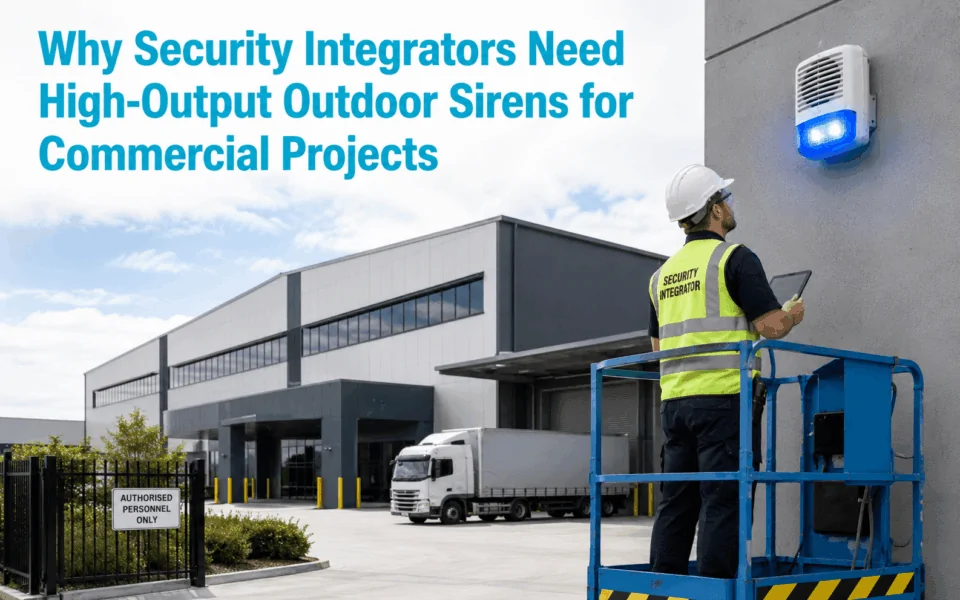
High-output outdoor sirens help security integrators create a faster and more noticeable local response on demanding commercial sites. Their value is not simply higher volume, but the combination of strong audibility, visual signalling, active deterrence and integration with the wider security system.
- Cut through industrial noise: High-output sirens can remain more noticeable around machinery, traffic, loading docks and other high-noise areas.
- Add visual confirmation: Integrated LED strobes help identify the affected building or alarm zone when sound is masked or difficult to locate.
- Strengthen active deterrence: A conspicuous audible and visual response can signal immediately that an intrusion has been detected and may discourage intruders from remaining on site.
- Support large or divided sites: Multiple strategically positioned sirens can provide more effective local warning than relying on one extremely loud device.
- Improve system coordination: Commercial sirens can work alongside monitoring, CCTV verification, intrusion detection and access control.
- Meet project-specific requirements: Integrators should consider environmental ratings, supervision features, backup power and any insurer or site-specific security requirements when selecting equipment.
For security integrators, the right commercial outdoor siren is essential for delivering robust commercial alarm systems. In public places like warehouses, retail centres, medical facilities, schools, and industrial sites, visible and audible deterrents need to perform reliably in harsh Australian conditions.
As commercial clients continue to expect smarter, more connected security systems, high-output outdoor sirens have become a core component of modern alarm deployments. For integrators, specifying the right unit from the outset can differ a compliant, scalable solution and costly issues later.
Why Commercial Sites Need a Different Siren Specification
Commercial security environments often place greater demands on alarm equipment than a typical residential property. The right siren specification should reflect the site’s size, noise level, layout, environmental exposure and monitoring requirements, rather than simply selecting the highest possible sound output.
- Larger premises: Warehouses, factories and commercial facilities may cover significantly more area, making it harder for one residential-style siren to provide effective notification across the site.
- Higher ambient noise: Machinery, ventilation systems, forklifts, traffic and production equipment can mask lower-output alarms.
- Warehouses and loading zones: Large open spaces and busy loading areas often require careful siren placement to maintain useful audible and visual coverage.
- Multiple buildings: Campuses, industrial complexes and multi-building facilities may need several coordinated external sounders rather than one central device.
- Greater outdoor exposure: External sirens may face rain, dust, heat and UV exposure, requiring appropriately rated enclosures.
- Longer alarm distances: Large sites can have substantial distances between detection zones, staff locations and external boundaries.
- More demanding supervision: Commercial systems may also require battery monitoring, tamper detection, fault reporting and integration with central monitoring platforms.
For integrators, the goal is therefore to match siren performance to the actual commercial environment, rather than treating maximum volume as the only specification that matters.

When a Standard Outdoor Siren May Be Insufficient
A standard outdoor siren can be suitable for a smaller office, retail tenancy or other relatively quiet commercial site. The issue is not whether a device is labelled residential or commercial, but whether its sound output, environmental protection and supervision features match the conditions of the project.
Background Noise Masks the Alarm
Warehouses, workshops and loading areas can have substantial ambient noise from machinery, forklifts, ventilation equipment and vehicle movements. In these environments, a siren that is clearly audible in a quiet office may be much harder to distinguish.
According to the National Fire Protection Association’s A Guide to Fire Alarm Basics, public-mode signaling is required to produce a sound level at least 15 decibels above the average ambient sound level and at least 5 decibels above the maximum sound level sustained for 60 seconds. In comparison, private-mode signaling is required to produce a sound level at least 10 decibels above the average ambient sound level(1 National Fire Protection Association’s A Guide to Fire Alarm Basics.Date of access on 24/08/2026↓).
Large or Divided Sites Reduce Effective Audibility
Distance, walls, storage racking, plant rooms and separate buildings can all reduce how effectively sound travels. A larger site may therefore need multiple strategically positioned sirens rather than one higher-output device. Integrators should consider where occupants, security staff and responders actually need to hear or identify the alarm.
Outdoor Exposure Is More Severe
External equipment may be exposed to rain, dust, heat, UV and changing temperatures. However, it is important not to assume that every residential-style siren has inadequate protection. IP ratings and environmental specifications vary considerably between products, so the actual datasheet should guide selection.
Greater Supervision May Be Required
Commercial projects may also place greater importance on ongoing device supervision, particularly where alarms are monitored remotely or protecting higher-value assets. Relevant features can include:
- Tamper detection to identify attempts to remove or open the siren.
- Battery monitoring to flag declining backup power.
- Connection supervision to identify communication loss.
- Fault reporting so system problems can be addressed before an alarm event.
The key distinction is therefore not simply that commercial sirens are louder, but that commercial sites may demand greater coverage, resilience and system supervision.

Operational Advantages of High-Output Outdoor Sirens
For security integrators, specifying a high-output outdoor siren is not simply about choosing a louder alarm. In commercial environments, the siren needs to remain noticeable despite machinery, vehicle movements, large open areas and other background noise. The main operational advantages are stronger audible coverage, an additional visual warning layer and a faster deterrent response when an intrusion occurs.
Noise Penetration in Busy Commercial Environments
Warehouses, loading docks, workshops and industrial facilities can have high ambient noise from forklifts, machinery, ventilation equipment and traffic. A low-output alarm that works well in a residential setting may therefore be much less effective on a commercial site.
Depending on the selected equipment, high-output commercial security devices can provide approximately 115 dB to 125 dB of sound output, helping the alarm stand out against substantial background noise. For example, DHS’s Vision Z-Wave Outdoor Siren provides a 115 dB alarm, while specialised high-output outdoor deterrent systems can reach 125 dB.
However, integrators should not select equipment based on the decibel rating alone. Ambient noise levels, mounting position, distance, walls, machinery and other physical obstructions all influence how effectively the alarm will actually be heard. On larger properties, several strategically positioned sirens may provide better coverage than relying on one extremely loud device.
Visual Layering When Audio Alone Is Not Enough
High-output outdoor sirens can also incorporate bright LED strobes that create a second layer of alarm indication. This becomes particularly useful where machinery or other operational noise masks the alarm, or where personnel can hear a siren but cannot immediately identify which part of a large property has triggered it.
Strategically positioned siren-and-strobe devices can help indicate the affected building, entrance or security zone. DHS’s industrial siren coverage guidance specifically recommends visual indicators in noisy environments where audio alerts may be difficult to hear.
For multi-zone commercial security systems, this visual layer can also support faster assessment by on-site staff, security personnel and responders.
Active Deterrence Before Loss Escalates
A high-output siren is also an active deterrence device rather than simply a notification device. Once an intrusion is detected, rapid siren activation immediately draws attention to the event and makes it considerably harder for an intruder to remain unnoticed.
This is particularly important for warehouses, construction sites, retail premises and facilities containing valuable equipment or stock, where reducing the amount of time an intruder remains on site can help limit theft and property damage. High-impact sound systems are specifically designed to create an immediate audible response intended to drive intruders away before losses escalate.
For security integrators, the key is to treat audio output, visual signalling and system activation logic as complementary parts of the overall deterrence strategy. When properly selected and positioned, high-output outdoor sirens give commercial alarm systems a much stronger on-site response capability.

How Much Siren Output Does the Site Actually Need?
Selecting an outdoor siren for a commercial project should not begin with the assumption that the highest decibel rating is automatically the best choice. Integrators need to assess usable audibility at the actual site, taking account of background noise, distance, physical obstructions and where people need to receive the warning.
dB Ratings Are Usually Specified at a Distance
Manufacturer sound-pressure ratings are commonly measured at a defined distance, often 1 metre from the device. This measurement is useful for comparing products, but it should not be interpreted as the level occupants will experience throughout a property.
For example, Bosch specifies its IUI-SIR-OD outdoor siren(2 Bosch specifies its IUI-SIR-OD outdoor siren. Date of access on 07/09/2026↓) at 100 dB to 109 dB at 1 metre depending on configuration. Ajax specifies an adjustable output of 85 dB to 113 dB at 1 metre for its StreetSiren.
Background Noise Matters
A 105 dB siren installed beside noisy plant equipment operates in a very different acoustic environment from the same device installed in a quiet office car park.
Integrators should consider the difference between the alarm level and normal ambient noise, particularly around workshops, loading areas, mechanical plant and busy vehicle zones.
Distance and Building Layout Matter
Sound level reduces with distance, while the physical site can further change how clearly an alarm is heard. Integrators should avoid simplified claims such as “a 115 dB siren covers X metres”.
Real-world audibility can be affected by:
- Walls and building façades
- Warehouse racking and machinery
- Siren mounting height and orientation
- Open or closed doors
- Wind and outdoor conditions
- Surrounding buildings and structures
Ajax itself advises installers to consider objects that may hinder sound transmission when choosing the installation position.
More Sirens Can Be Better Than One Extremely Loud Siren
For large warehouses, multi-building properties or divided industrial sites, several strategically distributed sirens may provide more effective local warning than concentrating maximum output at a single point.
The objective is therefore not to specify the loudest available siren. It is to design an alarm layout that provides appropriate, clearly identifiable warning in the areas where it is actually required.
Read more: Specifying Outdoor Sirens for Industrial Facilities: What Integrators Must Consider
What Environmental and Compliance Factors Should Integrators Consider?
Commercial outdoor sirens operate in environments that can expose equipment to rain, dust, heat and other contaminants. Security integrators should therefore consider environmental protection, project-specific insurance requirements and compatibility with the wider security system when specifying an external sounder.
Rugged Construction for Outdoor Conditions
Commercial sirens should have an enclosure suited to their installation environment. IP ratings such as IP55, IP65 or IP66 can provide increased protection against dust and water ingress, depending on the specific rating and product design.
This is particularly important for warehouses, loading areas, construction sites and exposed building façades. Integrators should also consider UV exposure, temperature range, mounting position and the condition of cable entries and seals. A high IP rating improves environmental resistance, but correct installation remains essential for maintaining protection over the equipment’s service life.
Insurance and Project Requirements
Some commercial properties may have insurance, risk-management or site security requirements that specify external audible or visual alarm indication. Requirements can vary considerably according to the insurer, property type, asset value and assessed security risk.
Integrators should therefore review the client’s insurance conditions and project specifications rather than assuming that one alarm configuration will satisfy every commercial installation.
Integration with the Wider Security System
An outdoor siren should not operate as an isolated device. Modern commercial alarm systems can integrate external sounders with intrusion detection, central monitoring, access control and CCTV verification.
For example, an intrusion event may trigger the siren and strobe while simultaneously sending an alert to a monitoring centre and directing operators to relevant CCTV footage. This coordinated approach gives integrators greater flexibility when designing high-output outdoor sirens for commercial projects, while supporting faster verification and a more structured response to genuine security events.

What Outdoor Sirens Contribute to a Layered Commercial Security Strategy
Outdoor sirens are most effective when they form part of a broader commercial security system rather than acting as a standalone deterrent. Their role is to provide an immediate local warning, make detection obvious and support faster identification of the affected area.
- Immediate local warning: Outdoor sirens alert people close to the affected premises as soon as an alarm condition is triggered. This can help on-site staff, security personnel and authorised occupants recognise that an event requires attention while remote notifications are also being transmitted.
- Audible and visual deterrence: A conspicuous siren makes it clear that an intrusion or security event has been detected. Where the device includes an integrated strobe, the visual warning can support alarm recognition in noisy environments or help people identify the source of the alert. The goal is not simply maximum noise, but a noticeable response that may discourage an intruder from remaining on site.
- Support for remote monitoring: Outdoor sirens can operate alongside central monitoring, CCTV verification, access control and mobile notifications. A security event may activate the local siren while the alarm system simultaneously sends information to a monitoring centre or nominated personnel. The siren is a local alarm output; it does not replace monitored alarm transmission. Integrators should treat local warning and remote reporting as complementary functions.
- Localisation of the alarm area: On warehouses, industrial campuses and multi-building commercial properties, multiple sirens or siren-and-strobe devices can help indicate which building or security zone has been activated. Zone-specific activation can provide clearer information than triggering every sounder for every event and may also improve local warning coverage.
In a commercial warehouse security project, Digital Home Systems (DHS) worked with the system requirements to improve alarm coverage across a large site where relying on a single warning device would not provide the most effective response. The solution used multiple outdoor sirens with visual strobes positioned around key areas of the property.
Rather than treating the sirens as standalone devices, they were incorporated into the wider security design alongside intrusion detection, access control and central monitoring. This allowed an alarm event to create an immediate local audible and visual warning while also supporting remote notification and further investigation.
Read more: Integrating Outdoor Sirens with Access Control & Intrusion Detection
In Conclusion
High-output outdoor sirens can play an important role in commercial security, but the right specification depends on much more than decibel output alone. Security integrators need to consider ambient noise, site size, building layout, environmental exposure, supervision requirements and integration with monitoring, CCTV and access control systems.
For smaller commercial sites, a standard outdoor siren may be sufficient. For warehouses, industrial facilities, multi-building properties and other demanding environments, a more robust siren strategy may be required, including higher output, visual strobes, improved environmental protection and multiple strategically positioned devices.
The key is to design the system around the actual site conditions rather than relying on a one-size-fits-all specification.
Digital Home Systems (DHS) supports security integrators with commercial alarm products, system design guidance, product specification and integration support. Whether you are designing a new commercial security system or upgrading an existing installation, DHS can help you select suitable sirens and integrate them with the wider alarm, access control and monitoring platform. Contact our team today!
FAQs
There is no single ideal dB level. Output should be selected according to ambient noise, distance, building layout and where the alarm needs to be heard.
No. Smaller offices or quiet commercial sites may be adequately served by a standard outdoor siren. The specification should match the actual site conditions and risk profile.
Not always. Large, divided or multi-building sites may benefit from multiple strategically positioned sirens or siren-and-strobe devices to improve local warning and zone identification.
Yes, provided the selected system offers suitable range, supervision, tamper protection, battery monitoring and reliable communication for the site.
Backup power is often valuable because it helps maintain alarm operation during a mains failure or deliberate power interruption. Integrators should check the siren, control panel and project requirements when designing backup power.




