
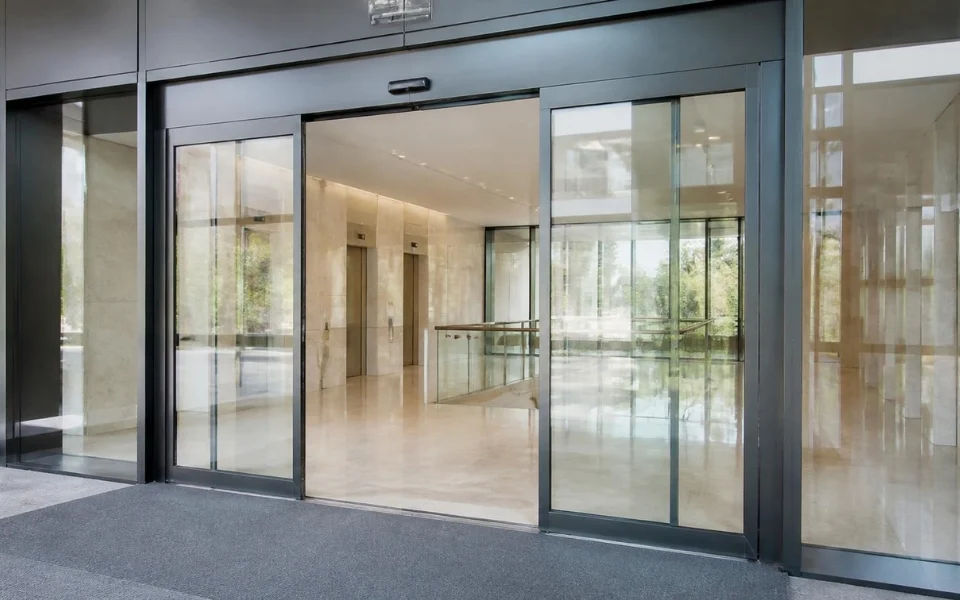
Automatic doors are widely used in Australian homes, retail stores, offices, clinics, hospitals, and public buildings because they improve accessibility, convenience, and hygiene. However, they also introduce moving mechanical and electrical risks if they are not correctly designed, installed, tested, and maintained.
Understanding automatic door safety requirements in Australia means looking beyond the door operator itself. Sensor positioning, door movement, operating speed, force settings, emergency operation, environmental conditions, and regular maintenance all contribute to safe performance.
For homeowners, businesses, and facility managers, understanding How Do Automatic Doors Work can also help when selecting, installing, maintaining, or upgrading an automatic door system.
- Safety Requirements: Automatic doors should be designed, installed, tested, and maintained according to the requirements applicable to their location and use
- Safety Sensors: Presence and safety sensors help detect users and obstructions before the door creates a hazard
- Door Movement: Opening speed, closing speed, force, alignment, and mechanical condition all affect safe operation
- Australian Requirements: The NCC, workplace health and safety obligations, and relevant Australian Standards may apply depending on the installation
- Maintenance: Regular inspection helps identify sensor, roller, track, hardware, and control issues before they become safety problems
- Vulnerable Users: Schools, healthcare facilities, aged care centres, and other high-use environments require particular attention to safety and accessibility
- Professional Installation: Correct installation, commissioning, and testing are essential for reliable automatic door operation
- DHS Experience: Digital Home Systems (DHS) considers the complete door system and actual site conditions when assessing automatic door safety
Why Are Automatic Door Safety Requirements Important?
Automatic doors are powered moving equipment that operate repeatedly throughout the day and interact with a wide range of users, including children, elderly people, wheelchair users, and people with limited mobility.

If safety requirements are overlooked, automatic doors can create risks such as:
- Impact injuries
- Entrapment
- Pinching or crushing
- Unexpected movement
- Failure to detect users or obstructions
For this reason, automatic door safety should be considered during system selection, installation, commissioning, maintenance, and future upgrades.
Who Is Responsible for Automatic Door Safety?
Responsibility can vary depending on the property, application, and applicable regulations.
What Are Homeowners Responsible For?
Homeowners should ensure that:
- The automatic sliding opener is correctly installed
- The door does not create a foreseeable risk to occupants or visitors
- Repairs and modifications maintain safe operation
- Safety features remain functional
What Are Businesses and Building Owners Responsible For?
Businesses, strata bodies, and facility managers generally have broader responsibilities because their doors may be used by employees, customers, visitors, and members of the public.
They should:
- Identify risks associated with the automatic door
- Maintain the equipment in a safe condition
- Arrange appropriate inspections and maintenance
- Address identified safety faults
- Keep relevant maintenance and inspection records
What Australian Standards Affect Automatic Sliding Doors?
Australia does not rely on one single requirement for every automatic door installation. Building requirements, workplace health and safety obligations, accessibility requirements, and relevant technical standards may all apply depending on the project.
For a more detailed explanation of accessible automatic door requirements, see Automatic Door Compliance, which covers the broader relationship between automatic operators, doorway design, activation controls, sensors, and accessibility.
The applicable requirements can vary according to:
- Building type
- Door location
- Intended use
- User requirements
- Emergency egress arrangements
- Installation environment
How Does the National Construction Code Affect Automatic Doors?
The National Construction Code (NCC) provides requirements relevant to building safety, access, egress, and other building considerations. 1 Australian Building Codes Board — NCC 2022, Part D1 Access and Egress. Date of access on 29/09/2026↓
Automatic sliding doors are commonly used in public and commercial buildings to support accessible entry and movement. However, the exact requirements depend on the building and application.
What Are the Workplace Safety Requirements for Automatic Doors?
In workplaces, automatic doors form part of the broader work environment and may be treated as powered equipment or plant depending on the circumstances. 2 Safe Work Australia — Model Code of Practice: Managing the Risks of Plant in the Workplace. Date of access on 29/09/2026↓
Employers and persons conducting businesses or undertakings should identify hazards, control risks, and ensure equipment is maintained in a safe condition.
This can apply to:
- Offices
- Warehouses
- Retail stores
- Medical facilities
- Aged care facilities
- Shared residential buildings
Why Do Automatic Sliding Doors Need Specific Safety Features?
Automatic sliding doors operate without direct manual control and may cycle hundreds or thousands of times depending on the application.
Without suitable safeguards, a door may:
- Close on a person or object
- Fail to detect a slow-moving user
- Continue moving when an obstruction is present
- Operate with excessive speed or force
A properly configured system therefore uses multiple safety mechanisms rather than relying on a single sensor or control feature.
What Safety Features Should an Automatic Sliding Door Have?
The exact requirements depend on the installation, but common safety features include:

Presence Detection Sensors
Sensors detect people or objects within the doorway and help prevent the door from closing when the opening is occupied.
Obstruction Detection
The system should respond appropriately when resistance or an obstruction is detected, such as stopping or reversing the door where the system design requires it.
Controlled Opening and Closing Speeds
Opening and closing speeds should be appropriate for the door, site conditions, traffic levels, and users.
Emergency Manual Operation
Where required, the door should provide an appropriate means of manual operation or move to a safe condition during a power failure or emergency.
For a deeper explanation of how sensors, controllers and operating parameters work together, see Automatic Sliding Door Control Logic.
How Should Automatic Door Sensors Be Positioned?
Sensor positioning is a critical part of automatic door safety.
A suitable installation should consider whether the system can:
- Detect users approaching from the required directions
- Cover the necessary width of the opening
- Detect slow-moving users
- Detect people remaining within the doorway
- Respond appropriately to obstructions
Poor positioning, incorrect settings, or changes around the doorway can reduce sensor effectiveness.
What Are Safe Force and Impact Limits for Automatic Doors?
Automatic doors should operate within appropriate force and movement parameters for their application.

Excessive force can increase the risk of:
- Bruising
- Crushing injuries
- Damage to mobility aids
- Damage to the door or surrounding structure
Force and speed settings should therefore be checked during commissioning and maintenance rather than assuming the original settings will remain suitable indefinitely.
How Should Automatic Doors Protect Children and Vulnerable Users?
Automatic sliding doors are often installed in locations where children, elderly people, wheelchair users, and people with limited mobility are present.
Additional attention may be required in:
- Childcare centres
- Schools
- Hospitals
- Medical clinics
- Aged care facilities
Sensor coverage, operating speed, door movement, and accessibility should be considered together rather than individually.
Residential vs Commercial Automatic Door Safety Requirements
| Factor | Residential | Commercial |
|---|---|---|
| Usage | Generally lower | Often high-frequency |
| Users | Household members and visitors | Employees, customers, visitors and public users |
| Safety focus | Safe everyday operation | Safety, accessibility, risk management and ongoing maintenance |
| Maintenance | Periodic checks | More frequent inspection may be required |
| Traffic | Usually lower | Can be significantly higher |
| Professional servicing | Recommended for technical faults | Particularly important for high-use installations |
What Are the Safety Requirements for Residential Automatic Doors?
Residential requirements can be less prescriptive depending on the installation, but safety remains important.
Homeowners should check that:
- Sensors are correctly positioned
- The door does not close with excessive force
- Children cannot easily be struck or trapped
- The door moves smoothly
- Safety features remain functional
What Are the Safety Requirements for Commercial Automatic Doors?
Commercial automatic doors generally experience higher traffic and greater public exposure.
Systems should be selected and maintained with consideration for:
- Accessibility
- Traffic volume
- User safety
- Building requirements
- Emergency arrangements
- Ongoing maintenance
How Do Automatic Sliding Doors Affect Fire Safety and Emergency Egress?
Automatic doors should not compromise emergency evacuation or access to required exits.
Depending on the building and door application, considerations may include:
- Operation during power failure
- Integration with fire alarm systems
- Emergency release arrangements
- Maintaining required evacuation paths
Fire safety requirements should be assessed as part of the overall building design rather than treated as a standalone automatic door setting.
How Often Should Automatic Doors Be Inspected and Maintained?
Inspection frequency depends on usage, environment, door type, and manufacturer requirements.

| Installation | Recommended Approach |
|---|---|
| High-traffic commercial door | Frequent inspection and professional maintenance |
| Standard commercial door | Regular scheduled inspection |
| Residential door | Periodic safety checks and maintenance |
| After repair or modification | Inspect and test before normal use |
Maintenance should include checks of sensors, rollers, tracks, door alignment, speed, force, controls, and other relevant safety components.
For a more detailed maintenance checklist, see How to Maintain Automatic Sliding Doors for Long-Term Performance, which covers sensor testing, track and roller inspection, alignment, controls, emergency functions, and scheduled servicing.
What Are the Common Safety Risks Caused by Poor Installation?
Many automatic door safety problems can originate from installation or commissioning rather than a defective operator.
Common examples include:
- Sensors mounted incorrectly
- Insufficient sensor coverage
- Misaligned door panels
- Incorrect force settings
- Incorrect operating speeds
- Inadequate commissioning
- Insufficient testing after installation
Professional installation and commissioning can help identify these problems before the door enters normal operation.
How Do You Choose a Compliant Automatic Sliding Door System?
When selecting an automatic sliding door, consider more than the purchase price.
Look for a system that:
- Is suitable for the intended application
- Supports appropriate safety sensors
- Allows suitable speed and force adjustment
- Has clear technical documentation
- Can be properly maintained
- Has available technical support and replacement components
The operator should also be matched to the door size, weight, traffic level, and environmental conditions.
Gate & Door Automation Systems provide automated solutions for doors and gates, supporting convenient access while allowing safety, control and system requirements to be considered as part of the overall installation.
Can You Retrofit Safety Features to an Existing Automatic Door?
Some existing automatic doors can be upgraded with additional or improved safety components.

Possible upgrades include:
- Replacing or upgrading sensors
- Updating control equipment
- Adjusting speed and force settings
- Replacing worn mechanical components
However, the existing operator, door hardware, and control system should be assessed before deciding whether a retrofit is appropriate.
What Are the Liability Risks of a Non-Compliant Automatic Door?
If an automatic door causes an injury and is found to have been inadequately installed, maintained, or operated, the property owner or responsible party may face legal and financial consequences.
Potential issues can include:
- Civil claims
- Regulatory action
- Repair costs
- Insurance complications
Maintaining appropriate records of installation, inspection, servicing, and repairs can also help demonstrate that safety has been actively managed.
How Can Automatic Door Safety Affect Insurance?
Insurance considerations depend on the policy and circumstances of an incident.
Property owners should not assume that an automatic door is covered regardless of its condition. Maintaining equipment properly and following applicable requirements can help reduce avoidable risk.
For specific insurance coverage questions, the relevant insurer or broker should be consulted.
What Safety Considerations Apply to Automatic Sliding Doors in Healthcare?
Healthcare environments can place additional demands on automatic doors.
Doors may need to accommodate:
- Wheelchairs
- Hospital beds
- Mobility equipment
- Staff movement
- High-frequency traffic
Reliable sensor detection, smooth operation, appropriate opening width, and regular maintenance are particularly important in these environments. For more information about automatic sliding doors in healthcare and aged-care environments, see Automatic Sliding Doors for Care.
How Do Automatic Sliding Doors Support Hygiene?
Automatic doors can reduce the need for users to physically touch door handles.
This can help reduce:
- Touchpoints
- Unnecessary physical contact
- Potential opportunities for cross-contamination
For this reason, automatic sliding doors can be particularly useful in clinics, hospitals, aged care facilities, and other hygiene-sensitive environments.
How Do Smart Controls Improve Automatic Door Safety?
Modern automatic door systems may provide additional monitoring and control capabilities, including:
- Usage monitoring
- Fault alerts
- System status monitoring
- Building management integration
These functions can help facility managers identify abnormal operation and respond to maintenance requirements more quickly.
What Environmental Factors Affect Automatic Door Safety?
The same automatic door system may perform differently depending on the installation environment.
Important factors include:
- Indoor or outdoor installation
- Wind exposure
- Weather conditions
- Available space
- Door weight and size
- Traffic volume
- Changes around the entrance
A system suitable for one site may not be suitable for another without appropriate configuration.
Why Is Staff and Occupant Training Important?
Technical safety features work best when users understand how the system should operate.
In commercial environments, staff should know:
- How the door normally operates
- What to do if a fault occurs
- How to recognise unusual or unsafe movement
- Who to contact when maintenance is required
User awareness provides an additional layer of protection alongside technical safety measures.
What Does Real-World Automatic Door Safety Experience Show?
Based on practical experience at Digital Home Systems (DHS), automatic door safety depends not only on the operator but also on sensor positioning, door alignment, speed and force settings, environmental conditions, and regular maintenance.
Common issues found in real-world installations include:
- Sensor misalignment affecting detection
- Worn rollers and tracks causing unstable movement
- Incorrect speed or force settings affecting safety
- Poor maintenance allowing minor faults to become larger problems
For DHS, a proper safety check should always consider the complete automatic door system, its actual site conditions, and how it performs during everyday use.
When Should You Replace an Automatic Sliding Opener?
Replacement may be appropriate when:
- Safety features are outdated
- Critical components are no longer supported
- The operator cannot be adjusted to suitable operating limits
- Mechanical components are excessively worn
- Recurring faults continue despite maintenance
Before replacing the complete system, a qualified technician can assess whether repair, retrofit, or replacement is the most appropriate solution.
Automatic Door Safety: Cost vs Safety Considerations
| Consideration | Lower-Cost Approach | Safety-Focused Approach |
|---|---|---|
| Initial cost | Generally lower | May be higher |
| Safety features | May be limited | More comprehensive |
| Maintenance | Can become reactive | Planned maintenance |
| Long-term risk | Potentially higher | Focused on risk reduction |
| Serviceability | Depends on product support | Considered during selection |
| Lifecycle value | Depends on reliability | Considers long-term operation |
The lowest purchase price does not necessarily represent the lowest overall cost. Door reliability, maintenance, safety, downtime, and potential liability should all be considered when evaluating an automatic door system.
Why Should You Work With Qualified Automatic Door Professionals?
Qualified installers and technicians can assess:
- Applicable Australian requirements
- Sensor positioning
- Door movement
- Speed and force settings
- Mechanical condition
- Safety functions
- Commissioning and testing requirements
Professional support is particularly important when installing, modifying, repairing, or troubleshooting automatic doors in commercial and public environments.
FAQs
Yes. Applicable building, workplace, accessibility, and technical requirements depend on the type and location of the automatic door
Safety depends on the complete system, including sensors, obstruction detection, suitable speed and force settings, correct installation, and maintenance
The appropriate frequency depends on usage, environment, manufacturer recommendations, and the installation. High-traffic doors generally require more frequent inspection
In some cases, sensors, controls, mechanical components, and operating settings can be upgraded. The existing system should be assessed before any retrofit
Yes. Any modification or repair that may affect door movement, sensors, controls, or safety functions should be followed by appropriate testing before normal operation
Final Thoughts
Automatic doors provide significant benefits for accessibility, convenience, hygiene, and everyday building operation, but these benefits depend on safe and reliable performance.
For Australian homeowners and businesses, automatic door safety requirements should be considered throughout the entire lifecycle of the system — from design and installation to commissioning, maintenance, repair, and eventual replacement.
Based on the practical approach used by Digital Home Systems (DHS), the safest approach is to assess the complete automatic door system and its actual site conditions, rather than focusing only on the operator.
A well-designed automatic sliding door combines appropriate safety sensors, correct installation, suitable operating settings, reliable hardware, and ongoing maintenance to support safe everyday operation.




