
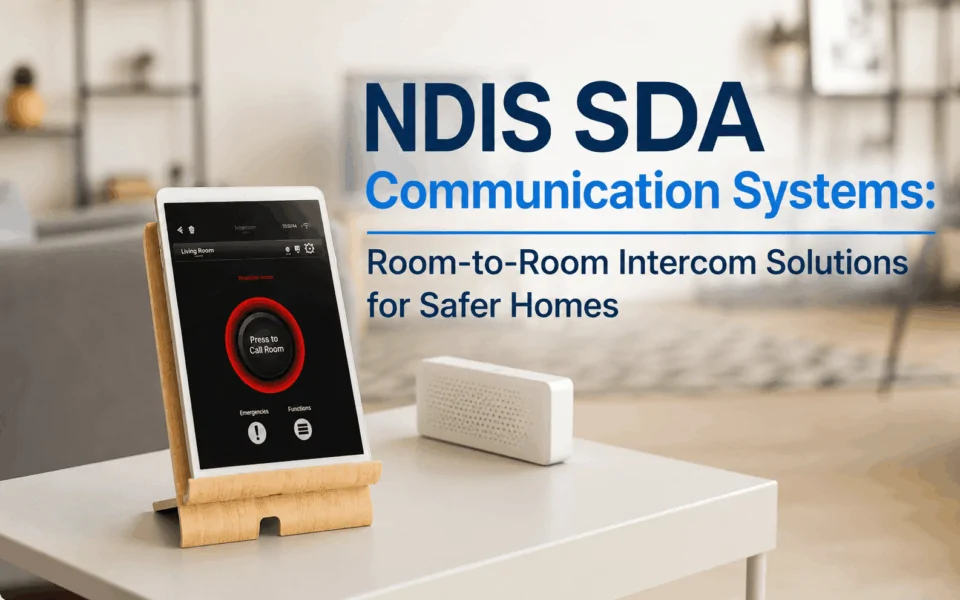
Modern NDIS SDA communication systems integrate emergency call functionality, mobile alerts, and smart home automation to create a connected environment where residents and carers can communicate instantly and reliably. Whether you are designing a new SDA property or upgrading an existing home, choosing the right system can significantly impact daily living outcomes.
In this guide, we’ll break down how SDA communication systems work, what features to prioritise for NDIS projects, and how to choose a solution that aligns with compliance, usability, and future integration needs.
What Is an SDA Room-to-Room Communication System?
An SDA room-to-room communication system is designed to help participants communicate more easily within a Specialist Disability Accommodation property(1 What Is SDA.Date of access on 17/08/2026↓). Depending on the system design, a participant may be able to contact onsite support workers, another bedroom, a shared support area, the front entrance, or nominated devices used by carers or support staff.
The exact setup can vary significantly between properties. Some systems use fixed room stations or wall-mounted intercoms, while others may connect with indoor monitors, mobile devices, access-control systems or video intercoms. The right design depends on the participant’s communication needs, the dwelling layout and how onsite support is provided. In 2022, 61% of people with disability living in households required assistance with at least one daily living activity(2 People with disability in Australia 2026.Date of access on 17/08/2026↓).
It is also important to distinguish room-to-room communication from an emergency or nurse-call system. They may be integrated in some projects, but they serve different purposes. A communication system supports everyday two-way contact, while an emergency call system is specifically intended to raise an alert when assistance is required. Treating these functions separately during system design helps avoid gaps in accessibility and support.
How Room-to-Room Intercom Systems Work for SDA Homes
A well-designed NDIS SDA communication system enables direct, instant communication throughout the entire home. A room-to-room intercom SDA system creates a connected environment where participants and carers can interact seamlessly, regardless of their location within the property.
- Instant communication between rooms. Participants can connect with carers or other areas of the home immediately, without delay or complicated steps. This ensures that help is always within reach in larger properties.
- Direct participant-to-carer calls. Communication becomes intentional and clear, ensuring carers understand exactly who needs assistance and where they are located.
- Centralised communication control. Carers can manage all interactions from a central point. Therefore, it will be easier for them to coordinate responses, prioritise tasks, and stay aware of what’s happening throughout the home.
This type of NDIS intercom system transforms communication from reactive to proactive.

Key Features of an NDIS-Compliant SDA Communication System
A well-designed NDIS SDA communication system must meet the practical demands of NDIS-funded Specialist Disability Accommodation (SDA). The right solution should combine reliability, accessibility, and integration, ensuring participants can communicate easily while carers can respond quickly and efficiently.
Below are the essential features to look for when selecting an NDIS intercom system for SDA housing.
Room-to-Room Intercom Functionality
At the core of any NDIS intercom system is reliable room-to-room communication. This allows participants to contact carers or other areas of the home instantly, without physically moving. Key capabilities include:
- Direct communication between bedrooms, bathrooms, and common areas
- Hands-free or one-touch calling options for ease of use
- Clear audio quality to ensure messages are understood without confusion
- Always-on availability for continuous support
This feature is essential for improving response times and enabling seamless communication across multi-resident SDA homes.
Emergency Call and Alert Systems
Effective NDIS SDA communication systems must include integrated emergency call functionality to support participant safety at all times.
- Dedicated emergency call buttons or wall-mounted panels
- Instant alerts sent to carers or staff devices
- Priority escalation for urgent situations
- Audible and visual alerts to ensure no call is missed
These systems are critical for reducing response delays and supporting duty-of-care requirements in SDA environments.
Central Monitoring and Mobile Notifications
Modern NDIS solutions go beyond fixed intercom stations, enabling carers to receive alerts wherever they are. Look for systems that provide:
- Central monitoring stations within the home
- Mobile notifications to smartphones or tablets
- Real-time alerts with room identification
- The ability to manage multiple participants simultaneously
This level of visibility allows carers to respond faster and manage workloads more effectively, especially in larger SDA properties.
Accessibility and User-Friendly Interfaces
Accessibility is a fundamental requirement for any assistive communication technology in SDA homes. Systems must be intuitive and adaptable to a wide range of participant needs.
- Large, easy-to-press buttons or touchscreens
- Clear visual indicators and audible feedback
- Customisable settings for different users
- Compatibility with voice control or assistive devices
Designing for accessibility ensures participants can use the system confidently and independently, improving both safety and quality of life.
Reliability and System Redundancy
Reliability is critical in SDA environments where communication systems are used daily for both routine and emergency situations. Important considerations include:
- Stable connectivity (wired, wireless, or hybrid systems)
- Backup power options to maintain operation during outages
- Redundant communication pathways to prevent system failure
- Proven hardware designed for continuous use
Choosing a reliable system ensures consistent performance and minimises the risk of downtime when communication is most needed.

Room-to-Room Intercom vs Emergency Call vs Door Intercom
Different communication systems in SDA housing serve different purposes. Although they can sometimes be integrated, they should not be treated as interchangeable. The most suitable design depends on how participants communicate, how support is provided and what should happen when assistance is needed.
Room-to-Room Intercom
A room-to-room intercom is primarily designed for everyday two-way communication within the property. For example, a participant may use a bedroom station to speak with an onsite support worker in a staff area or communicate with another nominated room.
The key function is conversation. Depending on the design, communication may be audio-only or video-enabled and may connect fixed stations, indoor monitors or nominated mobile devices.
Emergency or Assistance Call System
An emergency or assistance call system is designed for requesting help and escalating an alert, rather than simply starting a normal conversation.
Depending on participant needs and the project’s support model, it may use:
- Call buttons positioned in accessible locations.
- Pendants that can be carried or worn.
- Pressure pads for participants who cannot operate conventional buttons.
- Accessible switches selected around individual mobility requirements.
- Escalation logic that directs unanswered alerts to another carer, device or support point.
The exact configuration should be based on the participant’s needs and the required response process.
Entrance Video Intercom
An entrance video intercom serves a different purpose: visitor identification and entry communication. It allows a participant or support worker to communicate with someone at the front entrance and, where integrated with access control, may also allow a door or gate to be released remotely.
Comparison Table
| System Type | Primary Purpose | Typical Use in SDA Housing | Common Devices / Interfaces | Two-Way Communication |
| Room-to-Room Intercom | Everyday communication between participants, carers and nominated rooms | A participant contacts an onsite support worker, another bedroom or a shared support area | Wall stations, indoor monitors, touchscreens or nominated mobile devices | Yes – usually audio, with video available in some systems |
| Emergency / Assistance Call System | Requesting urgent or non-urgent assistance and escalating alerts | A participant activates a call when help is required, with alerts directed to carers or support staff | Call buttons, pendants, pressure pads and accessible switches | Not necessarily – the main function is raising and escalating an alert |
| Entrance Video Intercom | Visitor identification and communication at the property entrance | A participant or carer sees and speaks with a visitor before allowing access | External door station, camera, indoor monitor, smartphone or tablet | Yes – typically audio and video |
Why Some SDA Projects Need More Than One System
A single device rarely addresses every communication requirement. A front-door video intercom does not automatically provide room-to-room communication or an effective assistance-call function. Likewise, a bedroom call button may raise an alert without allowing the participant and support worker to speak.
For this reason, during our SDA projects, DHS often approaches SDA communication as an integrated system design rather than simply supplying an intercom. Room communication, emergency assistance, visitor entry and access control can be assessed separately and then integrated where appropriate.
Read more: Which Entry Upgrades May Fit SDA, SIL and Home Modification Discussions

Integrating Communication With Access Control and Home Automation
In some SDA projects, communication systems can be integrated with access control and home automation to make everyday tasks easier and more accessible. The level of integration should always reflect the participant’s abilities, support arrangements and the specific design of the dwelling.
- Automatic door and door-release integration. An entrance intercom can be connected with an automatic door operator or electronic locking system. A typical sequence may be visitor calls → participant answers → authorised door release, where the participant’s capability and project design allow it. This can reduce the need to physically approach the entrance to admit a visitor.
- Smart home and assistive technology integration. Communication devices may potentially interact with automated doors, lighting, blinds, environmental controls, accessible switches and other participant-specific automation. For example, a bedside interface could form part of a broader system that supports communication and environmental control. Home automation may be considered for NDIS funding where it satisfies the relevant funding criteria, but this depends on the participant’s individual circumstances rather than being automatically funded because a property is SDA.
- Access-control integration. Intercoms can also work alongside electronic locks, keypads, fobs or other credential-based access systems. This may allow participants, carers and authorised visitors to use different access methods while the intercom remains available for visitor communication.
The aim is not to make every SDA property technically complex. A well-designed system should integrate only the functions that provide genuine accessibility, independence, security or support benefits.

How to Choose the Right SDA Intercom System
The ideal NDIS SDA intercom system should support both participant independence and efficient care delivery. Selecting the right system impacts not only day-to-day communication but also long-term usability and compliance within an NDIS-funded environment.
Below are the key factors to consider when specifying a communication system for SDA housing.
New Builds vs Retrofit Installations
The type of property you are working with will significantly influence the system design.
For new SDA builds, there is greater flexibility to implement fully integrated solutions, including structured cabling, centralised control systems, and hardwired intercom networks. This approach typically offers higher reliability and allows for deeper integration with other building systems.
For retrofit projects, wireless or hybrid systems are often more practical. These solutions minimise disruption to existing structures while still delivering reliable room-to-room communication and emergency alert functionality. When upgrading an existing SDA NDIS home, it’s important to choose a system that can be installed efficiently without compromising performance.
Scalability for Multi-Resident SDA Homes
SDA properties often accommodate multiple participants, each with individual needs and support requirements. A suitable intercom system must be able to scale across:
- Multiple bedrooms and common areas
- Staff zones or central monitoring points
- Additional dwellings or extensions in the future
Look for systems that allow easy expansion without requiring a full redesign. Scalable solutions ensure the system can adapt as care models evolve or as the property grows.
Compatibility with Access Control and Automation Systems
Modern NDIS SDA communication systems should not operate in isolation. Instead, they should integrate with broader smart home and assistive technology ecosystems, including:
- Door and gate access control systems
- Lighting automation
- Sensors and monitoring devices
- Central control hubs (e.g. Z-Wave or KNX systems)
This level of integration allows actions to be automated. For example, unlocking a door in response to an intercom call or triggering lights during an emergency alert.
Accessibility and Ease of Use for Participants
An effective NDIS SDA intercom system must be designed with accessibility at its core. Participants may have varying physical, cognitive, or sensory needs, so the interface should be intuitive and easy to operate.
Key considerations include:
- Large, clearly labelled buttons or touch interfaces
- Visual and audible feedback for alerts
- Voice control or hands-free operation (where required)
- Simple, consistent user interactions across devices
Prioritising usability ensures participants can confidently use the system independently, supporting their autonomy and quality of life.
Choosing the Right Installer and Support Partner
Beyond the technology itself, the success of an NDIS SDA communication system depends heavily on the expertise of the installer and ongoing support provider.
When selecting a partner, consider:
- Experience with SDA and NDIS-related projects
- Knowledge of integrated automation systems
- Ability to design customised solutions for different property types
- Access to technical support, training, and after-sales service
Digital Home Systems (DHS) supports SDA providers, builders, consultants, and project teams with the design, supply, installation, and integration of communication, intercom, and assistive technology solutions. DHS can also coordinate the system with access control, automatic doors, smart lighting and broader building automation where required.
Working with an experienced provider helps ensure the system is not only installed correctly but also optimised for long-term performance, reliability, and future upgrades.

Final Thoughts,
In today’s SDA homes, communication systems are no longer a luxury – they are a necessity. A reliable NDIS SDA communication system plays a central role in improving safety, enhancing independence, and supporting efficient care delivery.
Without it, both participants and carers face unnecessary challenges that can impact daily life and overall well-being. With it, SDA homes become more connected, responsive, and supportive environments designed for better living outcomes.
Choosing the right communication system for an SDA project requires careful planning, the right technology, and an experienced partner who understands both NDIS requirements and integrated smart home solutions. Whether you are developing a new SDA property, upgrading an existing home, or specifying systems for a client, they can help you design a fully integrated communication solution tailored to your needs.
Need Help Choosing the Right Solution?
At DHS, we specialise in designing and delivering tailored SDA communication system solutions for NDIS homes. Whether you’re building a new property or upgrading an existing one, we can help you find the right system to meet your needs.
Contact us today to discuss your project and create a complete security solution for your property.
FAQs
An SDA communication system is a specialised intercom and alert solution designed for Specialist Disability Accommodation (SDA) homes. It enables participants to communicate with carers or support staff through room-to-room intercoms, emergency call buttons, and mobile alerts.
Intercom systems may be funded under the NDIS when they are considered part of assistive technology that supports a participant’s functional needs. In SDA settings, communication systems are often incorporated into the overall property design to enhance safety and accessibility.
While requirements can vary depending on the property and participant needs, compliant NDIS SDA communication systems typically include room-to-room intercom functionality, emergency call and alert systems, central monitoring, and accessible user interfaces.
The cost of an NDIS SDA communication system depends on several factors, including the size of the property, the number of rooms, the level of integration, and whether the system is wired or wireless. Basic intercom setups may be more affordable, while fully integrated smart systems with automation will require a higher investment.





Comments are closed.