
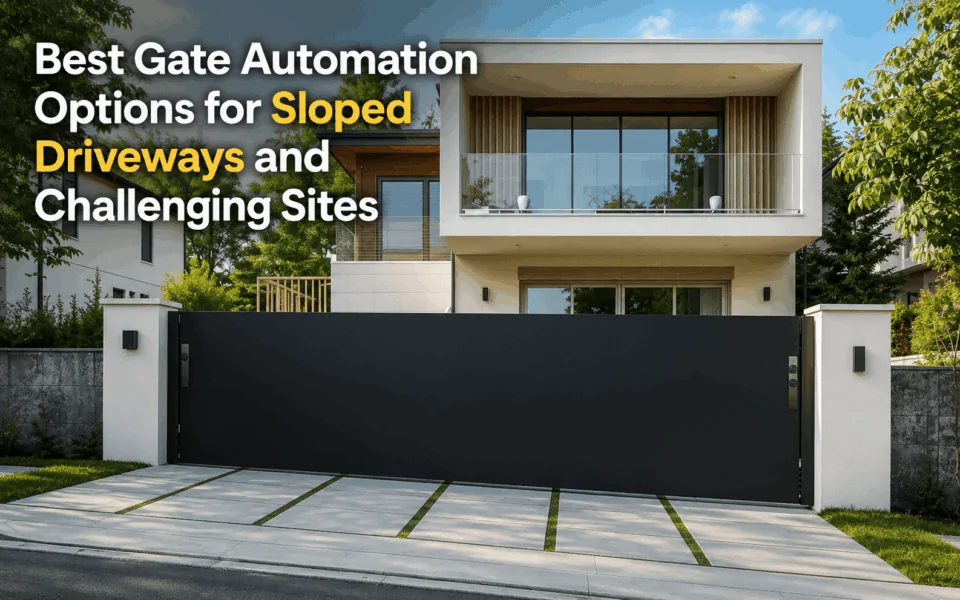
- Sliding gates are often the most practical choice for sloped driveways because they move sideways rather than sweeping across rising ground. They still need enough side run-back, suitable foundations and a clear travel path.
- Track sliding gates suit stable, well-prepared entrances, but the track, drainage and surrounding pavement must be designed carefully to prevent resistance, debris build-up and alignment problems.
- Cantilever gates are useful where a ground track is undesirable, particularly across drainage channels, uneven surfaces or busy vehicle entrances. However, they usually require more side space and stronger structural support.
- Swing gates need careful assessment on rising driveways. A conventional inward-opening gate may strike the driveway, so specialist hinge geometry, an alternative opening direction or a different gate type may be required.
- Bi-fold and telescopic gates can solve space constraints where there is limited swing clearance, a short driveway or insufficient side run-back for a conventional sliding gate.
Installing an automated gate on a flat driveway is relatively straightforward. However, when dealing with sloped driveways or uneven terrain, the process becomes significantly more complex. Many property owners encounter issues such as gates failing to open properly, overloaded motors, or safety risks caused by poor alignment.
This guide explores the best gate automation options for sloped driveways and challenging sites. It focuses on practical solutions, system design considerations, and choosing the right setup for your specific conditions.
Table of Contents
ToggleWhy Sloped Driveways Are Challenging for Gate Automation
Most gate systems are engineered with flat ground in mind. On a slope, everything changes—mechanics, load distribution, and movement geometry. When a driveway is sloped, the gate’s geometry changes as it opens and closes. This creates several mechanical and operational challenges.
One of the most common issues is ground clearance. A standard swing gate may scrape against the ground when installed on an incline. This not only affects usability but can also damage the gate and motor over time.
Another challenge is motor strain. When a gate operates on a slope, the motor must work harder to move the gate against gravity. This can shorten the system’s lifespan and increase the risk of failure.
Safety is also a concern. Improperly installed gates on sloped surfaces may close unevenly or apply excessive force, creating potential hazards for vehicles and pedestrians.
That’s why gate automation for sloped driveway projects must begin with site analysis—not product selection.

Understanding the Type and Direction of Your Slope
Before choosing a system, you need to understand what kind of slope you’re dealing with(1 Slope Calculation.Date of access on 17/08/2026↓). Not all slopes create the same challenges.
The significance of driveway gradient is reflected in official road-design guidance. Main Roads Western Australia notes that although most cars can operate on sealed gradients of 20% or 1:5(2 Main Roads Western Australia notes that although most cars can operate on sealed gradients of 20% or 1:5.Date of access on 17/08/2026↓), this gradient is considered extreme even for short distances such as driveways. While this figure relates to vehicle access rather than gate motors, it demonstrates how demanding steep driveway conditions can be and why the gate system must be designed specifically for the site.
An upward slope (rising toward the property) forces the motor to work harder when operating. A downward slope does the opposite—it accelerates the gate during closing, which can strain braking systems and reduce control.
Cross slopes (side-to-side uneven ground) create alignment issues that affect both swing and sliding gates.
Each scenario requires a different solution. Without identifying your slope type, even a high-end system may perform poorly.
Moreover, gravity is one of the most underestimated factors in gate automation for sloped driveway systems.
On an incline:
- The motor must overcome additional resistance when moving uphill
- The gate gains momentum when moving downhill
- Stopping distance increases
- Mechanical stress is amplified
This means a gate that performs perfectly on flat ground may struggle or fail on a slope. The solution is simple but often ignored: always overspec the motor for sloped conditions.
What Must Be Measured Before Choosing the Gate System
Before selecting gate automation for a sloped driveway or difficult site, the physical conditions of the entrance need to be measured carefully. These details determine whether a sliding, swing or more specialised gate configuration is realistic.
- Driveway gradient and ground clearance. Measure both the driveway slope and the area where the gate itself will travel. Swing gates may require additional clearance on sloping ground, while sliding gates need a reasonably suitable path beside the opening.
- Opening width. The clear driveway width affects gate size, motor selection and whether a single sliding leaf, double swing gate or specialist arrangement is practical.
- Side run-back space. Sliding gates need enough clear space beside the driveway to store the gate when open. Limited run-back may make a telescopic or other compact system more suitable.
- Gate height, weight and wind exposure. Larger and heavier gates place greater loads on motors, hinges, rollers and supporting structures. Solid gates in exposed locations also experience higher wind loads.
- Vehicle turning and stopping space. Check where vehicles can safely wait while the gate opens and whether a swinging gate would interfere with turning movements, footpaths or parked vehicles.
- Drainage and surface conditions. Poor drainage, uneven pavement, gravel or areas prone to water accumulation can affect tracks, foundations and underground cabling.
- Posts, footings and structural support. Gate posts and foundations must be capable of supporting the gate and automation equipment. Existing structures should be assessed before assuming they can be reused.
Together, these measurements help determine whether a sliding, swing or specialist gate system will operate safely and reliably on the site.
Best Gate Types for Sloped Driveways
Choosing the right gate for a sloped driveway depends on more than the gradient alone. Available side space, driveway geometry, drainage, vehicle movement, gate weight and structural conditions all influence what is practical. In many cases, several gate types may be technically possible, but each comes with different trade-offs.

Sliding Gates: Often the Simplest Option When Side Space Is Available
Sliding gates are often a practical choice on sloped driveways because the gate does not need to sweep across the rising or falling driveway surface. Instead, it moves laterally beside the opening.
However, this does not mean sliding gates are automatically the best solution for every slope. They still require sufficient side run-back, a suitable gate structure, appropriate foundations and a practical travel path. The area beside the driveway must also remain clear enough for the gate to open fully.
Track Sliding Gates
A track sliding gate can work well where a properly constructed track can be incorporated across the entrance. The gate travels on wheels along this track, making accurate alignment and surface preparation important.
On challenging sites, the track should be treated as part of the engineered gate path, rather than something simply installed over an uneven driveway. Gradient changes, drainage, pavement movement and debris accumulation can all affect long-term operation. The track and surrounding surface therefore need to be designed so the gate can travel smoothly without creating unnecessary resistance.

Cantilever Sliding Gates
Cantilever gates can be particularly useful where installing a ground track across the driveway is undesirable. They can suit sites with drainage channels, rough surfaces, heavy vehicle traffic, debris or uneven paving, because the gate spans the opening without relying on a track in the vehicle path.
The trade-off is that cantilever systems generally require more room beside the opening. The gate includes an additional counterbalance section, and the support posts, rollers and foundations need to handle the increased structural loads.
Swing Gates on Sloped Driveways
Swing gates require more careful assessment on sloping sites. The main issue is straightforward: if the driveway rises behind the gate, a conventional inward-opening leaf may hit the driveway surface before reaching the required opening angle.
That does not automatically rule out a swing gate. Depending on the site, alternatives may include changing the opening direction, adjusting the gate geometry or using specialist hinge arrangements.
Rising-Hinge or Uphill Swing Gate Solutions
Some sloping driveways can use rising-hinge systems that cause the gate leaf to lift as it swings open, helping it clear the rising ground.
These systems need to be designed carefully. The additional hinge geometry changes the gate’s movement and can increase mechanical complexity and stresses. Operator compatibility must also be checked, so rising hinges should not be treated as a universal retrofit solution for every sloped driveway.

For difficult entrances, DHS can assess the complete site geometry and help determine whether a conventional or specialist gate configuration provides the most reliable long-term solution.
Which Gate Type Works Best for Each Sloped Site?
There is no single gate type that suits every sloped driveway. The best option depends on the direction of the slope, available side space, vehicle movement, surface condition and the amount of structural work the site can accommodate.
As a quick guide, the following gate types are usually worth considering for common site conditions:
| Site condition | Usually worth considering |
| Driveway rises behind the gate | Sliding gate or specialist swing solution |
| Limited swing clearance | Sliding, telescopic or bi-fold gate |
| No ground track preferred | Cantilever sliding gate |
| Limited side run-back | Swing or bi-fold gate |
| Heavy commercial traffic | Sliding or cantilever gate, depending on site layout |
| Uneven entrance surface | Cantilever gate may be worth assessing |
| Short driveway with limited vehicle waiting space | Sliding, telescopic or bi-fold arrangement |
| Drainage channel across the entrance | Cantilever or another track-free solution |
| Wide opening with good side clearance | Conventional sliding gate |
| Existing swing gate on a rising driveway | Specialist hinge geometry or alternative gate configuration may need assessment |
For example, a cantilever gate may avoid problems with an uneven driveway surface, but it also needs substantial side run-back and suitable foundations. Likewise, a swing gate may work on a slope if the opening direction and ground clearance are suitable, but a conventional inward-opening arrangement can become impractical where the driveway rises sharply behind the gate.
The most reliable approach is to assess the complete entrance before choosing the automation system. Gradient, gate dimensions, run-back space, foundations, drainage and vehicle movement should all be considered together. DHS can assist with evaluating challenging sites and matching the gate layout, automation equipment and access requirements to the actual conditions rather than selecting a system based on slope alone.
How to Select the Right Gate Operator for a Sloped Site
Choosing the gate type is only the first step. The gate operator must then be selected to suit the gate’s actual weight, dimensions, movement, traffic level and site conditions. On a sloped driveway, this matters even more because poor geometry or additional resistance can place extra load on the automation gate system.
Gate Weight and Leaf Length
Operator selection should consider the complete gate, not weight alone. For swing gates in particular, leaf length has a major influence on the load placed on the operator, especially with long or heavy leaves. The operator must suit both the gate dimensions and the hinge geometry.
Duty Cycle and Traffic Volume
Usage frequency can completely change the specification. A residential gate operating ten times per day and an apartment or commercial entrance operating hundreds of times per day should not necessarily use the same operator. Higher-traffic sites generally require equipment designed for a heavier duty cycle.
Wind Loading
Wind is particularly important for solid aluminium gates, sheeted gates and privacy gates. A large solid gate can behave like a sail, creating significant additional forces on the operator, hinges and supporting structure.
Opening Speed
Opening speed may matter where vehicles must wait on a steep driveway or close to a busy road. A faster operator can reduce waiting time, but speed should still be balanced with gate weight, safety requirements and site layout.
Mechanical Stops, Limits and Position Feedback
Depending on the operator design, the system may rely on mechanical stops, limit switches, encoders or other position-feedback methods. These components need to be compatible with the gate geometry and correctly configured so the gate stops consistently.
Battery Backup or Manual Release
Where a power outage could leave vehicles or occupants unable to enter or exit, consider battery backup for the automatic gate power requirements or a practical manual-release arrangement. The release mechanism should also remain accessible during a fault.
Most importantly, do not simply oversize the motor to compensate for poor gate geometry. A stronger operator will not correct incorrect hinge geometry, a binding gate, poor track alignment, insufficient clearance or weak structural design. These issues should be resolved first, then the operator should be sized for a gate that already moves correctly and reliably.

What Safety Considerations Should Be Taken into Account for Sloped Installations?
Safety becomes even more important when a gate is installed on a sloped driveway. Gravity can affect the gate’s speed, stopping distance and overall movement, placing additional pressure on the motor, hinges, wheels and control system.
Key risks include:
- Downhill acceleration: A gate moving downhill may gain momentum faster than expected, making it more difficult for the motor to slow and stop the gate safely.
- Increased closing force: The combined effect of the gate’s weight and the slope can increase the force applied during closing, creating a greater risk to vehicles, pedestrians and nearby property.
- Uneven stopping behaviour: Sloped conditions can cause the gate to stop less smoothly or consistently, particularly if the motor, track or control settings are not correctly matched to the installation.
- Uncontrolled movement during a fault: If power is lost or a mechanical component fails, the gate may move under its own weight unless suitable braking or locking mechanisms are installed.
To reduce these risks, the automation system should include:
- Safety sensors and photocells: These devices detect vehicles, pedestrians and other obstacles within the gate’s travel path and prevent unsafe closing.
- Automatic stop and reverse functions: The gate should immediately stop and reverse if resistance or an obstruction is detected.
- Controlled braking: A suitable braking system helps manage downhill momentum and allows the gate to stop smoothly without placing excessive strain on the motor.
- Adjustable force and speed settings: The installer should be able to fine-tune the gate’s operating force, opening speed and closing speed according to the slope and gate weight.
- Mechanical stops and secure supports: Correctly positioned stops, hinges, rollers and foundations help prevent overtravel, misalignment and unexpected movement.
- Emergency release controls: A safe manual release should be accessible so the gate can be operated during a power failure without creating additional risk.
- Professional commissioning and testing: The completed system should be tested under normal operation, obstacle detection and power-failure conditions to confirm that it moves and stops safely.
A safe sloped gate system is not only about meeting compliance requirements. It must control the gate’s movement under all expected conditions while protecting users, vehicles, property and the automation equipment itself.

Common Mistakes DHS Encounters in Sloped Gate Projects
When Digital Home Systems (DHS) is asked to assess or take over a sloped driveway gate project, the problems are often caused by decisions made before the automation system was installed. In many cases, the motor itself is not the only issue—the gate design, site preparation and installation method may also need to be corrected.
Common mistakes include:
- Choosing appearance over practicality: Some gate designs do not provide enough clearance for a sloped driveway.
- Undersizing the motor: A motor suitable for flat ground may struggle against the additional resistance and momentum created by a slope.
- Ignoring mechanical problems: Worn hinges, uneven tracks, damaged wheels or poor alignment should be corrected before automation is installed.
- Overlooking downhill movement: Gates can accelerate on a decline without suitable braking, speed control and force settings.
- Poor installation and foundations: Misaligned tracks, unstable posts and inadequate drainage can increase motor strain and premature wear.
- Insufficient safety and service access: Photocells, obstacle detection and accessible components should be considered during the design stage.
DHS assesses the gate, slope, structure and automation together to determine whether the system can be adjusted, repaired or requires redesign.

In Conclusion
The best gate types for sloped driveways depend on the complete entrance design, not simply how steep the driveway is. Sliding, cantilever, swing, rising-hinge, bi-fold and telescopic gates can all be suitable in the right conditions, but each requires careful consideration of side clearance, drainage, gate weight, vehicle movement, foundations and automation requirements.
For the most reliable result, the gate layout should be resolved before selecting the motor or access control equipment. A well-designed system should move freely, suit the expected traffic level and provide safe, convenient access without relying on an oversized operator to overcome poor geometry.
Digital Home Systems (DHS) can help assess challenging driveway conditions and recommend a practical combination of gate configuration, automation equipment, safety devices and access control. Whether you are planning a new installation or upgrading an existing gate, contact DHS to discuss the right gate & door automation solutions for your property.
FAQs
Sliding gates are usually the most reliable option because they move horizontally and avoid ground-clearance issues. Cantilever systems are particularly suitable for uneven, unstable or debris-prone surfaces.
Yes, swing gates can work on mild slopes when there is sufficient clearance. They may require custom hinges, raked gate designs or articulated-arm motors to operate safely.
Usually, yes. Slopes increase resistance, momentum and mechanical load. The motor should provide additional torque, controlled braking, adjustable force settings and soft-start and soft-stop operation.
Cantilever gates are often better for difficult terrain because they remain suspended above the driveway. However, they require more side clearance, stronger foundations and a longer gate frame.
A sloped gate should include photocells, obstacle detection, automatic stop and reverse, adjustable force settings, controlled braking, secure mechanical stops and a safe manual release system.
Let’s Discuss Your Project!
Working With Your Preferred Installer
Supporting builders, electricians, and integrators across residential and commercial projects.
Reference sources
- 1Slope Calculation.Date of access on 17/08/2026 ↩︎
- 2Main Roads Western Australia notes that although most cars can operate on sealed gradients of 20% or 1:5.Date of access on 17/08/2026 ↩︎





Comments are closed.