
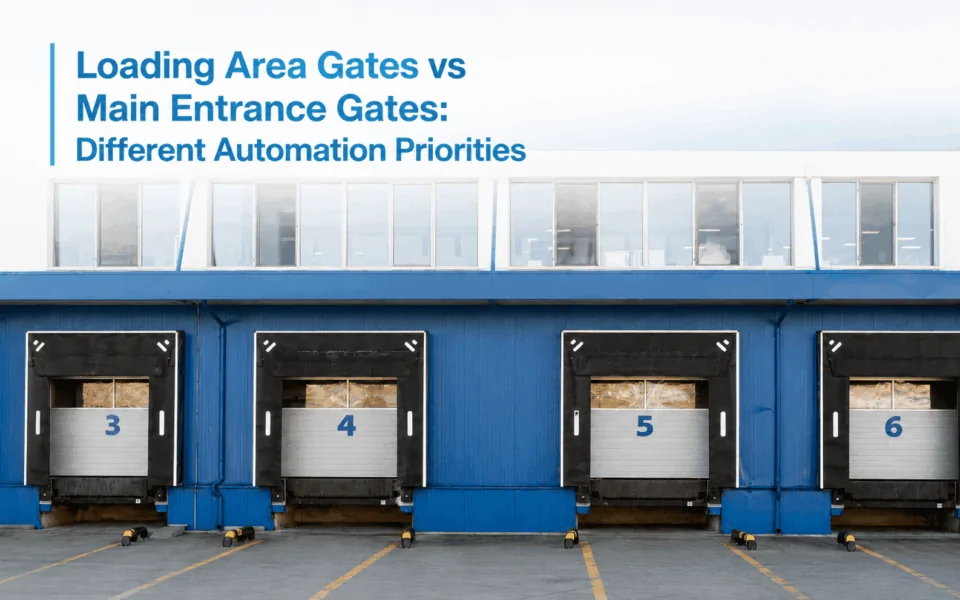
Loading area gate automation should focus on speed, durability, clearance and vehicle safety, especially where trucks and delivery vehicles move frequently. Meanwhile, main entrance gates prioritise controlled access, security, appearance and smooth operation, with stronger emphasis on visitor management and presentation.
- Motor selection should consider more than gate weight. Duty cycle, gate length, traffic frequency and site conditions can significantly affect long-term reliability.
- Vehicle detection is especially important in loading zones, where loops, photocells and safety devices must account for long trucks and trailers before the gate closes.
- Gate type should match the entrance. Sliding and cantilever gates often suit loading areas, boom gates support high-volume vehicle control, and swing gates can work well at visually important main entrances.
- Integration also differs by application: loading areas may connect with vehicle access systems, while main entrances commonly integrate with intercoms, CCTV, alarms and broader access control.
In commercial and industrial environments, gate automation plays a critical role in keeping operations secure, efficient, and reliable. In warehouses, logistics hubs, office buildings, and commercial facilities, automated gates are a necessity. However, systems that work perfectly at a front entrance may fail under the pressure of a high-traffic loading zone. Then, the loading area gate automation stands apart.
Let’s get to understand the differences between the loading area and the main entrance gates to truly support day-to-day operations!
Why Loading Zones and Entrances Demand Different Gate Strategies
Loading zones and main entrances serve different roles within a property. These differences influence how the gate operates, who uses it, and how often it’s activated.
Loading area gates are primarily used in logistics environments such as warehouses, distribution centres, and manufacturing facilities. These gates handle frequent vehicle movement throughout the day. Trucks, forklifts, and delivery vans rely on quick and reliable access to maintain tight schedules.
On the other hand, the main entrance gates are designed for controlled access. They manage the flow of employees, visitors, and authorised vehicles while maintaining a secure perimeter. In many cases, they also serve as a visual focal point, contributing to the overall impression of the property.
Because of these distinctions in the two gates, their traffic patterns, user behaviour, and operational priorities differ significantly. An industrial gate system built for logistics must prioritise efficiency and resilience; meanwhile, entrance gate planning focuses more on access control, safety, and presentation. This is why loading area gate automation requires a tailored solution that reflects its high-demand environment.
WorkSafe Victoria specifically stresses that loading and unloading areas need careful traffic-management design and separation of vehicles from pedestrians, keeping pedestrian-only and vehicle-only areas separated(1 WorkSafe Victoria specifically stresses that loading and unloading areas need careful traffic-management design.Date of access on 21/08/2026↓).

What are Loading Area Gate Automation Priorities
Loading area gate automation should prioritise traffic flow, durability, clearance and vehicle safety rather than appearance or visitor convenience alone. It is because loading areas operate very differently from residential driveways or visitor entrances. They may need to handle delivery trucks, service vehicles, forklifts and staff vehicles throughout the day, often during busy receiving periods.
High-Speed Gate Operation for Busy Loading Zones
Loading zones can quickly become congested if gates take too long to open and close. Delivery vehicles may arrive close together, while trucks waiting at the entrance can block internal traffic routes or even extend onto surrounding roads.
A faster gate operator can reduce these delays by shortening each access cycle. However, speed should always be balanced with the gate’s size, weight, travel distance and safety requirements. The goal is not simply to install the fastest motor available, but to select an operator capable of moving the gate efficiently and consistently under normal site conditions.
Heavy-Duty Gate Motors for Frequent Truck Access
Commercial loading gates often complete far more opening cycles than a typical residential gate. They may also be larger and heavier, particularly where wide industrial sliding gates are used.
The operator should therefore be selected according to the actual gate weight, length, duty cycle and expected number of movements per day. A motor that is only just powerful enough for the gate may experience excessive wear when subjected to frequent truck movements.
From DHS’s experience with commercial gate projects, one of the most common mistakes is selecting an operator based only on the gate’s weight. In busy loading areas, the number of daily cycles, gate length, vehicle flow and site conditions can be just as important.
We have seen sites where the gate itself was within the motor’s rated capacity, but frequent truck movements placed much greater demand on the system than expected. For this reason, DHS typically looks at the full operating environment before specifying the motor, safety loops, photocells and access-control equipment. Designing around real traffic patterns helps improve reliability and reduces unnecessary wear over time.
Read more: The Estimator’s Checklist: Specifying Commercial Gate Motors Without Underquoting
Wide Gate Openings for Large Delivery Vehicles
Loading entrances need enough usable opening width for trucks to enter without making tight or unsafe manoeuvres. This becomes especially important for semi-trailers, delivery trucks and vehicles that need to turn immediately after passing through the gate.
Gate layout should consider more than the physical width of the opening. Designers should also assess vehicle turning paths, gate posts, safety devices, kerbs and nearby structures.
Where space is limited, sliding gates can be particularly useful because they do not require a large swing area inside the vehicle path.
Vehicle Detection and Safety for Loading Area Gates
Safety becomes a major priority when large vehicles pass through an automated gate. Trucks may take significantly longer than passenger vehicles to clear the opening, and trailers can remain within the gate path even after the cab has moved through.
A loading-area system may therefore use several safety and detection devices, such as:
- induction loops positioned to detect vehicles approaching or occupying the gate area;
- photocells or safety beams across the opening;
- safety edges where there is a risk of contact with the moving gate; and
- presence detection configured to prevent the gate from closing while a vehicle remains in the danger zone.
Sensor positioning is critical. A poorly placed detector may recognise the front of a truck but fail to account for the trailer behind it. For this reason, the safety layout should be designed around the largest vehicles expected to use the site.
Durable Gate Construction for Industrial Loading Areas
Loading-area gates operate in demanding environments where minor impacts, vibration, dust and heavy vehicle activity are common. The gate itself should therefore be built to withstand more physical stress than a lightly used residential entrance.
Strong steel frames, appropriately sized posts, durable hardware and well-supported tracks or guide systems can help maintain alignment over time. Protective bollards may also be installed around motors, posts, access-control equipment and other vulnerable components where accidental vehicle contact is possible.
A rugged design does not make the gate immune to truck impacts, but it can reduce damage from everyday knocks and help protect critical automation equipment.
SafeWork NSW reports 17 notified industrial-gate incidents since 2017(2 SafeWork NSW reports 17 notified industrial-gate incidents since 2017. Date of access on 07/09/2026↓), including two fatalities, and identifies damage, wear, poor maintenance and failures of stoppers, rails, guides and support posts as major risks. That makes structural durability more than just a maintenance issue.

What are Main Entrance Gate Automation Priorities
Main entrance gates have a different job from gates used in loading and service areas. Instead of prioritising frequent truck movements and heavy-duty traffic flow, the front entrance usually needs to balance security, visitor management, appearance and everyday convenience. A well-designed main entrance gate automation system should protect the property while still creating a smooth and professional arrival experience for residents, staff, visitors and authorised vehicles.
Controlled Visitor and Vehicle Access
Access control is one of the most important priorities at a main entrance. The gate should allow authorised users to enter easily while giving property managers, residents or reception staff a reliable way to screen visitors.
Depending on the site, access may be managed through:
- keypads or PIN codes;
- proximity cards or fobs;
- mobile credentials;
- licence plate recognition;
- video intercoms; or
- remote gate release from an indoor monitor or smartphone.
The right method depends on who uses the property and how much control is required. An apartment development may rely heavily on intercom verification, while an office or commercial site may use staff credentials combined with visitor calling.
Strong Security at the Property Boundary
A main entrance gate forms part of the property’s first security layer, so preventing unauthorised access is a key design consideration.
The gate operator, locking arrangement and access-control system should work together so the gate cannot simply be pushed or forced open under normal conditions. Sites with higher security requirements may also use monitored gate positions, anti-tailgating workflows, CCTV coverage or alerts when a gate remains open unexpectedly.
Security should still be balanced with safe operation and emergency access requirements rather than treating the gate as an isolated barrier.
Entrance Design That Complements the Property
Unlike a loading-area gate, the main gate is often one of the first features visitors see. Its appearance can therefore influence the overall presentation of a home, apartment complex, office or commercial development.
Gate material, colour, profile, posts and automation hardware should complement the architecture rather than look like an afterthought. Where possible, motors, cabling and safety devices can be positioned neatly to maintain a clean entrance.
This makes design an important part of main entrance gate automation, particularly for premium residential and customer-facing properties.
Smooth and Quiet Everyday Operation
Main gates may operate close to homes, offices, reception areas or neighbouring properties, so smooth and quiet movement is often more important than maximum speed.
Correctly sized operators, well-aligned tracks or hinges and controlled acceleration and deceleration can help the gate move more quietly and reduce mechanical stress. Soft-start and soft-stop operation can also create a more polished user experience.
The aim is for the gate to feel like an integrated part of the entrance rather than a noisy industrial machine.
Integration With the Wider Security System
Modern main entrance gates increasingly operate as part of a connected security system rather than as standalone equipment.
Where compatible, the gate can integrate with intercoms, access control, CCTV, alarm systems and building automation. For example, a visitor may call through the video intercom, be visually verified, and then receive a controlled gate release while the event is recorded by nearby cameras.
This type of integration can make the entrance easier to manage while giving property owners a clearer view of who is entering and when.

Loading Area Gates vs Main Entrance Gates: Side-by-Side Comparison
Loading area gates and main entrance gates serve very different purposes, so their automation priorities should not be the same. Comparing them side by side makes it easier to see where speed, durability, security, access control and presentation matter most.
| Priority | Loading Area Gates | Main Entrance Gates |
| Main Goal | Keep trucks and deliveries moving efficiently. | Balance secure access with a professional entrance. |
| Speed | High priority to reduce queues and delays. | Smooth, controlled operation is usually more important. |
| Motor Capacity | Heavy-duty motors for frequent, large-vehicle use. | Reliable motors sized for normal daily traffic. |
| Clearance | Wide openings for trucks and trailers. | Typically designed for cars and visitor vehicles. |
| Safety | Robust loops, beams and vehicle detection. | Safety sensors for vehicles and pedestrians. |
| Access Control | Staff, drivers and delivery access. | Keypads, cards, apps and intercoms. |
| Security | Controlled access without slowing operations. | Strong focus on preventing unauthorised entry. |
| Construction | Rugged, durable and impact-resistant. | Strong but also visually integrated with the property. |
| Appearance | Secondary to function and durability. | Important for presentation and street appeal. |
| Integration | May connect with site security or vehicle systems. | Often integrates with CCTV, alarms and intercoms. |
| Key Priority | Speed, durability, clearance and safety. | Security, access control, appearance and integration. |
Choosing the Right Gate Type for Each Entrance
The right gate type should match the way each entrance is used. Loading areas usually prioritise vehicle clearance, durability and traffic flow, while main entrances often place more emphasis on security, appearance and controlled access.
At Digital Home Systems (DHS), we help assess the entrance layout, gate size, traffic frequency, vehicle type and access requirements before recommending an automation solution. This allows the gate operator, safety devices and access-control equipment to be matched to the actual demands of the site rather than selected as separate components.
Sliding Gates for Loading Areas
Sliding gates are often a practical choice for loading zones because they move sideways instead of swinging into the truck manoeuvring area. They can also suit wide commercial openings.
However, they require:
- sufficient run-back space;
- a suitable track or supporting structure;
- strong guides and rollers; and
- correctly installed stops.
Industrial sliding-gate safety should be taken seriously. SafeWork NSW has reported incidents involving failed tracks, guides, posts and stoppers, showing why structural integrity and regular maintenance are essential.
Cantilever Gates for Heavy-Traffic or Difficult Surfaces
Cantilever gates can be useful where a ground track across the driveway is undesirable. Because the gate is supported from the side, there is no track directly in the truck path. Potential advantages include:
- fewer issues with debris in tracks;
- suitability around drainage channels;
- better performance on some uneven surfaces; and
- a clear vehicle crossing point.
The trade-off is that cantilever gates generally need substantial foundations and additional side space for the counterbalance section.
Boom Gates for High-Volume Vehicle Control
Where the goal is to control vehicles rather than fully secure the perimeter, boom gates can be an efficient option. They typically provide:
- fast opening and closing cycles;
- high vehicle throughput;
- easy integration with access credentials or ANPR; and
- compatibility with intercoms and vehicle loops.
Boom gates can work particularly well at car parks, staff entrances and commercial vehicle checkpoints. However, they do not provide the same physical perimeter closure as a full sliding or swing gate.
Swing Gates for Main Entrances
Swing gates often suit residential, apartment and commercial front entrances where presentation matters and sufficient opening space is available. They can be a good option where:
- vehicle traffic is moderate;
- the swing path is clear;
- architectural appearance is important; and
- the gate needs to complement the property’s fencing or frontage.
For busy loading areas, however, swing leaves can take up valuable manoeuvring space and may interfere with large vehicles.
Ultimately, loading area gate automation often favours sliding, cantilever or boom systems, while swing gates may be better suited to main entrances where appearance and controlled everyday access are higher priorities.

In Conclusion
Loading-area gates and main entrance gates may use similar automation technologies, but they are designed around very different priorities. Loading area gate automation typically focuses on high vehicle throughput, heavy-duty operation, wide clearance, reliable detection and durability, while main entrance gates place greater emphasis on controlled access, security, presentation and integration with other building systems.
The most reliable result comes from designing each entrance around its actual traffic, gate size, operating frequency and security requirements rather than applying the same automation approach across the entire property.
Digital Home Systems (DHS) can help with gate automation system design, product selection, access control, intercoms, safety devices and system integration for commercial, industrial and residential projects. Explore DHS gate and door automation solutions or contact our team for help specifying the right automation setup for each entrance on your site.
FAQs
Often, yes. Loading-area gates usually handle larger gates, heavier vehicles and more frequent cycles, so the operator should be sized for the actual gate weight and duty cycle.
It depends on the security requirement. Boom gates suit fast vehicle control, while sliding gates provide a more complete physical perimeter closure.
Yes. ANPR can be used to recognise approved vehicles and trigger access automatically, provided the system is correctly integrated with the gate controller and access rules.
Use properly positioned vehicle loops, photocells or other presence sensors that monitor the full vehicle path, including trailers, before allowing the gate to close.
Where possible, no. Separating pedestrian and heavy-vehicle routes can reduce conflict points and improve overall site safety.
Service frequency should reflect usage, environment and manufacturer requirements. High-cycle industrial gates generally need more frequent inspection than lightly used residential systems.





Comments are closed.