
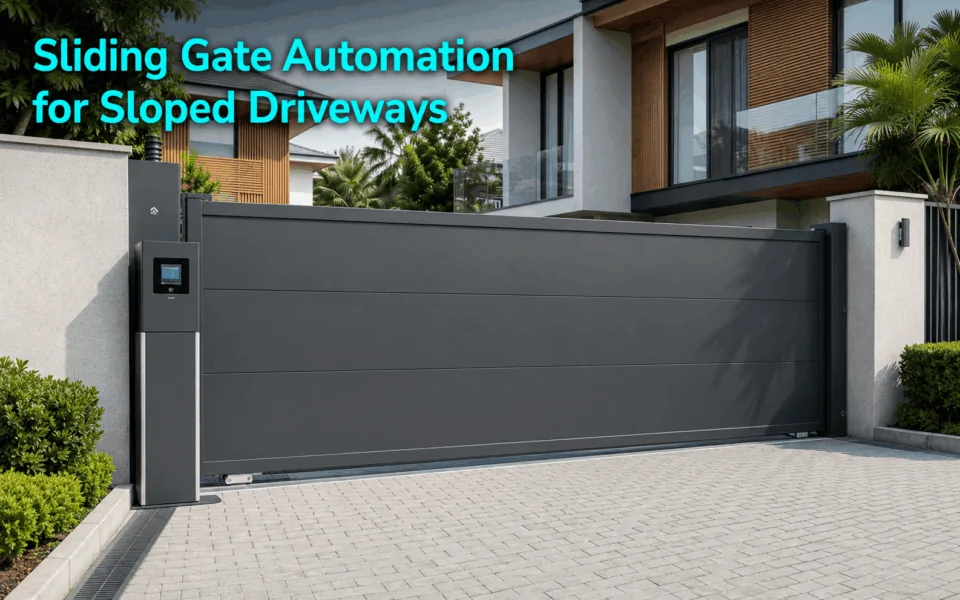
Sliding gate automation is often a strong choice for sloped or challenging driveways because it avoids the clearance problems of conventional swing gates. The best solution depends on the slope direction, available run-back space and site conditions, with tracked, cantilever or telescopic systems each suiting different layouts. Reliable automation starts with good foundations, drainage, alignment and a gate that already moves smoothly by hand, rather than using a larger motor to compensate for poor mechanical design.
Traditional swing gates often struggle on slopes due to clearance issues, uneven ground, and limited opening space. This is where sliding gate automation provides a superior solution. By operating horizontally, sliding gates eliminate the need for vertical clearance and adapt seamlessly to sloped environments.
In this comprehensive guide, we will explore how sliding gate automation works, why it is ideal for sloped driveways, and how to choose, install, and maintain the right system for long-term performance.
Can a Sliding Gate Work on a Sloped Driveway?
Yes, a sliding gate can work on a sloped driveway, but the slope needs to be considered as part of the overall gate design. The key issue is not simply whether the driveway is sloped, but whether the gate can move reliably along a properly defined travel path.
For successful sliding gate automation, installers need to assess the gate travel path, rack alignment, operator foundations, drainage and available side run-back space. The motor and rack also need to remain correctly aligned throughout the gate’s full movement.
Sliding gate operators are designed for gates travelling horizontally along a controlled path, so the operator cannot be treated separately from the gate structure and site geometry. Manufacturers such as Nice provide specific installation requirements covering operator mounting, rack engagement, travel limits and compatible safety devices.(1 Nice provide specific installation requirements.Date of access on 24/08/2026↓).
For sloped sites, careful planning of the gate path and supporting structure is therefore essential before selecting the automation equipment.
 Sliding gate automation system installed at residential driveway entrance.
Why Sliding Gates Are Often Better Suited to Sloped Driveways
Sliding gate automation is often a practical choice for sloped driveways because the gate moves sideways along the property boundary rather than swinging across changing ground levels. Key benefits include:
- Avoids ground clearance problems: Swing gates need sufficient clearance across their entire opening arc. On a sloped driveway, the bottom of the gate may scrape or strike the rising ground. A sliding gate travels horizontally along the fence line, avoiding most of these clearance issues.
- Provides consistent gate movement: A correctly designed sliding gate system follows a dedicated track or cantilever structure rather than the driveway surface itself. This allows the gate to maintain controlled, predictable movement even where the driveway has a noticeable incline.
- Makes better use of driveway space: Because the gate slides sideways, it does not require a large opening arc. Vehicles can generally park closer to the entrance without obstructing gate operation, which can be particularly useful on short, steep, or restricted driveways.
- Reduces vehicle and pedestrian conflicts: Swing gates move through a relatively large area as they open and close. Sliding gates have a more contained movement path along the boundary, helping reduce the risk of the gate swinging toward parked vehicles, approaching cars, or pedestrians.
- Works well with automated access systems: Sliding gates can be integrated with remote controls, keypads, intercoms, safety sensors, and access control systems. With the correct motor, safety devices, and gate design, automation can provide convenient and reliable access on challenging sloped sites.
How Does the Driveway Slope Relative to the Gate?
The direction of the slope matters just as much as the gradient itself. Before comparing sliding gate types, installers should understand how the ground changes relative to the gate opening and the proposed travel path.
- Driveway rises away from the street. This is where a sliding gate can have a major advantage over a conventional swing gate. Because the gate travels sideways along the boundary, it does not need to sweep over the rising driveway surface behind it. This can avoid the clearance problems that often affect inward-opening swing gates on uphill driveways.
- Driveway slopes across the entrance. This is more critical for sliding-gate design. If one side of the opening is substantially higher than the other, the installer must determine how the gate leaf itself will travel and how the track, rack and operator will remain correctly aligned. A standard sliding gate should not simply be assumed to follow the driveway gradient.
- Compound or uneven slopes. Some sites combine longitudinal slope, crossfall, uneven paving, retaining walls and multiple changes in elevation. These conditions can make a conventional tracked gate difficult to engineer and maintain. A cantilever arrangement may be worth assessing, or the site may require civil works, revised foundations or custom fabrication before the automation equipment is selected.
Which Sliding Gate Type Works Best on a Sloped Driveway?
The three most common options are track sliding, cantilever, and telescopic sliding gates. Choosing the right sliding gate system depends on the driveway slope, available side space, opening width, ground conditions, gate weight, and expected usage.

Track Sliding Gates
Track sliding gates operate using wheels that run along a metal track installed across the driveway opening. As the gate opens, the full gate leaf moves sideways along the boundary on this fixed track system.
This type of gate is generally simple and cost-effective, which makes it a common choice for residential properties. It can also support wide and heavy gates when properly designed, since the weight is distributed through the ground-supported track. However, reliable performance depends on the track being installed on a stable, level surface, as any unevenness or ground movement can affect operation.
Because the system runs directly on the ground, it is also more exposed to dirt, stones, and debris, which can interfere with smooth movement if not regularly maintained. For sloped driveways, the key factor is not only the gradient itself but whether a stable and continuous track can be installed across the full opening.
Cantilever Sliding Gates
Cantilever sliding gates operate without a ground track across the driveway. Instead, the gate is supported and balanced by a reinforced structure mounted to one side, allowing it to “float” above the opening as it moves.
This design removes the need for a track across the driveway, which eliminates issues caused by debris, water, uneven paving, or vehicles passing over the opening. It is often a practical solution for sites where ground conditions are difficult or where installing a track would be impractical.
Since the gate is supported from the side, the driveway entrance remains completely clear, improving both access and durability. However, this system requires additional side space to accommodate the counterbalance section of the gate, and it relies on strong foundations and precise installation to ensure stability.
Cantilever systems are often well suited to sloped or irregular sites, provided there is enough run-back space and the supporting structure is properly engineered.
Telescopic Sliding Gates
Telescopic sliding gates consist of two or more panels that move in sequence and overlap as the gate opens. This coordinated movement allows the gate to retract into a shorter space compared to a single large sliding leaf.
The main advantage of this system is its efficiency in tight spaces. Where a standard sliding gate would require a full gate width of clear run-back space, a telescopic system can significantly reduce that requirement. This makes it especially useful for properties with limited boundary space or obstructions near the driveway.
It is also a practical solution for wider entrances, where a single gate leaf would be too large or heavy to operate efficiently. As the panels stack neatly behind one another when open, the system makes better use of restricted areas.
The trade-off is increased mechanical complexity. Telescopic gates rely on additional rollers, cables, or synchronised components, which means accurate installation and regular maintenance are important for long-term reliability.

Site Conditions That Determine Whether a Sliding Gate Will Work
Installing sliding gate automation on a sloped driveway requires careful planning because the gradient can affect gate movement, motor load, structural stability, drainage, and available sliding space. The system should be designed around the actual site conditions rather than simply selecting an operator based on gate weight.
Slope Angle and Direction
The angle and direction of the driveway slope can directly affect how the sliding gate operates. If the gate travels uphill, the motor must work against gravity and may require additional power to move the gate smoothly. When travelling downhill, the system needs to control the gate’s movement and prevent excessive speed or additional load on the drive mechanism.
For steeper or irregular sites, the installer should assess the gradient together with gate weight, travel direction, and rolling resistance. Where installing a stable ground track is difficult, a cantilever system may provide a more practical alternative.
Read more: Best Gate Automation Options for Sloped Driveways and Challenging Sites
Ground Surface and Stability
A sliding gate relies on accurate alignment, so the condition of the ground and foundations is particularly important. Uneven paving, soft soil, cracked concrete, or ground movement can cause the track, posts, or supporting hardware to shift over time, increasing resistance and placing additional strain on the motor.
A reinforced concrete foundation is commonly used to provide stable support for the motor, gate posts, track, or cantilever roller assemblies. Proper foundations help maintain alignment and allow the gate to move smoothly over repeated opening and closing cycles.
Drainage and Water Management
Sloped driveways naturally direct rainwater toward lower areas, which can sometimes be close to the gate track, motor, or supporting foundations. Poor drainage can allow water, mud, leaves, and other debris to accumulate around these components, potentially affecting gate operation and accelerating corrosion.
Drainage channels and appropriate driveway grading can help direct water away from the automation equipment. For track sliding gates in particular, the track should be positioned and maintained so that water and debris do not regularly interfere with the gate wheels.
Space Requirements for Sliding
Sliding gates require sufficient clear space beside the driveway for the gate to move into when fully open. Before installation, the run-back area should be checked for obstacles such as buildings, landscaping, utility boxes, pedestrian gates, existing fencing, or changes in ground level.
Where side clearance is limited, a telescopic sliding gate can be a practical alternative. Multiple overlapping panels allow the gate to cover a wider entrance while requiring less run-back space than a conventional single sliding gate.
Read more: Speed Control & Soft Start Features in Sliding Gate Systems
Safety and Obstacle Detection
Safety is particularly important on sloped driveways because visibility and vehicle stopping positions may differ from those on a level entrance. Appropriate safety devices such as photocells, safety edges, and vehicle detection systems can help identify vehicles, pedestrians, or other obstacles within the gate’s operating area.
The position of these devices should be determined by the actual driveway layout and traffic flow. Correct opening and closing limits are also important to ensure the gate stops consistently without creating unnecessary stress on the automation system.

How to Select a Sliding Gate Operator for a Sloped Site
Choosing the right motor is essential for reliable sliding gate automation, particularly on sloped driveways where the system may need to handle additional resistance. Motor selection should consider more than just the gate’s size.
-
-
- Gate weight and size. The motor must be rated to comfortably handle the gate’s total weight and opening width. Larger or heavier gates generally require higher-capacity operators to maintain smooth and consistent movement.
- Driveway slope. If the gate itself travels uphill or downhill, the gradient can increase the load on the motor. The steeper the slope, the more important it is to allow sufficient motor capacity rather than selecting an operator close to its maximum rating.
- Duty cycle and usage frequency. Consider how many times the gate is expected to operate each day. A residential driveway with occasional use has different requirements from an apartment complex, commercial property, or industrial entrance.
- Motor speed. Opening speed may also be important, particularly for busy entrances. Faster operators can reduce waiting time, but the appropriate speed should be considered together with gate weight, site layout, and safety requirements.
- Weather protection. Select equipment with an appropriate enclosure and protection rating for the installation environment. Outdoor gate motors are exposed to rain, dust, heat, and changing weather conditions. According to the Australian Bureau of Meteorology, the Melbourne Regional Office records a mean annual rainfall of 648.3 mm. (2 Climate statistics for Australian locations.Date of access on 09/08/2026↓)
-
- Safety features. The motor should support appropriate safety equipment such as photocells, safety edges, obstacle detection, or vehicle detection where required. These features help the automated gate respond safely when an obstruction is detected.
- Smart controls and access options. Depending on the system, sliding gate automation can be integrated with remotes, keypads, intercoms, access control, mobile apps, and smart home systems.
A professional installer can calculate the actual gate load, assess the driveway gradient and expected usage, and recommend a motor with sufficient capacity for reliable long-term operation.
At Digital Home Systems (DHS), we help installers, contractors and property owners assess the complete gate setup, site conditions, access requirements and expected usage before selecting a suitable gate operator.
Common Installation Problems on Sloped Sliding Gates
Sloped driveways can expose weaknesses in gate design that may not be obvious on a flat site. Many reliability problems come from the gate geometry, foundations or travel path rather than the motor itself.
- Track installed to follow an uneven driveway. A sliding gate needs a controlled, predictable travel path. Installing track directly over dips, humps or changing gradients can cause binding, poor rack engagement and inconsistent movement.
- Poor drainage around the track. Water, mud and debris can collect around tracked gates, increasing resistance and accelerating wear. Drainage should be considered as part of the gate path, not as an afterthought.
- Insufficient cantilever foundation. Cantilever gates place significant loads on their support structure. Undersized footings can lead to movement, sagging and alignment problems over time.
- Incorrect motor or rack alignment. The pinion and rack need consistent engagement throughout the full gate travel. Misalignment can cause noise, excessive wear or unreliable operation.
- Gate is too heavy or difficult to move manually. Before automation, the gate should move smoothly by hand. A powerful motor should not be used to compensate for binding rollers, poor bearings or structural problems.
- Not allowing enough run-back space. If there is insufficient side clearance, the gate may not open fully or may require a different design such as telescopic sliding.
- Choosing the motor before finalising the gate. Operator selection should come after the gate dimensions, weight, travel geometry and usage requirements are confirmed. This helps ensure the motor suits the completed gate rather than an early assumption.
 Sliding gate automation integrated with smart home access control system.
How to Keep a Sliding Gate Reliable on a Sloped Site
Regular maintenance helps keep your sliding gate automation operating smoothly and reliably, especially on sloped driveways where the motor and mechanical components may experience additional loads.
- Keep the track and gate path clean: Regularly remove leaves, stones, dirt, and mud from the gate’s travel path. For track sliding gates, debris can obstruct the wheels, increase resistance, and place unnecessary strain on the motor.
- Check wheels, rollers, and moving parts: Inspect wheels, guide rollers, bearings, and other moving components for wear or damage. Where recommended by the manufacturer, appropriate lubrication can help reduce friction and maintain smooth movement.
- Monitor gate alignment: Check that the gate moves smoothly without rubbing, dragging, or becoming difficult to operate. Ground movement or repeated use can gradually affect alignment and increase the load on the automation system.
- Inspect the motor and drive system: Pay attention to unusual noises, slower movement, hesitation, or unexpected stopping. These symptoms can indicate problems with the motor, rack, pinion, limits, or other mechanical components.
- Test safety devices: Photocells, safety edges, and vehicle detection systems should be kept clean and tested regularly. Damaged or misaligned sensors can affect both gate operation and safety.
- Check drainage around the gate: Sloped driveways can direct rainwater, mud, and debris toward the gate system. Keep drainage channels clear and check that water is not collecting around the track, motor, or foundations.
- Arrange periodic professional servicing: A professional inspection can identify worn components, alignment problems, electrical faults, or excessive motor load before they develop into larger and more expensive repairs.
One common issue DHS encounters when consulting with clients and installers is a gate motor being selected primarily according to the gate’s stated weight. In practice, sliding gate automation on a sloping driveway can place different demands on the operator due to the gradient, gate movement resistance, track condition and frequency of use. We recommend assessing the complete installation, including gate weight and length, driveway gradient, duty cycle, track condition and required access controls.
In Conclusion
Sliding gate automation for sloped driveways can provide a practical and reliable solution where traditional swing gates are restricted by ground clearance, driveway gradient, or limited operating space. However, achieving reliable long-term performance depends on selecting the right gate system, motor capacity, foundations, drainage, safety equipment, and access controls for the specific site.
Every sloped driveway presents different challenges, so professional assessment is important before choosing between track, cantilever, or telescopic gate automation. At Digital Home Systems (DHS), we provide ultimate gate & door solutions tailored to residential and commercial properties across Melbourne.
Planning to automate a sliding gate on a sloped driveway? Contact us today to discuss your site requirements and find the right gate automation solution for your property.
FAQs
Yes. Sliding gates can suit many sloped driveways, provided the gradient, ground conditions, gate travel direction, available space, and structural requirements are properly assessed.
Often, yes. Sliding gates move sideways rather than across the driveway, reducing ground-clearance problems that can make conventional swing gates difficult to operate on steep slopes.
It depends on the site. Track gates suit stable surfaces, cantilever gates work well on uneven ground, while telescopic gates are useful where side space is limited.
Sometimes. If the gate travels uphill or downhill, additional load may be placed on the motor. Gate weight, gradient, width, and usage should determine motor selection.
A standard sliding gate generally needs sufficient space beside the driveway to accommodate the gate when open. Cantilever systems require additional space, while telescopic gates require less.




